
- Home
- Protocols

-


Protocol for Determination of Total Phenolic Content and Alcohol Content (Using Density Measurement Method) in Fruit Wines: roselle (Hibiscus sabdariffa), pineapple (Ananas comosus), and wild olive (Elaeocarpus floribundus) of Manipur

Last updated date: Jul 9, 2026 DOI: 10.21769/p2962 Views: 64 Forks: 0
 Download PDF
 Ask a
question
Ask a
question
 How to
cite
How to
cite
 Favorite


Abstract
Manipur, a part of the Indo-Burmese biodiversity hotspot, is rich in indigenous fruits with high potential for value-added products such as fruit wines. This study aimed to develop standardized protocols for the preparation of roselle (Hibiscus sabdariffa), pineapple (Ananas comosus), and wild olive (Elaeocarpus floribundus) wines and to determine their total phenolic content (TPC) and alcohol content. Wine samples were prepared using Saccharomyces cerevisiae under controlled fermentation conditions. Total phenolic content was estimated by the Folin–Ciocalteu method, while alcohol content was determined using the density measurement method. The standardized protocol provides a reliable method for fruit wine preparation and quality evaluation and will serve as a basis for future metabolomic studies and the scientific promotion of traditional fruit wines from Manipur.
Keywords: Fruit wine, Roselle, Pineapple, Wild Olive, Total phenolic content, Alcohol content, Manipur
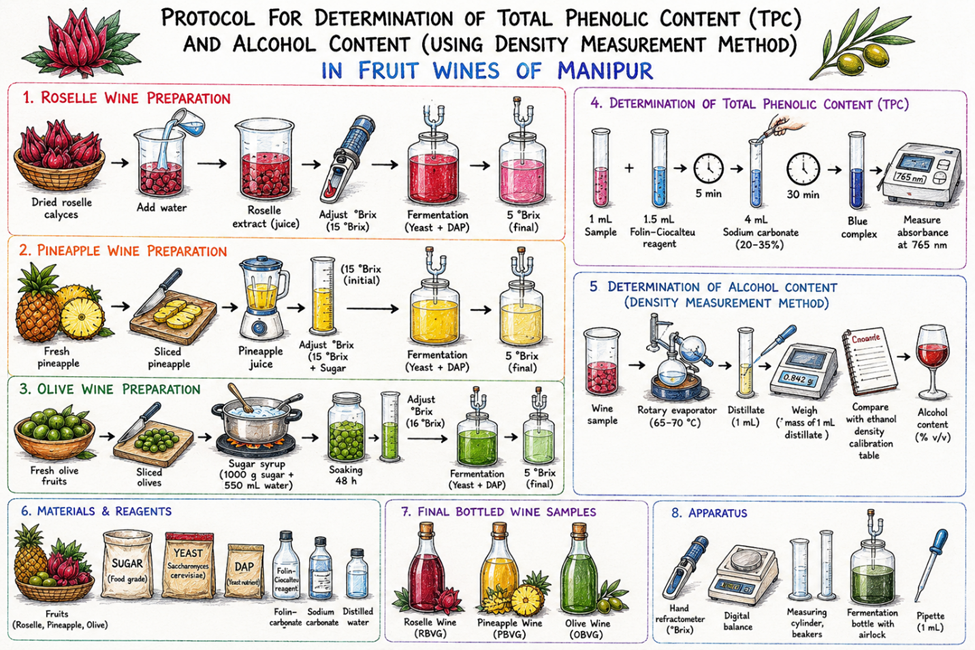
Figure 1. Graphical Image presentation
1. Materials and Reagents
The materials and methods employed in the present study for the preparation of fruit wines were adapted from the procedure described by Roufa et al. (2023) with minor modifications. The materials used for wine preparation are presented in Table 1.
1.1 Materials Used for Fruit Wine Preparation
Table 1. Materials used for the preparation of fruit wines
Category | Materials |
|---|---|
| Fruits | Fresh roselle (Hibiscus sabdariffa) calyces, fresh pineapple (Ananas comosus) fruits, fresh wild olive (Elaeocarpus floribundus) fruits |
| Reagents | Distilled water, food-grade granulated sugar, wine yeast (Saccharomyces cerevisiae), diammonium phosphate (DAP) as a yeast nutrient |
| Apparatus | Hand refractometer (°Brix), digital weighing balance, measuring cylinders, beakers, stainless steel knife, cutting board, glass fermentation bottles or food-grade fermenters fitted with airlocks, glass stirring rod, thermometer, wine bottles, and corks/caps for storage |
Table 1 presents the materials used for the preparation of roselle, pineapple, and olive wines. It includes the raw materials, reagents, and laboratory apparatus required during the fermentation process. Fresh fruits served as the primary substrates, while distilled water, granulated sugar, Saccharomyces cerevisiae, and diammonium phosphate (DAP) were used to facilitate and optimize alcoholic fermentation. The listed apparatus were employed for fruit processing, measurement of physicochemical parameters, fermentation, and storage of the finished wine samples.
1.1.2 Preparation of Roselle Wine
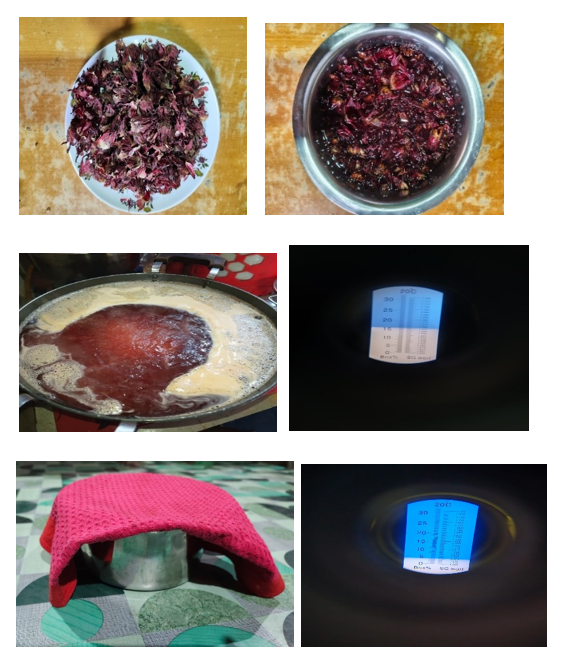
Figure 2. Preparation of roselle wine: (a) dried roselle calyces; (b) addition of water; (c) extracted roselle juice; (d) adjustment of initial total soluble solids (15 °Brix); (e) fermentation of roselle juice; and (f) final total soluble solids (5 °Brix).
The preparation of roselle wine was carried out following the procedure of Roufa et al. (2023) with slight modifications.
i. Dried roselle (Hibiscus sabdariffa L.) calyces were collected from a local source and thoroughly washed with clean water to remove dirt and other impurities.
ii. The cleaned calyces were soaked in distilled water at the required ratio to obtain the roselle extract (juice).
iii. Food-grade granulated sugar was added to the extract, and the total soluble solids (TSS) were adjusted to 15 °Brix, as determined using a hand refractometer.
iv. The prepared must was sanitized using an appropriate salt solution to minimize microbial contamination before fermentation.
v. Wine yeast (Saccharomyces cerevisiae) along with diammonium phosphate (DAP) as a yeast nutrient was added, and the mixture was transferred to fermentation bottles fitted with airlocks. Fermentation was carried out under controlled conditions until the TSS decreased to 5 °Brix, indicating completion of the primary fermentation process.
1.1.3 Preparation of Pineapple Wine
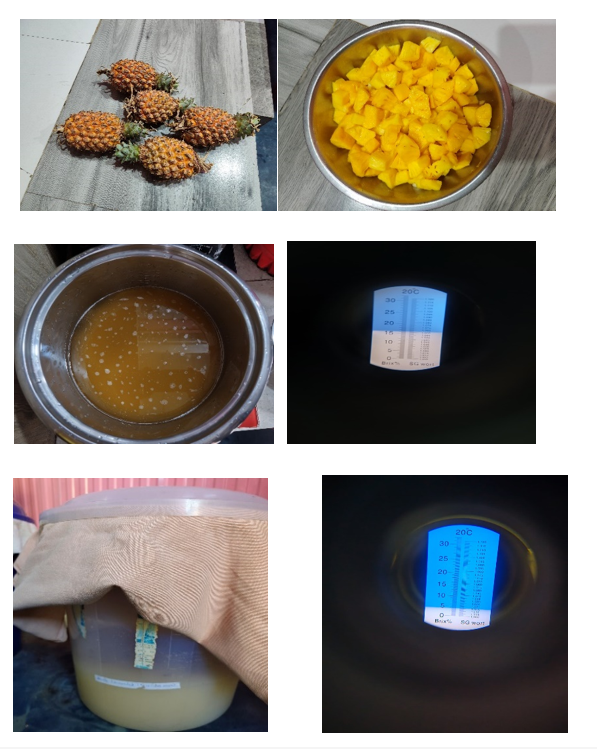
Figure 3. Preparation of pineapple wine: (a) fresh pineapple fruits; (b) sliced pineapple; (c) extracted pineapple juice; (d) adjustment of initial total soluble solids (15 °Brix); (e) fermentation of pineapple juice; and (f) final total soluble solids (5 °Brix).
The preparation of pineapple wine was carried out following the method described by Roufa et al. (2023) with slight modifications.
i. Fresh, ripe pineapple (Ananas comosus (L.) Merr.) fruits were washed thoroughly, peeled, sliced, and processed to obtain fresh pineapple juice, which was then transferred into a sanitized fermentation vessel.
ii. Distilled water was added to the juice and mixed thoroughly to obtain a final volume of 8.2 L.
iii. The total soluble solids (TSS) of the must were adjusted to 15 °Brix by adding food-grade granulated sugar, and the TSS was measured using a hand refractometer.
iv. Active dry wine yeast (Saccharomyces cerevisiae) was inoculated into the prepared must.
v. Diammonium phosphate (DAP) was added as a yeast nutrient to promote efficient yeast growth and fermentation.
vi. The mixture was stirred thoroughly using a sterile glass stirring rod to ensure uniform distribution of the yeast and nutrients.
vii. The fermentation vessel was sealed with an airlock, and fermentation was carried out under controlled conditions until the TSS decreased to 5 °Brix, indicating completion of primary fermentation.
viii. After fermentation, the wine was clarified, transferred into clean storage bottles, and preserved for subsequent physicochemical and biochemical analyses.
1.1.4 Preparation of Wild Olive Wine
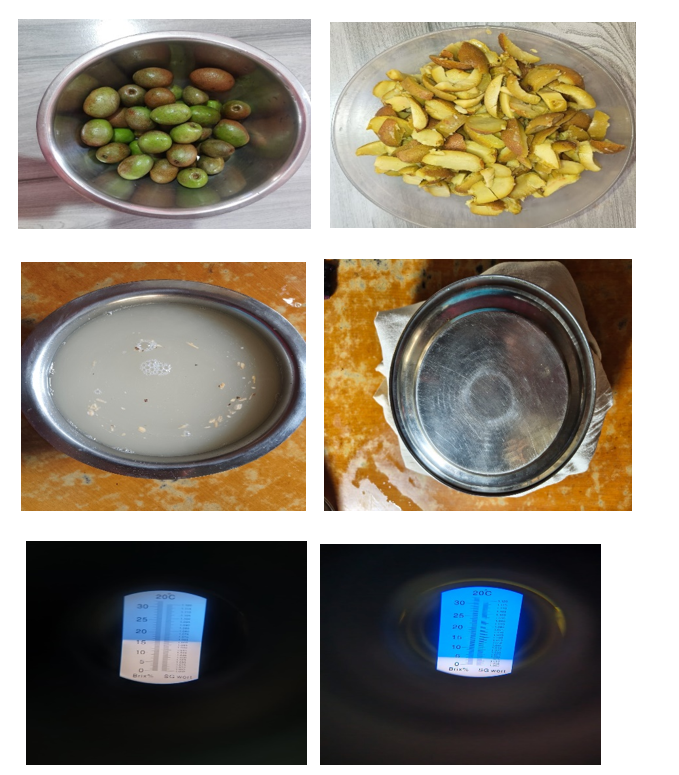
Figure 4. Preparation of olive wine: (a) fresh olive fruits; (b) sliced olives; (c) addition of Saccharomyces cerevisiae and diammonium phosphate (DAP); (d) fermentation of olive wine; (e) initial total soluble solids (16 °Brix); and (f) final total soluble solids (5 °Brix).
Fresh wild olive (Elaeocarpus floribundus Blume) fruits (500 g) were thoroughly washed with clean tap water to remove adhering dirt and other impurities.
The cleaned olives were boiled until softened and then cut into small pieces using a sterile stainless-steel knife.
A sugar syrup was prepared by dissolving 1000 g of food-grade granulated sugar in 550 mL of distilled water and heating the mixture until complete dissolution.
The chopped olives were immersed in the prepared sugar syrup and allowed to soak for 48 h at room temperature to facilitate extraction of soluble constituents.
After soaking, the olive must was adjusted to an initial total soluble solids (TSS) of 16 °Brix, as measured using a hand refractometer.
Active dry wine yeast (Saccharomyces cerevisiae) and diammonium phosphate (DAP) were added to the must, and the mixture was stirred thoroughly to ensure uniform distribution.
The fermentation vessel was fitted with an airlock and maintained under controlled fermentation conditions until the TSS decreased to 5 °Brix, indicating the completion of primary fermentation.
The fermented wild olive wine was then clarified, bottled, and stored under appropriate conditions for subsequent physicochemical and biochemical analyses.
2.0 Determination of Total Phenolic Content (TPC)
The total phenolic content of the wine samples was determined using the Folin–Ciocalteu colorimetric method.
The following materials and reagents were used for the analysis:
2.1 Materials:
- Wine samples: OBVG (Olive Wine), PBVG (Pineapple Wine), and RBVG (Roselle Wine)
- Folin–Ciocalteu reagent (2 N)
- Sodium carbonate solution (20–35%)
- Gallic acid standard solution (10–100 μg mL⁻¹)
- Distilled water
- 50% methanol
These reagents were used for the preparation of calibration standards and for estimating the total phenolic content of the wine samples. The results were expressed as milligrams of gallic acid equivalents (mg GAE L⁻¹ or mg GAE mL⁻¹) based on the gallic acid calibration curve, as appropriate.
2.1.1 Procedure
- A gallic acid stock solution was prepared by dissolving 10 mg of gallic acid in 10 mL of 50% methanol to obtain a concentration of 1 mg mL⁻¹.
- Working standard solutions of 20, 40, 60, 80, and 100 μg mL⁻¹ were prepared by serial dilution of the stock solution with distilled water to construct a standard calibration curve.
- An aliquot of 1 mL of each gallic acid standard solution or wine sample extract (OBVG, PBVG, and RBVG) was transferred into separate, labelled test tubes.
- 1.5 mL of 2 N Folin–Ciocalteu (FC) reagent was added to each test tube, and the mixtures were allowed to stand at room temperature for 5 min.
- Subsequently, 4 mL of 20–35% sodium carbonate solution was added, and the contents were mixed thoroughly to ensure complete reaction.
- The reaction mixtures were incubated at room temperature for 30 min to allow the development of a blue-colored complex.
- The absorbance of each solution was measured at 765 nm using a UV–Visible spectrophotometer, with distilled water serving as the blank.
A calibration curve was prepared by plotting absorbance against the concentration of gallic acid standards. The total phenolic content of the wine samples was calculated from the calibration curve and expressed as milligrams of gallic acid equivalents (mg GAE L⁻¹).
Calculation:
TPC= C× V extract × DF/V sample
Where:
C = concentration of phenolics obtained from the calibration curve (mg/mL, usually Gallic Acid Equivalent – GAE)
D (Dilution factor) =1ml
Sample volume= 1000μl=1ml
V extract= 6.5ml
2.1.2 Determination of alcohol content:
2.1.3 Materials:
The following materials and equipment were used for the determination of alcohol content:
- Wine samples: OBVG (Olive Wine), PBVG (Pineapple Wine), and RBVG (Roselle Wine)
- Rotary evaporator (for distillation)
- Distillate collection flask
- Distilled water
- Pipette (1 mL)
- Digital analytical balance
- Measuring tubes or glass vials
- Ethanol density calibration reference table
Water bath/heating system
2.1.4 Procedure:
The alcohol content of the fruit wine samples was determined using the density measurement method after distillation.
i. The three fruit wine samples, namely OBVG (Olive Wine), PBVG (Pineapple Wine), and RBVG (Roselle Wine), were distilled using a rotary evaporator maintained at 65–70 °C to separate ethanol from other constituents such as sugars and organic acids.
ii. After distillation, the collected distillate was allowed to cool to room temperature. An aliquot of 1 mL of the distillate was then transferred into a clean, dry, pre-weighed vial using a micropipette.
iii. The vial containing the distillate was weighed using a digital analytical balance, and the mass of the 1 mL distillate was determined.
iv. The density of the distillate was calculated by dividing the measured mass by its volume (1 mL) and expressed in g mL⁻¹.
v. The calculated density value was compared with a standard ethanol density calibration reference table to estimate the corresponding alcohol concentration.
vi. The alcohol content of each fruit wine sample was expressed as percentage alcohol by volume (% v/v) and recorded for further statistical analysis.
2.1.5 Quantities of Fruit, Sugar, and Water Used for Wine Preparation
The three fruit wines were prepared following a common fermentation protocol with slight modifications in the quantities of fruit, sugar, water, and fermentation ingredients according to the characteristics of each fruit. The amounts used for the preparation of pineapple, wild olive, and roselle wines are presented in Table 2.
Table 2. Quantities of fruit, sugar, water, and fermentation ingredients used for the preparation of fruit wines
Parameter | Pineapple Wine | Olive Wine | Roselle Wine |
|---|---|---|---|
| Fruit used | 500 g | 500 g | 50 g (dried calyces) |
| Sugar added | 3500 g | 1000 g | 1200 g |
| Water added | 6.7 L | 550 mL | 2.44 L |
| Initial total soluble solids (°Brix) | 15 | 16 | 15 |
| Final total soluble solids (°Brix) | 5 | 5 | 5 |
| Wine yeast (Saccharomyces cerevisiae) | 7.38 g | 0.30 g | 1.03 g |
| Diammonium phosphate (DAP) | 4.10 g | 0.50 g | 1.72 g |
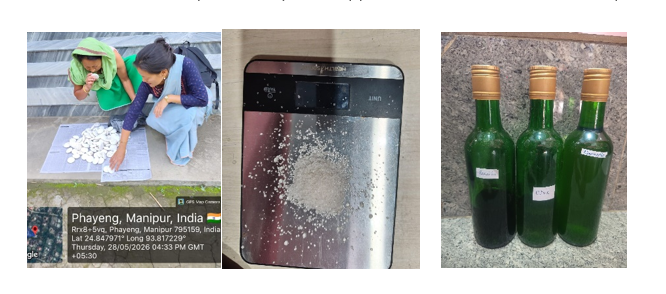
Figure 5. (a) Collection of wine yeast (Hamei); (b) food-grade diammonium phosphate (DAP) used as a yeast nutrient; and (c) final bottled roselle, pineapple, and olive wine samples.
2.2 Analysis of TPC of three Wine Samples
The prepared wine samples were subjected to the following analyses:
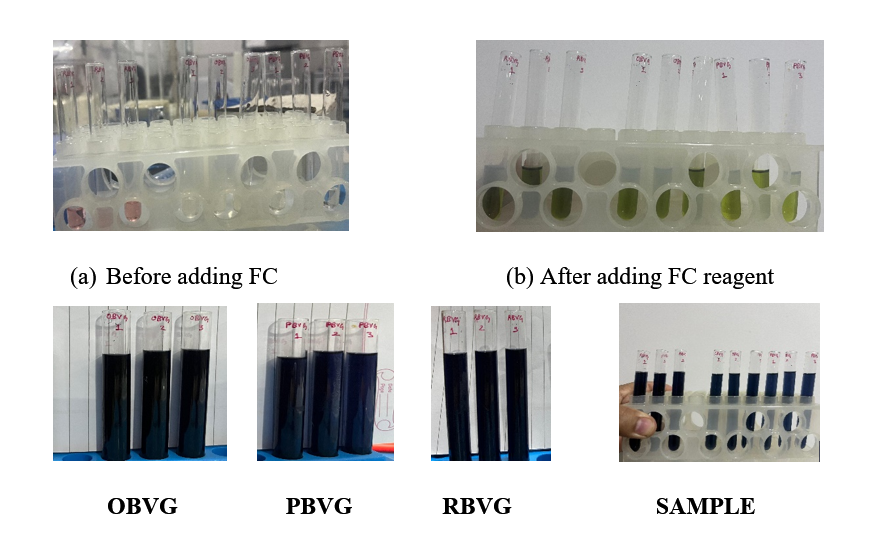
Figure 6. The prepared wine samples were subjected to the following analyses.
Table 3. Gallic Acid Equivalent –GAE/ml of three wine samples
SAMPLE
| TPC (mg GAE/ml sample)
|
PVBG |
0.56
|
| OBVG | 0.64
|
| RBVG | 0.80
|
Table 4. Ethanol density calibration reference used for the determination of alcohol contents
Ethanol (% v/v) | Density (g mL⁻¹) |
|---|---|
0 | 1.000 |
5 | 0.996 |
10 | 0.992 |
20 | 0.983 |
30 | 0.974 |
40 | 0.965 |
50 | 0.957 |
60 | 0.949 |
70 | 0.942 |
80 | 0.935 |
90 | 0.829* |
100 | 0.789 |
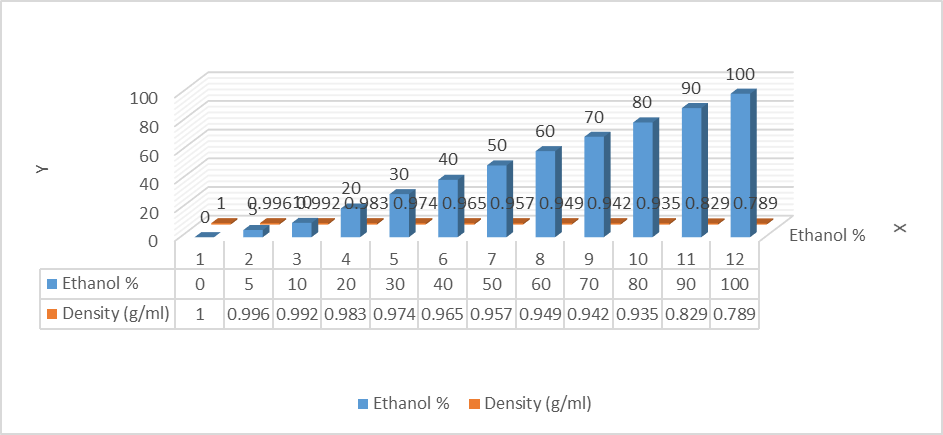
Figure 7. presents the ethanol density calibration reference used for estimating the alcohol content of the prepared fruit wines. The chart illustrates the inverse relationship between ethanol concentration (% v/v) and density (g mL⁻¹). As the ethanol concentration increases from 0% to 100% (v/v), the density decreases from approximately 1.000 g mL⁻¹ to 0.789 g mL⁻¹. The measured density values of the distilled wine samples were compared with this calibration chart (or reference table) to estimate the corresponding alcohol concentration. This density-based method provided a simple and reliable means of determining the alcohol content of the roselle, pineapple, and olive wines.
References
Haripyaree, A., Guneshwor, K., & Damayanti, M. (2010). Evaluation of antioxidant properties of phenolics extracted from Ananas comosus L. (Meitei Keehom), a variety of pineapple grown in Manipur. Notulae Scientia Biologicae, 2(2), 68–71.
Roufa, P., Evangelou, A., Beris, E., Karagianni, S., Chatzilazarou, A., Dourtoglou, E., & Shehadeh, A. (2023). Increase in total phenolic content and antioxidant capacity in wines with pre- and post-fermentation addition of Melissa officinalis, Salvia officinalis and Cannabis sativa. Horticulturae, 9(9), 956.
- Chanu, L G, Singh, N A, Singh, L L, Singh, T B, Chanu, S D, Devi , N R and S., S J(2026). Protocol for Determination of Total Phenolic Content and Alcohol Content (Using Density Measurement Method) in Fruit Wines: roselle (Hibiscus sabdariffa), pineapple (Ananas comosus), and wild olive (Elaeocarpus floribundus) of Manipur. Bio-protocol Preprint. 10.21769/p2962.
Do you have any questions about this protocol?
Post your question to gather feedback from the community. We will also invite the authors of this article to respond.
 Post a Question


