
- Home
- Protocols

-


Protocol for how to study social signal learning of the waggle dance in honey bees (Apis mellifera)
Last updated date: Apr 12, 2023 Views: 287 Forks: 0

 Download PDF
 Ask a
question
Ask a
question
 How to
cite
How to
cite
 Favorite


Shihao Dong1#, Tao Lin1#, James C. Nieh2* , and Ken Tan1*
1 CAS Key Laboratory of Tropical Forest Ecology, Xishuangbanna Tropical Botanical Garden, Chinese Academy of Sciences, Kunming 650000, Yunnan China.
2 Division of Biological Sciences, Section of Ecology, Behavior, and Evolution, University of California San Diego, La Jolla, CA 92093, USA
#Equal contribution to this work
*For correspondence: jnieh@ucsd.edu and kentan@xtbg.ac.cn
Abstract
Honey bees use a complex form of spatial referential communication. Their waggle dance communicates the direction, distance, and quality of a resource to nest-mates by encoding celestial cues, retinal optic flow, and relative food value into motion and sound within the nest. In a recent study, we show that correct waggle dancing requires social learning. Bees (Apis mellifera) without the opportunity to follow any dances before they first danced produced significantly more disordered dances with larger waggle angle divergence errors and encoded distance incorrectly. The former deficits improved with experience, but distance encoding was set for life. The first dances of bees that could follow other dancers had neither impairment. Social learning, therefore, shapes honey bee signaling, as it does communication in human infants, birds, and multiple other vertebrate species. This protocol provides detailed instructions on how to conduct this experiment.
Key Features
- Honey bees (Apis mellifera) perform their first waggle dances with more errors if they cannot first follow experienced waggle dancers.
- Directional and disorder errors improved over time, perhaps due to practice or observation.
- However, distance error did not change. Bees in experimental colonies continued to communicate longer distances than bees from control colonies.
- Dancing correctly requires social learning and may also include a component of cultural transmission (distance encoding).
Keywords: Honeybee, Waggle dance, Referential communication; Social learning, Experience
Background
Social learning, the process of learning by observing or interacting with others, is crucial in honing complex behaviors and adapting them to specific environmental circumstances 1 . Honey bee workers learn resource location and quality through the waggle dance, a sophisticated form of spatial referential communication 2 . However, it was unknown whether dance following can improve the dance performances of young waggle dancers or if the dance is entirely innate.
This protocol describes how to design an experiment in which bees cannot follow other waggle dancers before they begin to dance 3 . This setup can be employed by other researchers to further explore the role of social learning in eusocial insects and its impact on communication and decision-making within colonies. The experiment can provide a foundation for designing studies that investigate various aspects of social learning, including the following:
- Comparisons across species: By conducting similar experiments on different species of eusocial insects, researchers can compare the extent and mechanisms of social learning between species, as well as the influence of genetic and environmental factors on the development of complex behaviors and communication.
- Impact of social learning on colony performance: Researchers can investigate the relationship between the quality of social learning and the overall performance of the colony, including foraging efficiency, resource allocation, and reproductive success. This can help identify the benefits of social learning in colony organization and decision-making.
- Development of individual learning abilities: By manipulating the availability of social learning opportunities, researchers can study the development of individual learning abilities in eusocial insects and determine the importance of social learning in the acquisition and refinement of specific skills.
- Neural and molecular mechanisms: Investigating the neural and molecular mechanisms underlying social learning in eusocial insects can help elucidate the cognitive and physiological processes that facilitate the acquisition of complex behaviors and communication strategies.
- Social learning and colony adaptation: By examining the impact of social learning on the ability of colonies to adapt to changing environments, researchers can better understand the role of social learning in the evolution and resilience of eusocial insect societies.
- Artificial intelligence and robotics: Insights gained from studying social learning in eusocial insects can be applied to the development of artificial intelligence and swarm robotics, where decentralized decision-making and communication strategies are crucial for efficient problem-solving and adaptation.
By using this experimental setup as a starting point, researchers can expand our understanding of social learning in eusocial insects and its broader implications for evolution, ecology, and technology.
Location
The following are instructions on the location and timing of the experiments:
- House 10 Apis mellifera colonies (five control and five experimental) at a bee apiary. We used the Southwest Center for Biological Diversity, Chinese Academy of Sciences (Kunming, China).
- Carry out experiments during the months of April-June when conditions are good.
- Note that these months were chosen because the temperature differences between day and night are moderate and facilitate the survival of young bee colonies.
Materials and Reagents
All necessary materials and reagents are listed below in the sections in which they are used.
Solutions
55% w/v sucrose solution
Recipes
To 55 g of sucrose, add water until the total volume is 100 ml. Ensure that the sucrose is completely dissolved in the water.
Equipment
1) A high-definition video camera (HDR-PJ790, Sony).
2) An incubator (PRX-250B, Ningbo Saifu Experimental Instrument Co., Ltd.)
Procedure
Creating colonies
1) Remove combs with late-stage pupae from haphazardly selected large, healthy colonies.
2) Place the combs inside an incubator (PRX-250B, Ningbo Saifu Experimental Instrument Co., Ltd.) for 24 hours.
3) Maintain the incubator in a dark environment with a temperature of 34 ℃ and a relative humidity of 75%.
4) Transfer the young bees that emerge to a two-frame observation hive with a new egg-laying queen to create experimental colonies.
5) Ensure that the experimental colonies contain no eggs or brood but only the queen, 2800 newly emerged bees, and approximately a half comb of pollen and a half comb of honey.
6) Create control colonies from the same source colonies as the experimental colonies to ensure similar genetic backgrounds.
7) Mark 200 newly emerged bees with paint pens from the incubator.
8) Take the remaining 2600 bees of all ages to create the corresponding control colony.
9) Place the 200 newly emerged bees in the control colony and the 2800 newly emerged bees from the experimental colony (derived from the same source colony) in the same incubator at 34°C and 75% relative humidity. It is important that all bees (control and experimental) that will be observed experience the same incubator conditions.
10) Match each experimental colony with a control colony of the same genetic background (i.e. they share the same queen. Each observation hive consists of two combs (43.5x23 cm): one frame of brood and one frame of honey and pollen and is connected by a 2.2 cm inner diameter and 25 cm long tube through the wall to the outside.
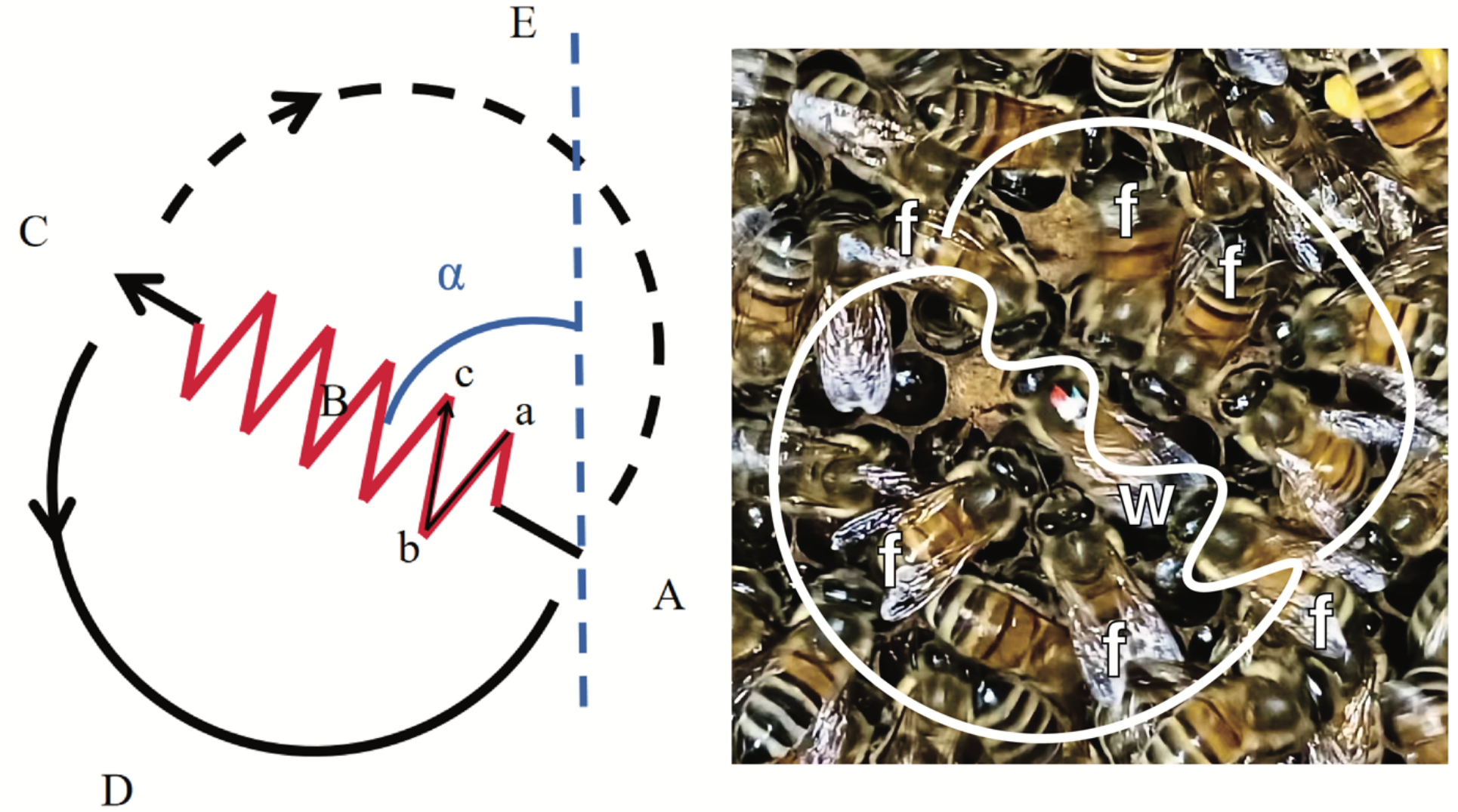
Figure 1. Diagram illustrating waggle dance measurements. A photo of a waggle dancing bee (w) surrounded by dance followers (f) is shown for context. The angle (α) of the waggle run is the angle between the waggle direction and the vertical dashed blue line (defined by gravity on a vertical comb). This waggle angle communicates the direction of the food source from the colony relative to the sun' s azimuth at the time of the dance. For example, if a food source is in the direction of the sun, the waggle run points straight up. If a food source is in the direction opposite the sun, the waggle run points straight down. In this example, α = 45° to the left of the vertical line and thus the food source is located 45° to the left of the sun' s azimuth. The waggle run consists of waggling motions of the abdomen made as the bee traverses a line crossing three points: A-B-C. The waggle duration is measured from point A to point C. Each waggle is defined by the abdominal tip moving from points a-b-c. (one peak-to-peak cycle). The return phase duration is measured as the time it takes a bee to return from a completed waggle run and is shown by the curve C-D-A or the curve C-E-A. In a fully ordered waggle dance, the dancer typically turns in the opposite direction on each repetition. For example, if the dancer traverses C-D-A, on the next return phase, it will likely follow the path C-E-A on the next turn phase.
Monitoring first waggle dances with no prior experience
1) Observe all colonies every day during daylight hours until the first bees fly out to forage.
2) Train these foragers to a 55% w/v sucrose feeder placed 150 m from the colony.
- Choose locations so that a direct flight path from the colony to the feeder results in bees from each colony experiencing similar levels of optic flow.
- Ensure that feeders are sited on a grass field with similar local landmarks (similar buildings and trees) at each feeder site.
3) Create feeders consisting of a 70 ml vial (8 cm high) inverted over a circular plastic disk with 18 feeding grooves through which the sucrose can flow.
- Fill the vial with sucrose solution, then invert on the plastic disk and place over a blue paper circle to help bees return to the feeder once they have learned its location.
- Ensure that no more than 30 foragers visit the feeder at a time and remove bees with an aspirator as needed to reduce crowding.
4) To train bees, place a glass vial at the entrance of the nest to trap the bees flying out and bring them to a feeder 150 m away, where they are released and begin to imbibe sucrose.
- Individually mark the bees with different paint pen colors.
- Allow bees to visit the feeder a few times until they waggle dance.
- Continuously observe all visits of every bee to the feeder.
5) Record the first five waggle dance performances of five different bees per colony using a high-definition video camera (HDR-PJ790, Sony).
- Illuminate observation colonies with natural light from a window.
- Measure the time it takes for foragers to fly back from the feeder to the nest immediately before they waggle dance (defined as return times with measurements coordinated with the hive and feeder observers via two-way radios).
- Ensure that these trained foragers do not follow each other's dances and that there are no other waggle dancers in the colonies.
Revisiting waggle dancing after 20 d of experience
1) Retrain the marked foragers whose first dances were observed 20 days later to the same 150 m feeder locations and record their waggle dances to determine if their dancing (E2 Older Dancers and C2 Older Dancers bees) has changed. At this point, the workers should be, on average, 29 and 30 days old in experimental and control colonies, respectively.
2) Video-record these waggle dancers and measure their return times (see above).
- Hypothesize that E2 Older Dancers dances, due to experience, have increased precision and orderliness above that of E1 First Dances naive dances.
- In the 20 days between E1 First Dances naive and E2 Older Dancers dances, the feeder is not available,
- Note that E2 Older Dancers can only follow other dancers of the same age with similar experience levels. C2 Older Dancers can follow dancers of different ages with different experience levels.
Measuring the waggle dance
1) To analyze the waggle dance, use Tracker software (V4.91). This software is free and runs on most major platforms.
2) Exclude the first waggle run for each dance of every bee and analyze the subsequent six waggle runs 4.
3) Define a dance as a series of consecutive waggle runs and return phases during one visit of a forager inside the nest.
4) For each dance (Figure 1), measure:
- The waggle run angle relative to gravity
- The waggle dance divergence angle (the maximum difference between waggle angles during six waggle runs)
- The waggle run duration, defined as the bee beginning to turn and starting to waggle her abdomen and ending when she stopped waggling her abdomen and moved into another turn
- The waggle duration error (the duration difference between longest and shortest waggle run within a dance)
- Waggle duration variance (coefficient of variance of the waggle durations)
- The number waggles per waggle run (each waggle defined as one complete from right to left to right movement of the abdominal tip)
- Variance in the number of waggles per waggle run (coefficient of variance of the number of waggles per waggle run per dance)
- Return phase duration
- Return phase duration variance (coefficient of variance)
- Total number of waggle runs within a dance
- The number of dance followers (each follower defined as a bee following a waggle dancer for ≥ 5 s) per waggle dance performance.
- To measure the start and stop of a waggle run, respectively define them by measuring the start and stop of dancer wing oscillations from the video (recorded at 60 fps).
- Measure the rate of return phase non-alternations (dance disorder) and define it as the number of non-alternating return phases 5 .
- Count the pattern of consecutive return phases and calculate the disorder proportion by dividing the total number of return phase non-alternations by the total number of waggle runs within a dance.
- After a dancer makes a waggle phase, she can make a return phase by turning either to her left (L) or her right (R). Dancers often alternate these return phases (i.e. L-R-L-R). A non-alternation return phase occurs when she makes two consecutive return phases in the same direction. For example, the pattern L-L-L-L would be counted as three return phase non-alternations since we compare each return phase direction with the prior one.
- The significance of dance disorder to followers is not clear. Followers may predict, to some degree, the direction in which a dancer will next turn, to assist their tracking, but this remains to be determined.
- For additional details on how to measure waggle dances, we recommend these excellent papers 6-9 .
Data analysis
1) To analyze the data, use JMP Pro V16.1.0. You may also use different statistical software, but it is important to use repeated-measures models since you will be comparing the behavior of the same bees when they are younger and then older.
2) For testing the differences in the age of first foraging between experimental and control colonies, use Analysis of Variance (ANOVA) with colony type as the independent variable and age of first foraging as the dependent variable.
3) For the measurements shown in Table 1, use Repeated Measures Mixed Models (REML algorithm) with colony type, bee ID, time point, the interaction of colony type x time point, and colony as random effects.
4) Log-transform the waggle durations, waggle duration range errors, and the number of waggle runs based on the inspection of model residuals.
5) To test for differences between the treatment groups within a dance on variance in waggle durations, the number of waggles per waggle run, and return phase durations, calculate the coefficient of variation (CV=standard deviation/mean) and run the models with these coefficients of variation. Make all corrected pairwise comparisons using Tukey Honestly Significant Difference (HSD) tests.
6) To test for correlations between divergence angles and disorder proportions per dance, use linear regressions, one per bee type (E1 First Dances naive, E2 Older Dancers, C1 First Dances, and C2 Older Dancers).
Validation of Protocol
1) Data obtained by using this protocol can be obtained here: DOI: 10.5281/zenodo.7301648. The number of replicates recommended are shown in the datasheet provided
2) Recommended statistical analyses are shown above.
3) These results were published in Science (2023), DOI: doi/10.1126/science.ade1702.
Troubleshooting
Problem: Difficulty in training bees at different times of the year due to varying natural food availability.
Solution: Employ a classic training technique, albeit slower, by positioning the feeder in contact with the colony entrance.
1) Gradually increase the gap between the feeder and nest entrance in increments, first by 1 cm units and later by meters once bees commence flying to the feeder 10.
2) Ensure all trained bees return before relocating the feeder.
3) If bees fail to return, revert to the feeder's previous position and decrease the relocation distance.
4) Maintain a record of bees visiting the feeder using a census sheet.
Problem: Bees do not consistently perform waggle dances.
Solution: Select a period of relative natural food scarcity.
1) Increase sucrose concentration if consistent waggle dancing remains unobserved.
2) Utilize a saturated sucrose solution (2.5M) if needed.
3) If waggle dances persistently fail to materialize, consider rescheduling experiments for a different season.
Problem: During periods of food dearth, non-focal colonies discover the feeder and compete with trained bees.
Solution: Implement the following preventative measures:
1) Rigorously monitor training. Mark each bee that lands on the feeder and verify its return to the focal colony. If the marked bee is absent from the focal colony, capture it with an aspirator and freeze it at day's end upon its subsequent return to the feeder. This minimizes bee sacrifice by curbing recruitment from non-focal colonies.
2) Refrain from training bees at previously used locations visited by non-focal bees.
3) Minimize sucrose concentration to limit recruitment, as higher concentrations increase recruitment. Employing the minimum concentration necessary for trained foragers to revisit the feeder mitigates the risk of massive recruitment by non-focal colonies and regulates focal colony forager numbers.
4) Recognize that the observation colony has fewer combs than standard and feral colonies, making it easier for non-focal colonies to overtake the feeder.
5) If feasible, conduct experiments in areas with fewer competing honey bee colonies.
Acknowledgments
This work was supported by the CAS Key Laboratory of Tropical Forest Ecology, Xishuangbanna Tropical Botanical Garden, Chinese Academy of Sciences. Additional funding was provided by the CAS 135 program (No. 2017XTBG-T01), the National Natural Science Foundation of China (No. 31770420) to K. Tan.
Competing interests
The authors declare no competing interests.
Ethical considerations
We used honey bees, Apis mellifera, which are invertebrates that are not endangered or protected.
REFERENCES
- Leadbeater, E., and Chittka, L. (2007). Social learning in insects — from miniature brains to consensus building. Current Biology 17, R703-R713. 10.1016/j.cub.2007.06.012.
- von Frisch, K. (1967). The dance language and orientation of bees, 2nd printing, 1993 Edition (Belknap Press).
- Dong, S., Lin, T., Nieh, J.C., and Tan, K. (2023). Social signal learning of the waggle dance in honey bees. Science 379, 1015-1018. doi:10.1126/science.ade1702.
- Couvillon, M.J., Riddell Pearce, F.C., Harris-Jones, E.L., Kuepfer, A.M., Mackenzie-Smith, S.J., Rozario, L.A., Schürch, R., and Ratnieks, F.L.W. (2012). Intra-dance variation among waggle 8 runs and the design of efficient protocols for honey bee dance decoding. Biology Open 1, 467-472. 10.1242/bio.20121099.
- Tan, K., Wang, Z., Yang, M., Fuchs, S., Luo, L., Zhang, Z., Li, H., Zhuang, D., Yang, S., Tautz, J.R., et al. (2012). Asian hive bees, Apis cerana, modulate dance communication in response to nectar toxicity and demand. Animal Behaviour 84, 1589-1594. 10.1016/j.anbehav.2012.09.037.
- Wario, F., Wild, B., Couvillon, M.J., Rojas, R., and Landgraf, T. (2015). Automatic methods for long-term tracking and the detection and decoding of communication dances in honeybees. Frontiers in Ecology and Evolution 3, 549-514. 10.3389/fevo.2015.00103.
- Schürch, R., Zwirner, K., Yambrick, B.J., Pirault, T., Wilson, J.M., and Couvillon, M.J. (2019). Dismantling Babel: creation of a universal calibration for honey bee waggle dance decoding. Animal Behaviour 150, 139-145. 10.1016/j.anbehav.2019.01.016.
- Preece, K., and Beekman, M. (2014). Honeybee waggle dance error: adaption or constraint? Unravelling the complex dance language of honeybees. Animal Behaviour 94, 19-26. 10.1016/j.anbehav.2014.05.016.
- Griffin, S.R., Smith, M.L., and Seeley, T.D. (2012). Do honeybees use the directional information in round dances to find nearby food sources? Animal Behaviour 83, 1319-1324. 10.1016/j.anbehav.2012.03.003.
- Seeley, T.D. (1995). The wisdom of the hive (Harvard University Press).
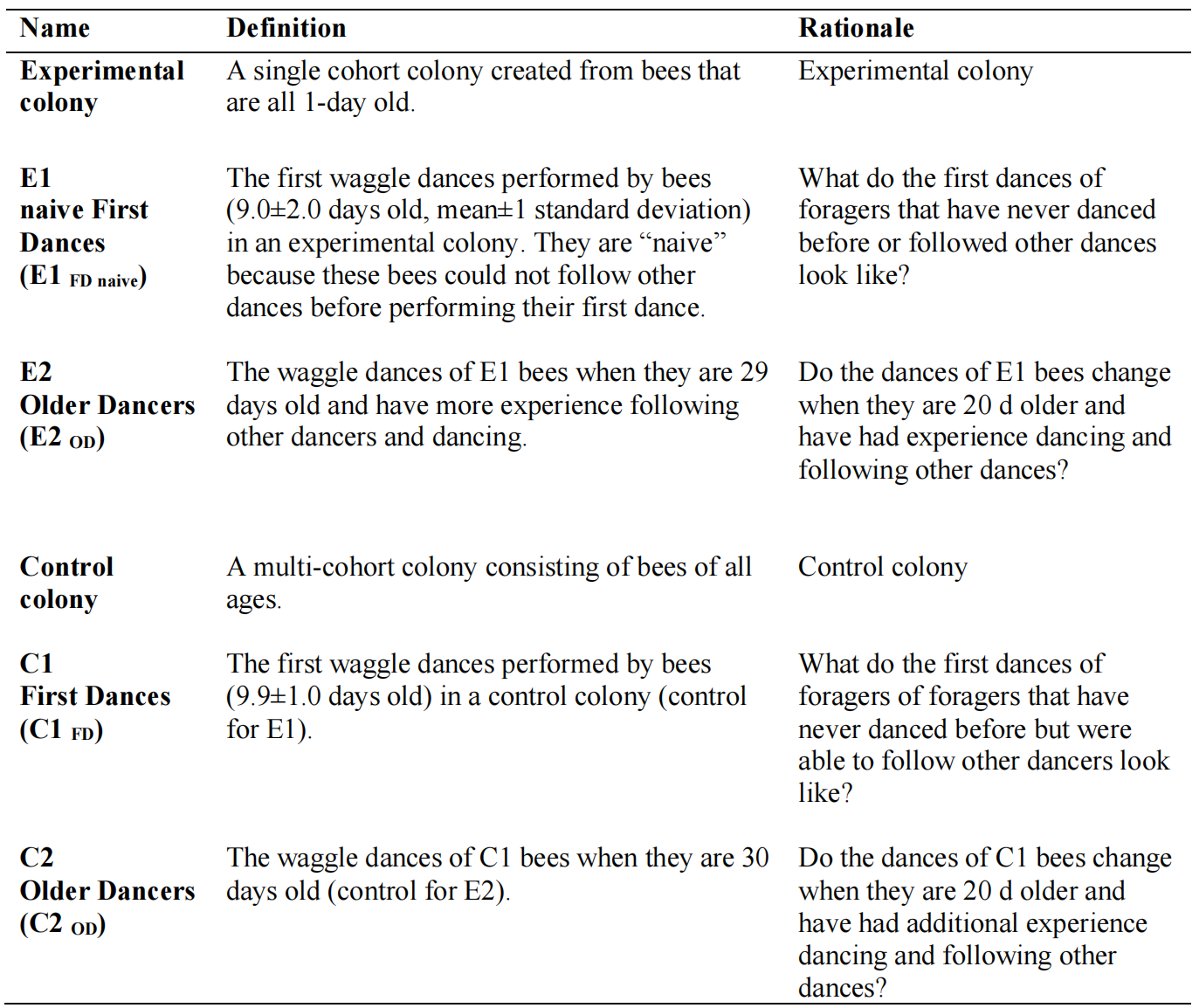
Table 1. Definitions of the different colonies and bee types. The rationale explains the main reason for observing the dances at each stage.
- Dong, H S, Lin, T, Tan, K and Nieh, J C(2023). Protocol for how to study social signal learning of the waggle dance in honey bees (Apis mellifera). Bio-protocol Preprint. bio-protocol.org/prep2203.
- Dong, S., Lin, T., Nieh, J. C. and Tan, K.(2023). Social signal learning of the waggle dance in honey bees. Science 379(6636). DOI: 10.1126/science.ade1702
Do you have any questions about this protocol?
Post your question to gather feedback from the community. We will also invite the authors of this article to respond.
 Post a Question


