


Optimized Phenol–Chloroform–Isoamyl DNA Extraction Protocol for Single Fish Eggs

(*contributed equally to this work) 发布: 2026年10月20日第16卷第20期 DOI: 10.21769/BioProtoc.5839 浏览次数: 29
评审: Amr Galal Abdelraheem IbrahimAnonymous reviewer(s)
 PDF
PDF  Q&A
Q&A





Abstract
Reliable DNA extraction is essential for genetic research on marine species; however, obtaining sufficient DNA from single fish eggs remains challenging. Existing protocols often require optimization to achieve high PCR efficiency. The optimized phenol–chloroform–isoamyl extraction protocol presented in this paper improves DNA yield and quality from individual eggs of Atlantic bluefin tuna (Thunnus thynnus), bogue (Boops bops), saddled seabream (Oblada melanura), and painted comber (Serranus scriba) by modifying buffer volumes, incubation times, and washing steps, following prior micropuncturing of eggs on a glass slide. DNA quality is confirmed by spectrophotometry, PCR amplification of the mitochondrial COI gene, electrophoresis, and Sanger sequencing. This method provides a low-cost and effective approach for species identification from individual fish eggs.
Key features
• Effective and low-cost DNA extraction method from fish eggs.
• Uses only standard reagents and equipment, allowing wide application in all laboratories.
• High PCR efficiency.
Keywords: Atlantic bluefin tuna (Thunnus thynnus) Fish eggs
Phenol–chloroform DNA extraction
Mitochondrial COI gene
Species identification
Fish eggs
Phenol–chloroform DNA extraction
Mitochondrial COI gene
Species identification
Graphical overview
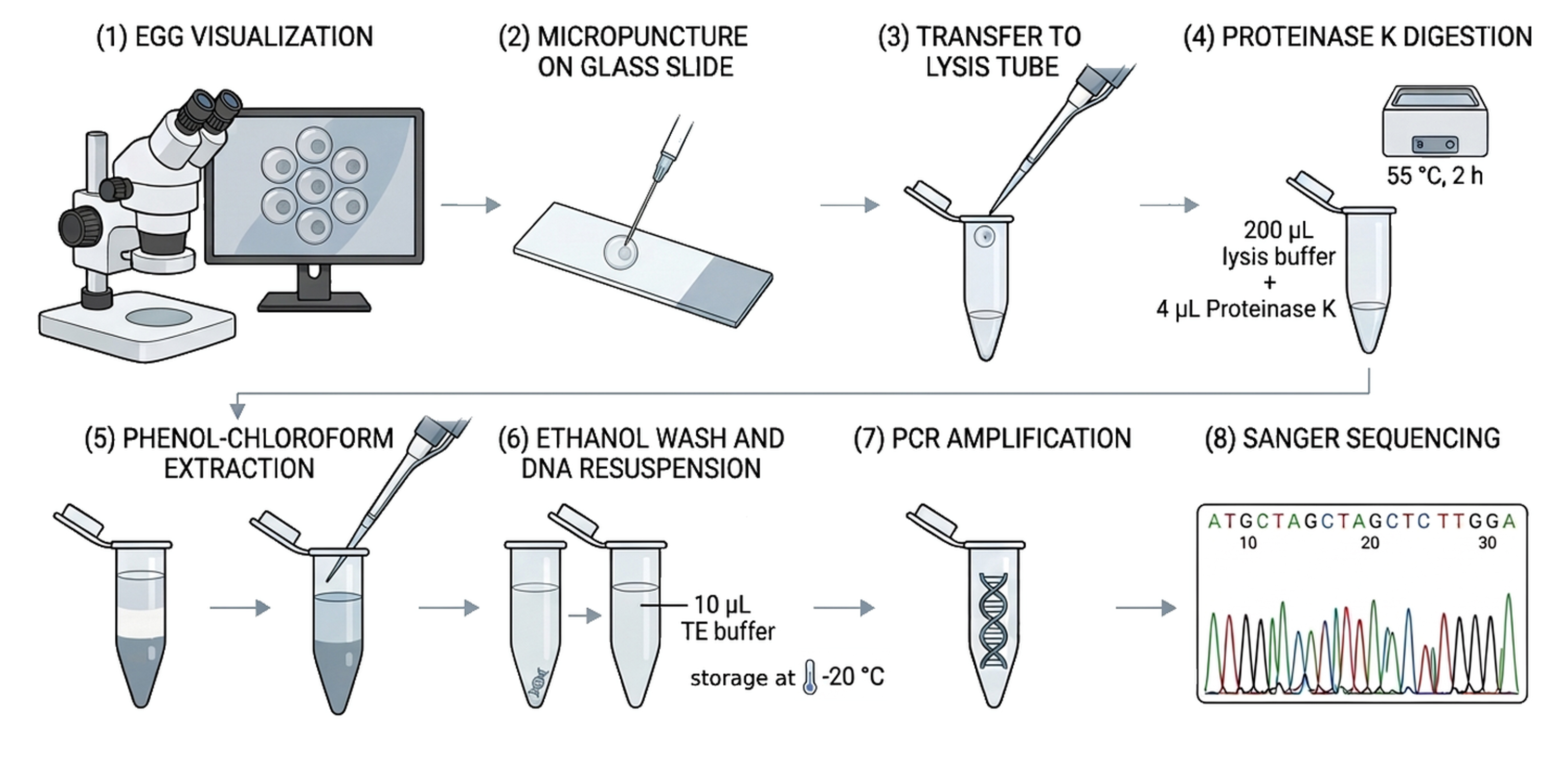
Optimized phenol–chloroform–isoamyl protocol for DNA extraction from single fish eggs. Includes egg visualization under a stereomicroscope, micropuncture on a glass slide, transfer to lysis buffer, Proteinase K digestion, phenol–chloroform extraction, ethanol washing, DNA resuspension and storage at -20 °C, PCR amplification, and Sanger sequencing.
Background
Today, almost all methods for stock research on marine species rely on genetic studies. To obtain high-quality DNA, effective DNA extraction is required. There are many reliable protocols and commercial kits for isolating DNA from tissue, which provide high yields and excellent quality DNA. However, DNA extraction from a single fish egg may result in lower yields due to uniform cell stages. Aranishi (2006) [1] used a one-tube method for DNA extraction, while Golotin et al. (2023) [2] described a low-cost, non-enzymatic protocol for isolating embryonic cells from fish eggs. In our samples, the existing protocols did not consistently provide sufficient DNA yield for reliable PCR amplification from individual fish eggs. Therefore, further optimization was required to achieve reliable PCR amplification and to develop an optimized protocol for DNA extraction from individual fish eggs collected in the vicinity of Atlantic bluefin tuna (Thunnus thynnus) aquaculture farms. The primary aim of the sampling was to confirm the occurrence of T. thynnus spawning within the aquaculture cages. However, the area surrounding aquaculture facilities is also inhabited by a diverse assemblage of wild fish species, as aquaculture cages can attract wild fish by providing increased food availability and serving as functional marine protected areas [3]. Consequently, eggs of other teleost fish species were also collected during sampling conducted around the cages. These eggs were initially selected under a stereomicroscope based on their morphological characteristics and size, while their species identity was subsequently confirmed by molecular analysis. Because eggs of different fish species may occur simultaneously in the vicinity of aquaculture cages, and morphological characteristics alone may not be sufficient for reliable species identification, an efficient DNA extraction protocol for individual fish eggs is required. The protocol described here incorporates micropuncturing of eggs on a glass slide (see General note 1), reducing the volume of lysis buffer to 200 μL, adjusting the volume of phenol–chloroform–isoamyl alcohol, optimizing the incubation period (2 h), and extending the washing period to overnight.
Materials and reagents
Biological materials
1. Fish eggs
Reagents
1. 96% alcohol (Sigma-Aldrich, catalog number: 32294), storage: 4 °C
2. Phenol–chloroform–isoamyl alcohol mixture (Sigma-Aldrich, catalog number: 77617), storage: 4 °C
3. Proteinase K, 20 mg/mL (Thermo Fisher, catalog number: AM2542), storage: -20 °C
4. TE buffer (Thermo Fisher, catalog number: 12090015), storage: 4 °C
5. HotStartTaq DNA Polymerase kit (Qiagen, catalog number: 203203), storage: -20 °C
6. SYBR Safe (Thermo Fisher, catalog number: S33102), storage: room temperature
7. Agarose (Sigma-Aldrich, catalog number: 9012-36-6), storage: room temperature
8. DNA ladder (Cleaver Scientific Ltd., catalog number: CSL-MDNA-100BP), storage: 4 °C
9. GelPilot DNA loading dye, 5× (Qiagen, catalog number: 239901), storage: 4 °C
10. Milli-Q water (MQH2O), storage: room temperature
11. 1 M Tris-HCl, pH 8.0 (Thermo Fisher, catalog number: J22638.AP), storage: room temperature
12. 0.5 M EDTA, pH 8.0 (Thermo Fisher, catalog number: R1021), storage: room temperature
13. 5 M NaCl, RNase-free (Invitrogen, catalog number: AM9760G), storage: room temperature
14. 10% SDS (Invitrogen, catalog number: 15553027), storage: room temperature
Solutions
1. Lysis buffer (see Recipes)
2. 70% alcohol (see Recipes)
3. Proteinase K, 20 mg/mL (see Recipes)
Recipes
1. Lysis buffer
| Reagent | Final concentration | Quantity or volume |
|---|---|---|
| 1 M Tris-HCl | 10 mM | 2 mL |
| 0.5 M EDTA | 1.25 mM | 0.5 mL |
| 5 M NaCl | 150 mM | 6 mL |
| 10% SDS | 0.2% | 4 mL |
| H2O | n/a | 184 mL |
| Total | n/a | 200 mL |
Store the prepared lysis buffer at room temperature and use within 12 months.
2. 70% alcohol
| Reagent | Final concentration | Quantity or volume |
|---|---|---|
| Ethanol (96%) | 70% | 36.5 mL |
| Distilled H2O | to a final volume of 50 mL | |
| Total | n/a | 50 mL |
Store the prepared 70% alcohol at 4 °C.
3. Proteinase K, 20 mg/mL
| Reagent | Final concentration | Quantity or volume |
|---|---|---|
| Proteinase K powder | 20 mg/mL | 100 mg |
| MQH2O | 5 mL | |
| Total | n/a | 5 mL |
Add MQH2O to the powder and mix gently by inversion or pipetting. Avoid vigorous vortexing to prevent shearing the enzyme. Divide the 5-mL solution into small working aliquots (e.g., from 100 μL to 1 mL) to avoid repeated freeze/thaw cycles. Store liquid aliquots at -20 °C.
Laboratory supplies
1. Safe-lock 1.5 mL tubes (Eppendorf, catalog number: 0030120086)
2. PCR tubes (Eppendorf, catalog number: 0030124332)
3. Falcon 50 mL (Eppendorf, catalog number: 0030122178)
4. Pipette tips, 1–20 µL, 20–200 µL, 200–1,000 µL (Gilson, catalog numbers: F171203, F171503, F171703)
5. Laboratory gloves
6. Laboratory scissors
7. Histology glass slides (Thermo Scientific, catalog number: 960004)
8. Medical sterile needles: 22G × 1+14″ (0.7 × 30 mm) (black) and 21G × 1 + 12″ (0.8 × 40 mm) (green) (Sterican®, B. Braun, Germany; catalog numbers: 4657624 and 4657527)
Note: Both 21G and 22G needles are suitable for egg micropuncture; therefore, no specific gauge recommendation based on egg size is required.
Equipment
1. Pipettes (Gilson, model: Pipetman L, FA10002M; FA10005M)
2. UV air recirculator (BioSan, model: UVR-Mi)
3. Stereomicroscope (Olympus, model: SZX12) with DeltaPix camera (model: HDMI16AMDPX)
4. Laboratory rack
5. Isolation and PCR cabinet (BioSan, model: UVT-S-AR)
6. Thermoshaker (BioSan, model: TS-100c)
7. Vortex (BioSan, model: V-1 plus)
8. Centrifuge (Eppendorf, model: 5430 R)
9. Mini centrifuge (Boeco, model: M-6)
10. Spectrophotometer (IMPLEN, model: N50)
11. PCR (Eppendorf, model: nexus GX2)
12. Electrophoresis system (Cleaver Scientific, model: microDOC-CSL-MDOCUV254)
Software and datasets
1. BioEdit-Biological sequence alignment editor, version 5.0.9 (Hall, 1999) [4]
2. BLAST (Basic Local Alignment Search Tool) (National Center for Biotechnology Information; free to use); https://blast.ncbi.nlm.nih.gov/Blast.cgi
Procedure
登录/注册后免费查看全文
文章信息
稿件历史记录
提交日期: May 30, 2026
接收日期: Sep 7, 2026
在线发布日期: Sep 15, 2026
出版日期: Oct 20, 2026
版权信息
© 2026 The Author(s); This is an open access article under the CC BY-NC license (https://creativecommons.org/licenses/by-nc/4.0/).
如何引用
Žužul Vrgoč, I., Lepen Pleić, I., Ivanišević, K. and Šegvić-Bubić, T. (2026). Optimized Phenol–Chloroform–Isoamyl DNA Extraction Protocol for Single Fish Eggs. Bio-protocol 16(20): e5839. DOI: 10.21769/BioProtoc.5839.

 Download Citation in RIS Format
分类
环境生物学 > 海洋脊椎动物
分子生物学
您对这篇实验方案有问题吗?
在此处发布您的问题,我们将邀请本文作者来回答。同时,我们会将您的问题发布到Bio-protocol Exchange,以便寻求社区成员的帮助。
 发布问题
发布问题


