


Efficient Generation of Fetal Hepatic Stellate Cells from hiPSC

发布: 2026年10月05日第16卷第19期 DOI: 10.21769/BioProtoc.5827 浏览次数: 23
评审: Samantha HallerAniruddha Vijay SavargaonkarSravanthi S P Nadiminti
 PDF
PDF  Q&A
Q&A





Abstract
Human induced pluripotent stem cell (hiPSC)-derived liver organoids have emerged as valuable models for studying human liver development. However, existing organoid systems often lack developmentally matched cell populations, particularly fetal hepatic stellate cells (HSCs), limiting their ability to recapitulate key developmental processes. Current approaches for generating HSCs rely on primary cells, immortalized cell lines, or hiPSC differentiation methods that frequently produce activated HSC-like cells and often require cell sorting. Here, we describe an efficient protocol for generating expandable fetal-like HSCs from hiPSCs through a stepwise differentiation strategy that mimics embryonic HSC development. The resulting cells can be robustly expanded while maintaining characteristic molecular and functional features of fetal HSCs. This protocol provides a reproducible and scalable source of fetal-like HSCs without cell sorting and supports the generation of multicellular liver organoids containing developmentally relevant stromal components. Beyond the validation of the protocol in studies of liver maturation and vascularization, it can be applied to investigations of HSC biology and congenital liver diseases.
Key features
• Efficient generation of fetal-like HSCs from hiPSCs without cell sorting.
• Robust expansion of hiPSC-derived HSCs in vitro while maintaining fetal HSC characteristics.
• Generation of developmentally relevant HSCs for multicellular liver organoid construction.
• Applicable to studies of HSC biology, liver development, vascularization, and cell–cell interactions; successful implementation requires experience in hiPSC maintenance and differentiation.
Keywords: Human induced pluripotent stem cell Hepatic stellate cell
Differentiation
Expansion culture
Liver development
Hepatic stellate cell
Differentiation
Expansion culture
Liver development
Graphical overview
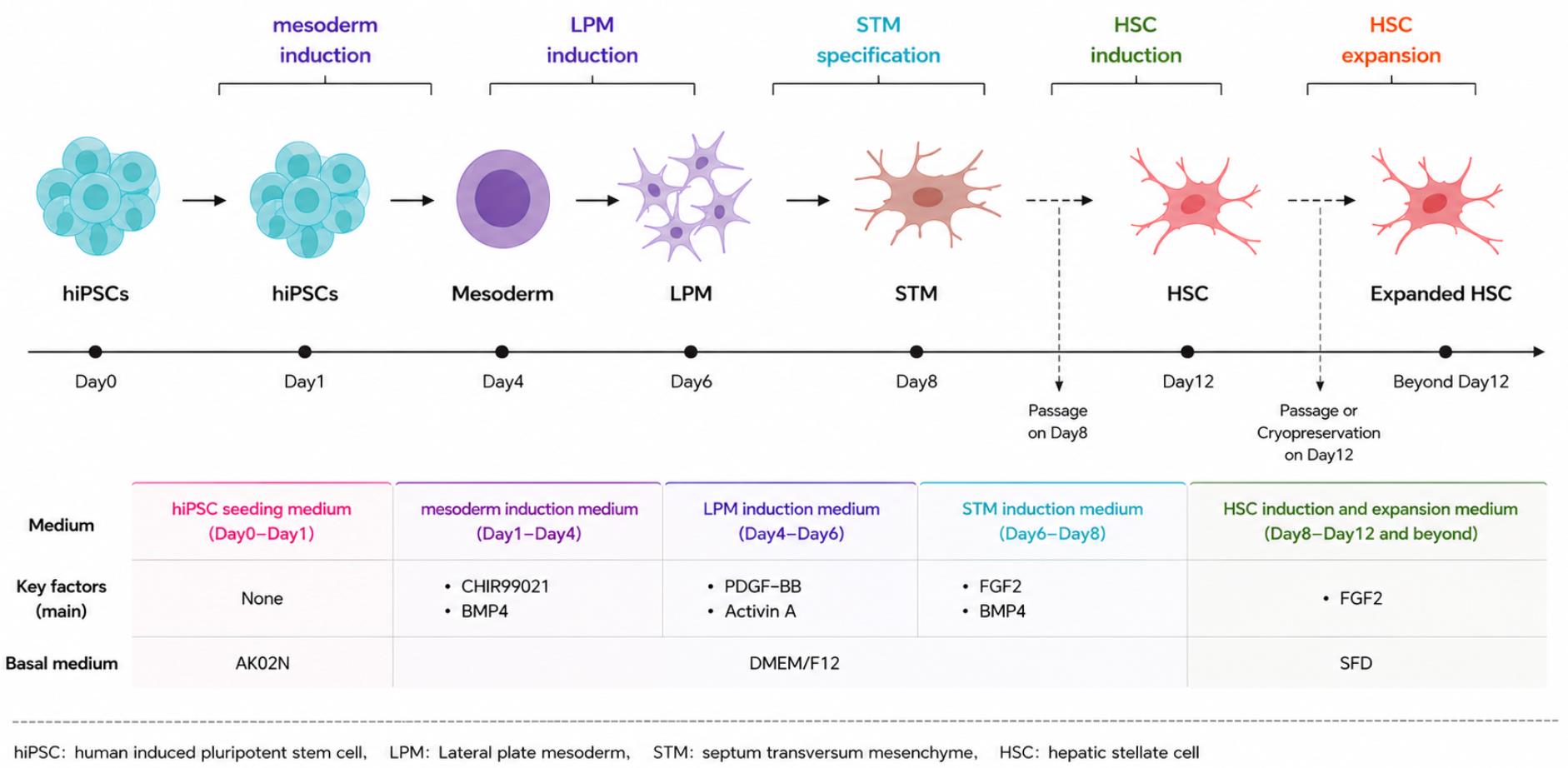
Representation of the experimental design to generate human induced pluripotent stem cell (hiPSC)-derived hepatic stellate cells (HSCs) using the indicated combination of small molecules and cytokines
Background
Hepatic stellate cells (HSCs) are important components of the developing liver microenvironment. Studies in animal models and single-cell RNA sequencing (scRNA-seq) datasets suggest that HSCs promote hepatoblast differentiation and support the maintenance of hematopoietic stem cells during liver development [1,2]. However, the functions of HSCs during human liver organogenesis remain incompletely understood.
Human induced pluripotent stem cell (hiPSC)-derived liver organoids (LOs) provide a useful platform for modeling human liver development in vitro [3]. Nevertheless, the existing LO systems lack key cell types, particularly developmentally stage-matched HSCs. The absence of fetal-like HSCs may limit the ability of these models to recapitulate the multicellular microenvironment required for liver maturation and vascularization.
Previously reported methods for differentiating HSC-like cells from hiPSCs often generate activated HSC-like cells or require cell sorting to enrich the target population [4–6]. These limitations increase experimental complexity and may reduce the scalability and reproducibility of HSC production. Here, we describe a robust protocol for generating expandable fetal-like HSCs from hiPSCs by sequentially mimicking key stages of embryonic HSC development through stage-specific cytokine modulation. The resulting cells retain features of fetal HSCs and can be expanded to support large-scale downstream applications.
Beyond investigating HSC-mediated regulation of liver maturation and vascularization in a multicellular organoid system [7], this protocol may facilitate studies of HSC biology, human liver organogenesis, congenital liver disorders, drug safety testing, and regenerative medicine. The scalable generation of fetal-like HSCs also provides a valuable cell source for engineering more physiologically relevant human liver models.
Materials and reagents
Biological materials
1. Human iPSC line (M48) (Kyoto University, catalog number: N/A)
Reagents
1. StemFit AKO2N (Ajinomoto Co., Inc, catalog number: AJ100)
2. Dulbecco’s modified Eagle medium/nutrient mixture F-12 (DMEM/F12) (Thermo Fisher Scientific, catalog number: 11320033)
3. D-MEM (high glucose) with L-glutamine and phenol red (Fujifilm Wako, catalog number: 043-30085)
4. Iscove’s modified Dulbecco’s medium (IMDM) (Invitrogen, catalog number: 12440-053)
5. Ham’s F-12 K medium (Invitrogen, catalog number: 21127-022)
6. D-PBS (Nacalai Tesque. Inc, catalog number: 14249-24)
7. Glutamax (Thermo Fisher Scientific, catalog number: 35050061)
8. B27 supplement (S50X) (Thermo Fisher Scientific, catalog number: 17504001)
9. N2 supplement (S100X) (Invitrogen, catalog number: 175020-01)
10. Bovine serum albumin (Sigma-Aldrich, catalog number: A9647-100G)
11. L-glutamine (Wako, catalog number: 073-05391)
12. Penicillin-streptomycin (Thermo Fisher Scientific, catalog number: 15140122)
13. Monothioglycerol solution (Fujifilm Wako, catalog number: 195-15791)
14. L-ascorbic acid (Sigma-Aldrich, catalog number: A4544-25G)
15. Fetal bovine serum (FBS) (Funakoshi, catalog number: S1820)
16. Sodium butyrate (Sigma-Aldrich, catalog number: B5887)
17. Y-27632 dihydrochloride (Wako, catalog number: 034-24024)
18. iMatrix-511TM (Nippi, Inc, catalog number: 381-07363)
19. TrypLE Express Enzyme (1×), no phenol red (Thermo Fisher Scientific, catalog number: 12604013)
20. CHIR-99021 (Cayman, catalog number: 13122)
21. Bone Morphogenetic Protein 4 (BMP4) (R&D Systems, catalog number: RSD-314-BP-050-50)
22. Platelet-derived growth factor-BB (PDGF-BB) (Peprotech, catalog number: 100-14B)
23. ACTIVIN A (Ajinomoto Inc, catalog number: P08476)
24. Fibroblast growth factor 2 (FGF2) (Wako Pure Chemical Industries, catalog number: 060-04543)
25. WNT3a (R&D Systems, catalog number: 5036-WN-500)
26. Forskolin (Cayman, catalog number: 11018)
27. Vascular endothelial growth factor (VEGF) (R&D, catalog number: 293-VE-01M)
28. Dexamethasone (DEX) (Sigma, catalog number: D2915-100MG)
29. Oncostatin M (OSM) (R&D System, Minneapolis, Minnesota, USA, catalog number: 295-OM)
30. N-acetyl cysteine (NAC) (Sigma-Aldrich, catalog number: A7256)
31. DAPI (Nacalai Tesque, catalog number: 19178-91)
32. Antifade mounting medium (Abcam, catalog number: ab104135)
33. ECL blocking reagent, human (Roche, catalog number: RPN418)
34. 4% paraformaldehyde (PFA) (Fujifilm, catalog number: WK16320145)
35. Triton X-100 (Sigma, catalog number: T8787)
36. STEM-CELLBANKER® (Amsbio, catalog number: 11924)
37. Propidium iodide (PI) (Sigma, catalog number: P4170-10MG)
38. Retinol (Sigma, catalog number: R2625-50mg)
39. Antibodies (flow cytometry and immunostaining):
a. PE mouse anti-human CD166 (ALCAM) (BD Pharmingen, catalog number: 559263; working dilution 1:20)
b. APC mouse anti-human CD73 (BD Pharmingen, catalog number: 560847; working dilution 1:20)
c. PE labeled anti-human PDGFRα (BD Pharmingen, catalog number: 556002; working dilution 1:20)
d. PE mouse anti-human PDGFRβ (BD Pharmingen, catalog number: 558821; working dilution 1:20)
e. APC mouse anti-human CD71 (BD Pharmingen, catalog number: 551374; working dilution 1:20)
f. Mouse anti-human α-SMA (Sigma, catalog number: 2547; working dilution 1:100)
g. Rabbit anti-human collagen I α1 (Novus Biological, catalog number: NB600-408; working dilution 1:200)
h. Rabbit anti-human fibronectin (Abcam, catalog number: ab2413; working dilution 1:200)
i. Mouse anti-human vimentin (Abcam, catalog number: ab8069; working dilution 1:200)
j. Donkey anti-mouse IgG (H+L) Alexa Fluor 488 (Invitrogen, catalog number: A-21202; working dilution 1:500)
k. Donkey anti-goat IgG (H+L) Alexa Fluor 555 (Invitrogen, catalog number: A-21432; working dilution 1:500)
l. Donkey anti-rabbit IgG (H+L) Alexa Fluor 647 (Invitrogen, catalog number: A-31573; working dilution 1:500)
Solutions
1. Plate coating solution (see Recipes)
2. AK02N complete medium (see Recipes)
3. hiPSC seeding medium (see Recipes)
4. Mesoderm induction medium (see Recipes)
5. Lateral plate mesoderm induction medium (see Recipes)
6. Septum transversum mesenchyme (STM) induction medium (see Recipes)
7. Serum-free defined medium (SFDM) (see Recipes)
8. HSC induction and expansion medium (see Recipes)
9. Quench medium (see Recipes)
10. FACS buffer (see Recipes)
11. Blocking buffer (see Recipes)
12. DAPI working solution (see Recipes)
Recipes
1. Plate coating solution
| Reagent | Final concentration | Quantity or volume |
|---|---|---|
| D-PBS | N/A | 10 mL |
| iMatrix-511 | 2.5 μg/mL | 50 μL |
Prepare fresh.
2. AK02N complete medium
| Reagent | Final concentration | Quantity or volume |
|---|---|---|
| StemFit AK02N basal medium A | 79.60% (v/v) | 398 mL |
| Liquid B | 20% (v/v) | 100 mL |
| Liquid C | 0.40% (v/v) | 2 mL |
Mix well by inverting the bottle 5 times. The mixed medium can be stored at 4 °C for up to two weeks. Alternatively, aliquot the medium and store at -20 °C for up to 6 months.
3. hiPSC seeding medium
| Reagent | Final concentration | Quantity or volume |
|---|---|---|
| AK02N complete medium (Recipe 2) | N/A | 10 mL |
| Y-27632 dihydrochloride (10 mM) | 10 μM | 10 μL |
| iMatrix-511 | 2.5 μg/mL | 50 μL |
Prepare fresh.
4. Mesoderm induction medium
| Reagent | Final concentration | Quantity or volume |
|---|---|---|
| DMEM/F12 | N/A | 25 mL |
| B27 | 1% | 250 μL |
| Glutamax | 1% | 250 μL |
| CHIR-99021 (2 mM) | 8 μM | 100 μL |
| BMP4 (25 μg/mL) | 25 ng/mL | 25 μL |
Store at 4 °C for up to 1 week.
5. Lateral plate mesoderm induction medium
| Reagent | Final concentration | Quantity or volume |
|---|---|---|
| DMEM/F12 | N/A | 25 mL |
| B27 | 1% | 250 μL |
| Glutamax | 1% | 250 μL |
| PDGFBB (10 μg/mL) | 10 ng/mL | 25 μL |
| ACTIVIN A (33.3 μg/mL) | 2 ng/mL | 1.5 μL |
Store at 4 °C for up to 1 week.
6. STM induction medium
| Reagent | Final concentration | Quantity or volume |
|---|---|---|
| DMEM/F12 | N/A | 25 mL |
| B27 | 1% | 250 μL |
| Glutamax | 1% | 250 μL |
| FGF2 (5 μg/mL) | 10 ng/mL | 50 μL |
| BMP4 (25 μg/mL) | 12 ng/mL | 12 μL |
Store at 4 °C for up to 1 week.
7. SFDM
| Reagent | Final concentration | Quantity or volume |
|---|---|---|
| IMDM | 75% (v/v) | 375 mL |
| Ham’s F-12 K medium | 25% (v/v) | 125 mL |
| B27 | 1% | 5 mL |
| N2 | 0.5% | 2.5 mL |
| Bovine serum albumin (50 mg/mL) | 0.5 mg/mL | 5 mL |
| L-glutamine (200 mM) | 2 mM | 5 mL |
| Penicillin–streptomycin (100×) | 1% | 5 mL |
| Monothioglycerol solution | 0.45 mM | 4.5 mL |
| L-ascorbic acid (125 mM) | 0.5 mM | 2 mL |
| EGF (20 μg/mL) | 10 ng/mL | 250 μL |
| VEGF (50 μg/mL) | 10 ng/mL | 100 μL |
| FGF2 (5 μg/mL) | 10 ng/mL | 1,000 μL |
| HGF (5 μg/mL) | 20 ng/mL | 2,000 μL |
| Dexamethasone (100 μM) | 100 nM | 500 μL |
Store at 4 °C for up to 1 week.
8. HSC induction and expansion medium
| Reagent | Final concentration | Quantity or volume |
|---|---|---|
| SFDM | N/A | 100 mL |
| FBS | 5% | 5 mL |
| FGF2 (5 μg/mL) | 10 ng/mL | 200 μL |
| NAC (5 mM) | 10 μM | 200 μL |
Store at 4 °C for up to 1 week.
9. Quench medium
| Reagent | Final concentration | Quantity or volume |
|---|---|---|
| D-MEM (high glucose) | N/A | 500 mL |
| Penicillin-streptomycin | 1% | 5 mL |
| FBS | 5% | 25 mL |
Store at 4 °C for up to 1 month.
10. FACS buffer
| Reagent | Final concentration | Quantity or volume |
|---|---|---|
| D-PBS | N/A | 100 mL |
| FBS | 2% | 2 mL |
| PI (1 mg/mL) | 1 μg/mL | 100 μL |
Store at 4 °C in the dark for up to 1 month.
11. Blocking buffer
| Reagent | Final concentration | Quantity or volume |
|---|---|---|
| D-PBS | N/A | 100 mL |
| ECL Prime blocking agent | 10% | 10 g |
| Triton X-100 | 0.3% | 300 μL |
Store at 4 °C for up to 1 month.
12. DAPI working solution
| Reagent | Final concentration | Quantity or volume |
|---|---|---|
| DAPI | 1 μg/mL | 10 μL |
| Antifade mounting medium | N/A | 10 mL |
Store at 4 °C in the dark for up to 1 month.
Laboratory supplies
1. Falcon 12-well clear-bottom TC-treated multiwell cell culture plate (Corning, catalog number: 353043)
2. Falcon 100 mm TC-treated cell culture dish (Corning, catalog number: 353003)
3. Falcon® 15 mL high clarity PP centrifuge tube (Corning, catalog number: 352096)
4. Falcon® 50 mL high clarity PP centrifuge tube (Corning, catalog number: 352070)
5. Falcon® 5 mL round-bottom polystyrene test tube (Corning, catalog number: 352008)
6. Millex-GP syringe filter unit, 0.22, polyethersulfone, 33 mm, gamma sterilized (Millipore, catalog number: SLGPR33RB)
7. Bio freezing vessel, Bicell (NFZ, catalog number: 4100)
Equipment
1. Laboratory centrifuge with rotors for 15 and 50 mL conical tubes (Kubota, catalog number: 4000)
2. Inverted phase contrast microscope (Nikon, model: ECLIPSE TS100)
3. Leica Microsystems fluorescence microscope (Leica, model: THUNDER Imager Tissue)
4. BD FACSCelesta Cell Analyzer (BD Biosciences, Mississauga, Canada)
5. Tomy Capsulfuge Centrifuge (TOMY KOGYO, model: PMC-060)
Software and datasets
1. FlowJo software (BD Biosciences, version: 10.8.1)
Procedure
登录/注册后免费查看全文
文章信息
稿件历史记录
提交日期: Jul 20, 2026
接收日期: Aug 27, 2026
在线发布日期: Sep 16, 2026
出版日期: Oct 5, 2026
版权信息
© 2026 The Author(s); This is an open access article under the CC BY license (https://creativecommons.org/licenses/by/4.0/).
如何引用
Yang, X., Taniguchi, H. and Nie, Y. Z. (2026). Efficient Generation of Fetal Hepatic Stellate Cells from hiPSC. Bio-protocol 16(19): e5827. DOI: 10.21769/BioProtoc.5827.

 Download Citation in RIS Format
您对这篇实验方案有问题吗?
在此处发布您的问题,我们将邀请本文作者来回答。同时,我们会将您的问题发布到Bio-protocol Exchange,以便寻求社区成员的帮助。
 发布问题
发布问题


