


Identifying D-Group Mitogen-Activated Protein Kinases as Substrates of Arabidopsis Tyrosine Phosphatase RLPH2 Using Phospho-Tyrosine Peptide Enrichment
利用磷酸化酪氨酸肽富集技术鉴定 D 组丝裂原活化蛋白激酶为拟南芥酪氨酸磷酸酶 RLPH2 的底物

发布: 2026年09月05日第16卷第17期 DOI: 10.21769/BioProtoc.5810 浏览次数: 286
评审: Kishwar Jahan ShethiNoelia ForesiAnonymous reviewer(s)
 PDF
PDF  Q&A
Q&A
参见作者原研究论文
The authors used this protocol in:

Jan 2026




Abstract
Identifying substrates of protein phosphatases has been technically challenging and has hampered progress in the field of plant sciences. Small molecule inhibitors of protein phosphatases have aided in uncovering classes of phosphatases that target substrates, but that too has severe limitations. Here, we describe a method that enriches phosphorylated substrates using TiO2 and phospho-tyrosine antibodies in phosphatase knockout lines of Arabidopsis thaliana. When compared to wild-type plants, this approach permits identification of putative substrates and specific phosphorylation sites by mass spectrometry, allowing for further in vitro or functional validation. The key to the approach described here is the use of phosphatase knockout lines to maintain substrates in a phosphorylated state and using phospho-tyrosine antibodies to enrich for tyrosine phosphorylated peptides.
Key features
• Requires genetic knockout lines for the protein phosphatase of interest to uncover increased phosphorylation of putative substrates compared to wild type.
• Phospho-peptides are (quantitatively) compared using mass spectrometry.
• Tyrosine phosphorylated peptides are immunoprecipitated after TiO2 phospho-peptide enrichment.
• Putative substrates identified with this protocol can later be validated with in vitro assays using synthetic phospho-peptides and/or phospho-proteins.
Keywords: Phospho-proteomics (磷酸化蛋白质组学) Tyrosine phosphatase (酪氨酸磷酸酶)
Mitogen-activated protein kinase (丝裂原活化蛋白激酶)
Arabidopsis thaliana (拟南芥)
Protein kinase activation loop (蛋白激酶活化环)
Quantitative mass spectrometry (定量质谱分析)
Tyrosine phosphatase (酪氨酸磷酸酶)
Mitogen-activated protein kinase (丝裂原活化蛋白激酶)
Arabidopsis thaliana (拟南芥)
Protein kinase activation loop (蛋白激酶活化环)
Quantitative mass spectrometry (定量质谱分析)
Graphical overview
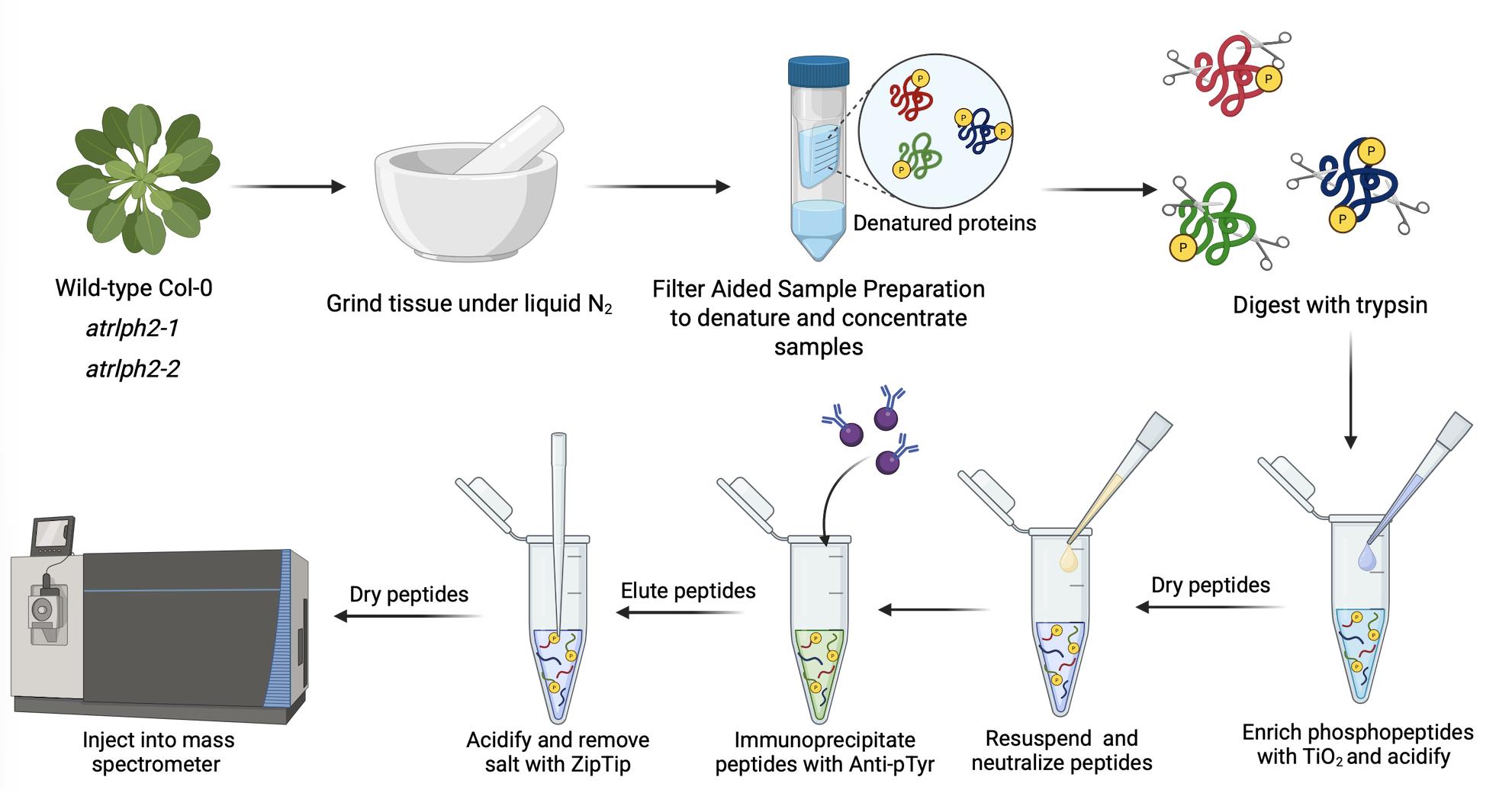
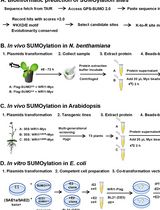
Schematic of the RLPH2 phospho-tyrosine (pY) substrate enrichment pipeline
Background
Protein post-translational modifications (PTMs) such as phosphorylation largely regulate cellular signaling pathways by changing the protein’s structural properties, its subcellular localization, its binding capacity to other proteins, or its activity [1]. In plants, protein phosphorylation has been linked to diverse functions such as plant growth and development, defense, cell cycle regulation, and hormone biosynthesis and signaling [2]; therefore, it is crucial to properly characterize the players involved in this process.
Protein kinases add a phosphoryl group principally onto serine (Ser), threonine (Thr), and tyrosine (Tyr), whereas protein phosphatases remove phosphate. Large-scale plant phospho-proteomics has shown that the abundance of phospho-serine, phospho-threonine, and phospho-tyrosine in plants parallels that in humans, namely 84%–86%, 10%–12%, and 2%–4%, respectively [3,4]. Although levels of tyrosine phosphorylation are similar in plants and humans, there are very few tyrosine-specific phosphatases identified to date [5,6].
Identifying the substrates of protein phosphatases has been technically challenging, and progress in understanding these enzymes has fallen behind knowledge of the counteracting enzymes, the protein kinases. Recently, we have identified a novel type of protein phosphatase [7,8], the Arabidopsis thaliana Rhizobiales–like phosphatase 2 (RLPH2). It was predicted to be a serine/threonine-specific phosphatase due to its primary sequence; however, in vitro phospho-peptide assays revealed its preference for phospho-tyrosine residues. This was later supported by the crystal structure that demonstrated a deeper active site pocket than other protein phosphatases of the same family (the PPP-family); therefore, the RLPH2 active site is able to accommodate the larger phospho-tyrosine substrates [9].
Mass spectrometry analysis of covalent modifications has completely altered our view of the extent of these key regulatory features of proteins, particularly their prevalence in vivo. This is true not only for protein phosphorylation but also for other post-translational modifications, including methylation, acetylation, and glycosylation [10,11]. The sensitivity of this approach is contingent upon enriching covalently modified peptides and has allowed the discovery of low-abundance sites. For phospho-peptides, this typically requires the use of TiO2 beads that will bind modified phospho-peptides to serine, threonine, and tyrosine [12,13]. Phospho-tyrosine typically represents only 2% of a eukaryotic phosphoproteome; thus, we have employed anti-phospho-tyrosine antibodies coupled to a Sepharose/agarose matrix to further enrich for this modification that could be masked by phospho-serine/threonine peptides.
In vitro work has revealed the substrate specificity of RLPH2 and hinted at the important structural features the substrates should possess [7]. To identify endogenous substrates, T-DNA knockout (KO) lines of the RLPH2 phosphatase were used along with their corresponding wild-type control. This approach can also be used in any organism with the protein phosphatase knocked out or edited by CRISPR-Cas technology to express a non-active phosphatase. When coupled with phospho-peptide enrichment and mass spectrometry, the door opens to decipher the substrates of protein phosphatases of all classes.
Materials and reagents
Biological materials
1. Arabidopsis thaliana Nössen wild type
2. T-DNA insertion mutant lines for protein phosphatase RLPH2 (AT3G09970), atrlph2-1, and atrlph2-2 in Nössen background; seeds purchased from RIKEN, atrlph2-1 (RATM-13-2130-1_G), and atrlph2-2 (RATM-13-3204-1_G)
Reagents
1. Murashige and Skoog medium (MS) (Phytotech Labs, catalog number: M401)
2. Agar (Sigma-Aldrich, CAS No.: 9002-18-0)
3. HEPES (Sigma-Aldrich, CAS No.: 7365-45-9)
4. SDS (Sigma-Aldrich, CAS No.: 151-21-3)
5. DTT (Thermo Scientific, catalog number: 20290)
6. Coomassie Brilliant Blue G-250 (Bio-Rad, catalog number: 1610406)
7. 95% ethanol (Fisher Scientific, CAS No.: 64-17-5)
8. 85% phosphoric acid (Sigma-Aldrich, CAS No.: 7664-38-2)
9. Tris (Sigma-Aldrich, CAS No.: 77-86-1)
10. Urea (Sigma-Aldrich, CAS No.: 57-13-6)
11. EDTA (Sigma-Aldrich, CAS No.: 60-00-4)
12. Iodoacetamide (Sigma-Aldrich, CAS No.: 144-48-9)
13. Ammonium bicarbonate (Sigma-Aldrich, CAS No.: 1066-33-7)
14. Trypsin (Promega, catalog number: V5113)
15. NaCl (Sigma-Aldrich, CAS No.: 7647-14-5)
16. Trifluoracetic acid (Sigma-Aldrich, CAS No.: 76-05-1)
17. Acetonitrile (Sigma-Aldrich, CAS No.: 75-05-8)
18. Formic acid (FA) (Sigma-Aldrich, CAS No.: 64-18-6)
19. Ammonium hydroxide (Sigma-Aldrich, CAS No.: 1336-21-6)
20. Sodium hydroxide (Sigma-Aldrich, CAS No.: 1310-73-2)
21. TiO2 beads (Merck, CAS No.: 13463-67-7)
22. Anti-phospho-tyrosine antibody agarose beads (Santa Cruz, catalog number: sc-7020)
23. Anti-phospho-tyrosine antibody Sepharose beads (Cell Signaling, catalog number: 7902, p-Tyr-100)
Solutions
1. 0.5× MS-agar (see Recipes)
2. Extraction buffer (see Recipes)
3. Bradford reagent (see Recipes)
4. Urea buffer (see Recipes)
5. IAA solution (see Recipes)
6. IAA urea solution (see Recipes)
7. ABC buffer (see Recipes)
8. ABC buffer with trypsin (see Recipes)
9. Salt solution (see Recipes)
10. 25% (v/v) TFA (see Recipes)
11. Desalt binding buffer (see Recipes)
12. Desalt elution buffer (see Recipes)
13. 30% ACN solution, 0.1% TFA (see Recipes)
14. Loading buffer (see Recipes)
15. 20% (v/v) formic acid (FA) (see Recipes)
16. Wash buffer (see Recipes)
17. 70% EtOH (see Recipes)
18. Elution buffer 1 (see Recipes)
19. Elution buffer 2 (see Recipes)
20. IP buffer (see Recipes)
21. 0.1 M NaOH (see Recipes)
22. IP elution buffer (see Recipes)
23. Solvent A (see Recipes)
24. Solvent B (see Recipes)
Recipes
1. 0.5× MS-agar, pH 5.7
| Reagent | Final concentration | Quantity or volume |
|---|---|---|
| MS | 0.5× | 2.2 g |
| Agar | 0.6 % | 6 g |
| ddH2O | n/a | 1 L |
| Total | n/a | 1 L |
2. Extraction buffer, pH 8.0
| Reagent | Final concentration | Quantity or volume |
|---|---|---|
| HEPES | 25 mM | 595.75 mg |
| SDS | 4% | 4 g |
| DTT | 100 mM | 1.54 g |
| ddH2O | n/a | 100 mL |
| Total | n/a | 100 mL |
3. Bradford reagent
| Reagent | Final concentration | Quantity or volume |
|---|---|---|
| Coomassie Brilliant Blue G-250 | 0.1% (w/v) | 100 mg |
| 95% ethanol | 4.7% (w/v) | 50 mL |
| 85% phosphoric acid | 8.5% (w/v) | 100 mL |
| ddH2O | n/a | 850 mL |
| Total | n/a | 1 L |
4. Urea buffer, pH 8.0
| Reagent | Final concentration | Quantity or volume |
|---|---|---|
| Tris | 50 mM | 302.85 mg |
| Urea | 8.0 M | 24.02 g |
| EDTA | 2 mM | 29.22 mg |
| ddH2O | n/a | 50 mL |
| Total | n/a | 50 mL |
5. IAA solution
| Reagent | Final concentration | Quantity or volume |
|---|---|---|
| Iodoacetamide | 500 mM | 92.48 g |
| ddH2O | n/a | 1 L |
| Total | 500 mM | 1 L |
6. IAA urea solution
| Reagent | Final concentration | Quantity or volume |
|---|---|---|
| 500 mM iodoacetamide | 50 mM | 100 mL |
| Urea buffer (Recipe 4) | n/a | 900 mL |
| Total | 50 mM | 1 L |
7. ABC buffer, pH 8.5
| Reagent | Final concentration | Quantity or volume |
|---|---|---|
| Ammonium bicarbonate | 50 mM | 98.82 mg |
| ddH2O | n/a | 25 mL |
| Total | 50 mM | 25 mL |
8. ABC buffer with trypsin at 1:100 (enzyme: substrate)
| Reagent | Final concentration | Quantity or volume |
|---|---|---|
| Ammonium bicarbonate buffer (Recipe 7) | 50 mM | 9.90 mL |
| Trypsin | 1:100 (trypsin:peptide) | 100 μL |
| Total | n/a | 10 mL |
9. Salt solution
| Reagent | Final concentration | Quantity or volume |
|---|---|---|
| NaCl | 500 mM | 29.22 g |
| ddH2O | n/a | 1 L |
| Total | 500 mM | 1 L |
10. 25% (v/v) TFA
| Reagent | Final concentration | Quantity or volume |
|---|---|---|
| Trifluoracetic acid | 25% (v/v) | 25 mL |
| ddH2O | n/a | 75 mL |
| Total | 25% (v/v) | 100 mL |
11. Desalt binding buffer
| Reagent | Final concentration | Quantity or volume |
|---|---|---|
| Acetonitrile | 3% (v/v) | 3.0 mL |
| 25% (v/v) TFA (Recipe 10) | 0.1% (v/v) | 400 μL |
| ddH2O | n/a | 96.6 mL |
| Total | n/a | 100 mL |
12. Desalt elution buffer
| Reagent | Final concentration | Quantity or volume |
|---|---|---|
| Acetonitrile | 60% (v/v) | 60 mL |
| 25% (v/v) TFA (Recipe 10) | 0.1% (v/v) | 400 μL |
| ddH2O | n/a | 39.6 mL |
| Total | n/a | 100 mL |
13. 30% ACN solution, 0.1% TFA
| Reagent | Final concentration | Quantity or volume |
|---|---|---|
| Acetonitrile | 30% (v/v) | 30 mL |
| Trifluoracetic acid | 0.1% (v/v) | 100 μL |
| ddH2O | n/a | 69.9 mL |
| Total | n/a | 100 mL |
14. Loading buffer
| Reagent | Final concentration | Quantity or volume |
|---|---|---|
| Acetonitrile | 80% (v/v) | 80 mL |
| Trifluoracetic acid | 6% (v/v) | 6 mL |
| ddH2O | n/a | 14 mL |
| Total | n/a | 100 mL |
15. 20% (v/v) FA
| Reagent | Final concentration | Quantity or volume |
|---|---|---|
| FA | 20% (v/v) | 20 mL |
| ddH2O | n/a | 80 mL |
| Total | 20% (v/v) | 100 mL |
16. Wash buffer
| Reagent | Final concentration | Quantity or volume |
|---|---|---|
| Acetonitrile | 50% (v/v) | 50 mL |
| Trifluoracetic acid | 0.1% (v/v) | 100 μL |
| ddH2O | n/a | 49.9 mL |
| Total | n/a | 100 mL |
17. 70% EtOH
| Reagent | Final concentration | Quantity or volume |
|---|---|---|
| 95 % ethanol | 70% (v/v) | 73.68 mL |
| ddH2O | n/a | 26.32 mL |
| Total | 70% (v/v) | 100 mL |
18. Elution buffer 1, pH 11.0
| Reagent | Final concentration | Quantity or volume |
|---|---|---|
| Ammonium hydroxide | 5% (v/v) | 95 mL |
| ddH2O | n/a | 5 mL |
| Total | 5% (v/v) | 100 mL |
19. Elution buffer 2
| Reagent | Final concentration | Quantity or volume |
|---|---|---|
| Acetonitrile | 80% (v/v) | 80 mL |
| FA | 2% (v/v) | 2 mL |
| ddH2O | n/a | 18 mL |
| Total | n/a | 100 mL |
20. IP buffer, pH 7.4
| Reagent | Final concentration | Quantity or volume |
|---|---|---|
| HEPES | 50 mM | 1.19 g |
| NaCl | 50 mM | 292.2 mg |
| ddH2O | n/a | 100 mL |
| Total | n/a | 100 mL |
21. NaOH
| Reagent | Final concentration | Quantity or volume |
|---|---|---|
| NaOH | 0.1 M | 4.00 g |
| ddH2O | n/a | 1 L |
| Total | 0.1 M | 1 L |
22. IP elution buffer
| Reagent | Final concentration | Quantity or volume |
|---|---|---|
| Acetonitrile | 80% (v/v) | 80 mL |
| FA | 2% (v/v) | 2 mL |
| ddH2O | n/a | 18 mL |
| Total | n/a | 100 mL |
23. Solvent A
| Reagent | Final concentration | Quantity or volume |
|---|---|---|
| FA | 0.1% (v/v) | 100 μL |
| ddH2O | n/a | 99.9 mL |
| Total | 0.1% (v/v) | 100 mL |
24. Solvent B
| Reagent | Final concentration | Quantity or volume |
|---|---|---|
| Acetonitrile | 100% (v/v) | 99.9 mL |
| FA | 0.1% (v/v) | 100 μL |
| Total | 0.1% (v/v) | 100 mL |
Laboratory supplies
1. Sep-Pak C18 cartridges (Waters, catalog number: WAT054960)
2. C8 stage tips 200 μL (Thermo Scientific, catalog number: SP321)
3. Amicon Ultra Centrifugal Filters (centricons) MW cutoff 30 kDa (Millipore, catalog number: UFC901096)
4. ZipTip C18 pipette tips (Millipore, catalog number: ZTC18S960)
5. Mortar and pestle (CoosTek, catalog number: 60332)
6. Falcon tubes (15 and 50 mL) (Millipore, catalog numbers: CLS352096, CLS352070)
7. pH indicator strip (MicroEssentialLab, catalog number: F01-WIDRG-010140-SRD)
Equipment
1. Speed vacuum, SpeedVac SPD210 vacuum concentrator (Thermo Fisher, catalog number: SPD210-230)
2. Centrifuge swing rotor for Falcon tubes 50 mL, TX-150 Swinging Bucket Rotor, compatible with Thermo Scientific ST8 Megafuge 8 and SL8 centrifuges (Thermo Fisher, catalog number: 750055701)
3. Microtube centrifuge, Accuspin Micro 17/17R Microcentrifuge (Fisher Scientific, catalog number: 13100675)
4. C18 nano-flow analytical column, nanoEase M/Z Peptide BEH C18 Column 130 Å, 1.7 μm, 300 μm × 150 mm (Waters, catalog number: 186009259)
5. Nanoflow LC (nLC1200) (Thermo Fisher), Nanoflow LC (nLC1200) (Thermo Fisher, catalog number: ES803)
6. High-resolution mass spectrometer (Thermo Fisher or equivalent), Orbitrap Fusion Mass Spectrometer (Thermo Fisher, catalog number: FETD2-10002)
7. Tabletop Eppendorf shaker, Orbi-Shaker MP (Sigma-Aldrich, catalog number: Z742450)
8. Heating block, Corning LSE Single Block (Sigma-Aldrich, catalog number: CLS480124-1EA)
9. Vortex, Corning LSE Vortex Mixtures (Sigma-Aldrich, catalog number: CLS6775-1EA)
10. Spectrophotometer or Nanodrop (capable of measuring 280 nm), Nanodrop One/One Microvolume UV-Vis Spectrophotometer (Thermo Fisher, model: ND-ONE-W)
11. End-over-End Rotator, Benchmark RotoMini Rotator (Sigma-Aldrich, model: BMSR2020-1EA)
Procedure
登录/注册后免费查看全文
文章信息
稿件历史记录
提交日期: May 11, 2026
接收日期: Jul 15, 2026
在线发布日期: Aug 24, 2026
出版日期: Sep 5, 2026
版权信息
© 2026 The Author(s); This is an open access article under the CC BY license (https://creativecommons.org/licenses/by/4.0/).
如何引用
Labandera, A. M., Kurucz, B., Uhrig, R. G. and Moorhead, G. B. (2026). Identifying D-Group Mitogen-Activated Protein Kinases as Substrates of Arabidopsis Tyrosine Phosphatase RLPH2 Using Phospho-Tyrosine Peptide Enrichment. Bio-protocol 16(17): e5810. DOI: 10.21769/BioProtoc.5810.

 Download Citation in RIS Format
分类
植物科学 > 植物分子生物学 > 蛋白质
植物科学 > 植物生物化学 > 蛋白质
分子生物学 > 蛋白质 > 脱酰作用
您对这篇实验方案有问题吗?
在此处发布您的问题,我们将邀请本文作者来回答。同时,我们会将您的问题发布到Bio-protocol Exchange,以便寻求社区成员的帮助。
 发布问题
发布问题


