


R-Loop Modification and Quantification by Dot Blot
R-loop 修饰的斑点印迹检测与定量分析

(*contributed equally to this work) 发布: 2026年09月05日第16卷第17期 DOI: 10.21769/BioProtoc.5806 浏览次数: 422
评审: Anonymous reviewer(s)
 PDF
PDF  Q&A
Q&A
参见作者原研究论文
The authors used this protocol in:

Mar 2025




Abstract
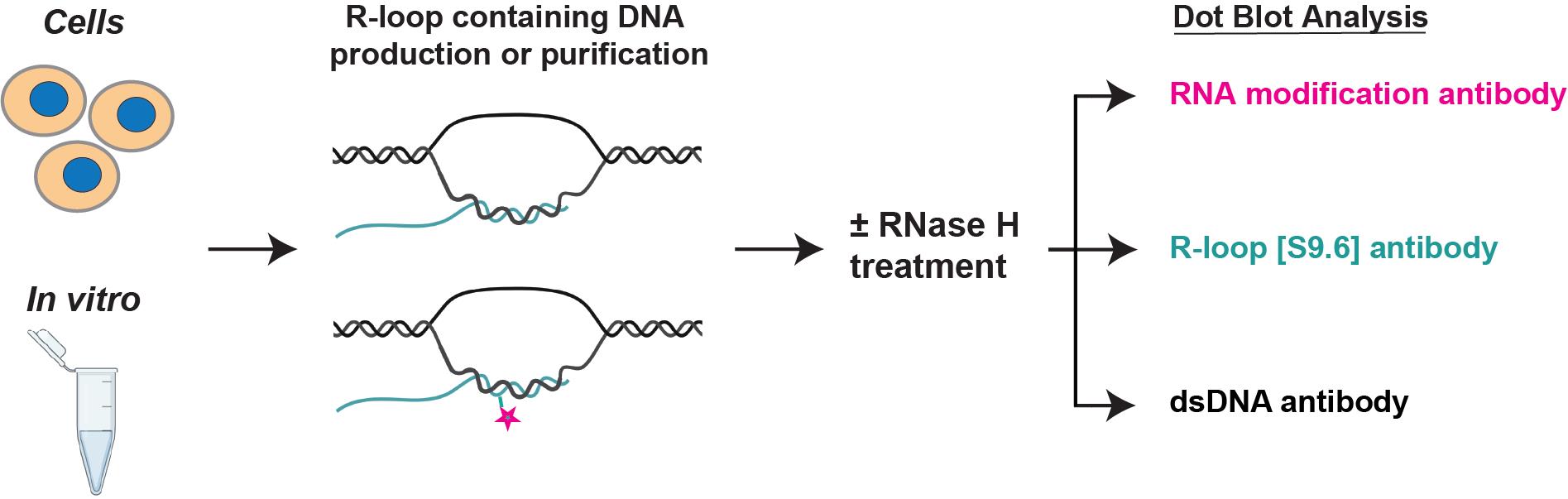
RNA modifications and their “writer,” “eraser,” and “reader” proteins are emerging as key regulators of gene expression and DNA repair through dynamically regulating RNA:DNA hybrids, or R-loops, during transcription. Therefore, it is paramount to develop rigorous techniques for accurate analysis of R-loop modifications. A convenient method for analyzing RNA modifications within total RNA is by dot blot with specific RNA modification antibodies; however, analysis of the modification of the RNA moiety within R-loops presents specific challenges. Here, we provide a detailed protocol for the production or purification of DNA containing R-loops in vitro and from cells, and the analysis of the RNA moiety modifications by dot blot. The DNA containing R-loops is treated with either mock or RNase H, which specifically degrades the RNA within RNA:DNA hybrids, to control for the specificity of the signal as originating from R-loops. Known quantities of the mock or RNase H–treated DNA are then spotted on three membranes, each blotted with antibodies that recognize double-stranded DNA, RNA:DNA hybrids, or the specific RNA modification antibodies of interest, such as m6A or ac4C. Thus, this protocol is useful to both biochemists and cell biologists with scientific interests at the intersection of R-loops and epitranscriptomics.
Key features
• R-loops produced via in vitro transcription of R-loop-forming DNA sequences can serve as substrates for biochemical assays, quantification standards, or antibody specificity controls.
• R-loop-containing DNA can be purified from cells after gene editing or various treatments to analyze how global R-loop levels and modifications are regulated.
• This protocol was initially applied to the study of the role of NAT10 and ac4C modification of the RNA moiety within R-loops in human cells.
• Requires 4–7 days to complete, depending on the origin of R-loops (in vitro transcription vs. from cells).
Keywords: R-loop (R-loop) Epitranscriptomics (表观转录组学)
Dot blot (斑点印迹)
ac4C (N4-乙酰胞苷(ac4C))
NAT10 (NAT10)
Epitranscriptomics (表观转录组学)
Dot blot (斑点印迹)
ac4C (N4-乙酰胞苷(ac4C))
NAT10 (NAT10)
Graphical overview
Background
R-loops are non-B nucleic acid structures formed by an RNA:DNA hybrid and the displaced ssDNA of the original DNA duplex [1]. They are formed by reinvasion of the DNA template by the nascent RNA molecule in a co-transcriptional manner. Two major classes of RNAPII-associated R-loops can be distinguished: type I R-loops are smaller (less than 60 nt long) and are associated with paused promoters, while type II R-loops are more variable in size (median size of 300 nt long) and are associated with gene bodies [2]. R-loops regulate key cellular processes, and their dynamic formation, resolution by helicases, or degradation by RNase H and other nucleases fine-tune transcription timing and yield and contribute to genome (in)stability [3]. Several RNA modifications and their “writer,” “eraser,” and “reader” proteins have recently emerged as key regulators of R-loops during transcription and DNA repair [4]. These include m6A [5–9], m5C and its oxidated derivative hm5C [10–12], A-to-I editing [13–16], and, more recently, ac4C [17]. Given the novelty of the R-loop epitranscriptomics field, it is important to develop accurate techniques for the analysis of RNA modifications within R-loops at the global level (e.g., dot blot, mass spectrometry), at the single R-loop loci level (e.g., next generation sequencing or direct sequencing), and at the single-cell level (e.g., immunofluorescence, single cell sequencing).
Here, we provide a detailed protocol for the global analysis of R-loop RNA modification by dot blot. This protocol was developed based on existing protocols for the production or purification of DNA containing R-loops in vitro and from cells [18,19], as well as our own development of the analysis of the RNA moiety modifications (i.e., ac4C) by dot blot [17]. In addition to molecular genetics controls consisting of the knock-out of the RNA-modifying writer (i.e., NAT10-KO), the DNA containing R-loops is treated with either mock or RNase H, which specifically degrades the RNA within RNA:DNA hybrids, to control for the specificity of the signal as originating from R-loops. Known quantities of the mock- or RNase H–treated DNA are then spotted on three membranes, each blotted with antibodies that recognize double-stranded DNA, RNA:DNA hybrids, and the specific RNA modification. In addition to the RNase H treatment control, we add an excess RNase A + T treatment control, which removes any trace of RNA from the samples [17]. This additional control is particularly important for the analysis of m5C and hm5C within R-loops, as these modifications exist at high levels in DNA (5mC and 5hmC). Additionally, as previously mentioned, R-loops from different loci (type I vs. type II) can have different lengths and stabilities, likely making RNA modifications associated with R-loops at paused promoters (type I) more difficult to detect. This is why it is important to use a gentle method of purifying R-loop-containing DNA [18] when probing R-loops for RNA modifications. As mentioned above, our protocol also contains a section for in vitro R-loop production, which can serve as substrates for biochemical assays, quantification standards, or for antibody specificity controls. Thus, this protocol is useful to scientists who aim to decipher how RNA modifications regulate R-loops at both the biochemical and functional levels.
Materials and reagents
Biological materials
1. HeLa control and NAT10-KO cells (gift from Dr. Shalini Oberdoerffer)
Reagents
1. pFC53-mAIRN plasmid (gift from Dr. Frédéric Chédin)
2. T3 RNA polymerase (Promega, catalog number: P2083)
3. 5× transcription optimized buffer (Promega, catalog number: P1181)
4. 1 M dithiothreitol (DTT) (ACROS Organics, catalog number: AC426380100)
5. 100% Tween-20 (Thermo Fisher Scientific, Fisher BioReagents, catalog number: BP337-500)
6. Ribonucleotide tri-phosphates (75 mM rATP, rGTP, rUTP, rCTP) (components of the MEGAscript T7 Transcription kit) (Thermo Fisher Scientific, Invitrogen, catalog number: AM1334)
7. Nuclease-free water (not DEPC-treated) (Thermo Fisher Scientific, Invitrogen, catalog number: AM9937)
8. 1 M Tris-HCl, pH 8.0 (Thermo Fisher Scientific, Invitrogen, catalog number: AM9855G)
9. 0.5 M EDTA, pH 8.0 (Thermo Fisher Scientific, Invitrogen, catalog number: AM9260G)
10. Ribonuclease (RNase) A (10 mg/mL) (Thermo Fisher Scientific, Thermo Scientific, catalog number: EN0531)
11. Ribonuclease (RNase) H (5 U/μL) (New England Biolabs, catalog number: M0297S)
12. Proteinase K (New England Biolabs, catalog number: P8107S)
13. 100% glycerol (MilliporeSigma, catalog number: G5516-500ML)
14. Agarose (low-EEO/multi-purpose/molecular biology grade) (Thermo Fisher Scientific, Fisher BioReagents, catalog number: BP160-500)
15. SYBR Safe DNA gel stain (10,000×) (Thermo Fisher Scientific, Invitrogen, catalog number: S33102)
16. Micro-Bio Spin 6 Columns (Bio-Rad, catalog number: 7326221)
17. 1× Dulbecco's phosphate-buffered saline (DPBS), no calcium, no magnesium (Thermo Fisher Scientific, Gibco, catalog number: 14190250)
18. Trypsin-EDTA (0.05%), phenol red (Thermo Fisher Scientific, Gibco, catalog number: 25300054)
19. Dulbecco’s minimum essential medium (DMEM), high glucose (Thermo Fisher Scientific, Gibco, catalog number: 11965118)
20. FoundationTM fetal bovine serum (FBS) (GeminiBio, catalog number: 900-108)
21. Penicillin-streptomycin-glutamine (PSQ) (100×) (Thermo Fisher Scientific, Gibco, catalog number: 10378016)
22. Trypan blue solution, 0.4% (Thermo Fisher Scientific, Gibco, catalog number: 15250061)
23. Sodium dodecyl sulfate (SDS) (MilliporeSigma, catalog number: L3771-1KG)
24. Phenol-chloroform-isoamyl alcohol mixture (25:24:1) (MilliporeSigma, catalog number: 77617-100ML)
25. Sodium acetate (NaOAc), 3 M aq. soln., pH 5.2, RNAse-free (Thermo Fisher Scientific, catalog number: AAJ61928AK)
26. Ethyl alcohol, pure (MilliporeSigma, catalog number: E7023-500ML)
27. NEBuffer r2.1 (10×) (New England Biolabs, catalog number: B6002S)
28. BsrGI-HF (New England Biolabs, catalog number: R3575S)
29. EcoRI-HF (New England Biolabs, catalog number: R3101S)
30. HindIII (New England Biolabs, catalog number: R0104S)
31. SspI-HF (New England Biolabs, catalog number: R3132S)
32. XbaI (New England Biolabs, catalog number: R0145S)
33. Glycogen (5 mg/mL) (Thermo Fisher Scientific, Invitrogen, catalog number: AM9510)
34. DNA gel loading dye (6×) (Thermo Fisher Scientific, Thermo Scientific, catalog number: R0611)
35. GeneRuler 1 kb DNA ladder, ready-to-use (Thermo Fisher Scientific, Invitrogen, catalog number: SM0313)
36. Ribonuclease (RNase) T1 (1,000 U/μL) (Thermo Fisher Scientific, Thermo Scientific, catalog number: EN0541)
37. PBS (10×), pH 7.4 (Thermo Fisher Scientific, Gibco, catalog number: 70011044)
38. Ethylenediaminetetraacetic acid, Di Na Salt Dihydr. (Na2EDTA·2H2O) (Crystalline powd./electrophor.) (Thermo Fisher Scientific, Fisher BioReagents, catalog number: BP120-500)
39. Anti-DNA-RNA hybrid (S9.6) antibody (Kerafast, catalog number: ENH001)
40. ds DNA marker antibody (HYB331-01) (Santa Cruz Biotechnology, catalog number: sc-58749)
41. Anti-N4-acetylcytidine (ac4C) antibody (EPRNCI-184-128) (Abcam, catalog number: ab252215)
42. Nonfat dry milk (Cell Signaling Technology, catalog number: 9999S)
43. Anti-rabbit IgG, HRP-linked antibody (Cell Signaling Technology, catalog number: 7074V)
44. Anti-mouse IgG, HRP-linked antibody (Cell Signaling Technology, catalog number: 7076V)
45. Pierce ECL western blotting substrate (Thermo Fisher Scientific, catalog number: 32160X4)
46. SuperSignal West Femto maximum sensitivity substrate (Thermo Fisher Scientific, catalog number: 34095)
47. Tris base (Fisher Scientific, catalog number: BP152-500)
48. Boric acid (Fisher Scientific, catalog number: BP168-500)
49. Sodium hydroxide (MilliporeSigma, catalog number: 221465-500G)
Solutions
1. 2.5% Tween-20 (see Recipes)
2. 2.5 mM rNTP (see Recipes)
3. 50% glycerol (see Recipes)
4. 0.5 M EDTA (see Recipes)
5. 10× TBE buffer (see Recipes)
6. TE buffer (see Recipes)
7. 20% SDS (see Recipes)
Recipes
1. 2.5% Tween-20
| Reagent | Final concentration | Volume |
| 100% Tween-20 | 2.5% | 1 mL |
| Nuclease-free water | n/a | 39 mL |
| Total | n/a | 40 mL |
Store at 4 °C.
2. 2.5 mM rNTP
| Reagent | Final concentration | Volume |
| rATP (75 mM) | 2.5 mM | 1 μL |
| rGTP (75 mM) | 2.5 mM | 1 μL |
| rUTP (75 mM) | 2.5 mM | 1 μL |
| rCTP (75 mM) | 2.5 mM | 1 μL |
| Nuclease-free water | n/a | 26 μL |
| Total | n/a | 30 μL |
Store at -20 °C.
3. 50% glycerol
| Reagent | Final concentration | Volume |
| 100% glycerol | 50% | 50 mL |
| ddH2O | n/a | 50 mL |
| Total | n/a | 100 mL |
Autoclave the solution. Store at room temperature.
4. 0.5 M EDTA
| Reagent | Final concentration | Quantity or volume |
| Na2EDTA·2H2O | 0.5 M | 186.12 g |
| ddH2O | n/a | 800 mL |
| Stir the solution vigorously | ||
| NaOH | Adjust to pH 8.0 | ~ 20 g of NaOH pellets |
| ddH2O | to 1 L | |
| Total | n/a | 1,000 mL |
Filter the solution using a 0.22-μm filter. Store at room temperature.
5. 10× TBE buffer
| Reagent | Final concentration | Quantity or volume |
| Tris base | 890 mM | 108 g |
| Boric acid | 890 mM | 55 g |
| ddH2O | n/a | 800 mL |
| 0.5 M EDTA, pH 8.0 (Recipe 4) | 20 mM | 40 mL |
| ddH2O | to 1 L | |
| Total | n/a | 1,000 mL |
Filter the solution using a 0.22-μm filter. Store at room temperature.
6. TE buffer
| Reagent | Final concentration | Volume |
| 0.5 M EDTA, pH 8.0 | 1 mM | 100 μL |
| 1 M Tris-HCl, pH 8.0 | 10 mM | 500 μL |
| Nuclease-free water | n/a | 49.4 mL |
| Total | n/a | 50 mL |
Store at room temperature.
7. 20% SDS
| Reagent | Final concentration | Quantity or volume |
| SDS | 20% | 200 g |
| ddH2O | n/a | 800 mL |
| Stir the solution overnight on a stir plate at 50 °C | ||
| ddH2O | to 1 L | |
| Total | n/a | 1,000 mL |
Filter the solution using a 0.22-μm filter. Store at room temperature.
Laboratory supplies
1. Pipette tips LTS, 1,000 μL (Mettler Toledo, catalog numbers: 30389212 and 30389272)
2. Pipette tips LTS, 200 μL (Mettler Toledo, catalog numbers: 30389240 and 30389276)
3. Pipette tips GP LTS, 20 μL (Mettler Toledo, catalog numbers: 30389226 and 30389274)
4. Serological pipettes, 10 mL (Genesee Scientific, GenClone, catalog number: 12-104C)
5. Serological pipettes, 5 mL (Genesee Scientific, GenClone, catalog number: 12-102C)
6. DNA LoBind tubes, 2 mL (Eppendorf, catalog number: 022431048)
7. DNA LoBind tubes, 1.5 mL (Eppendorf, catalog number: 022431021)
8. 0.2-mL PCR tubes (Eppendorf, catalog number: 951010006)
9. Cell culture/Petri dishes, 150 × 20 mm (Thermo Fisher Scientific, Nunc, catalog number: 168381)
10. Disposable borosilicate glass Pasteur pipettes (Thermo Fisher Scientific, Fisherbrand, catalog number: 13-678-20D)
11. Cell counting slides, 500 slides (Logos Biosystems, Luna, catalog number: L12002)
12. MaXtract high density, 100 × 15 mL (Qiagen, catalog number: 129065)
13. PhaseShield gel tubes (200 × 2 mL) (Biofargo, catalog number: M2302-20-H)
14. 15-mL conical centrifuge tubes (Corning, Falcon, catalog number: 352097)
15. 50-mL conical centrifuge tubes (Corning, Falcon, catalog number: 352070)
16. BrightStar-Plus positively charged nylon membrane, 30 cm × 45 cm (Thermo Fisher Scientific, Invitrogen, catalog number: AM10102)
17. Syringe filters (30 mm, 0.22 µm, PES, PP, non-sterile) (VWR, catalog number: 76479-018)
Equipment
1. Rainin Pipet-Lite XLS LTS single-channel pipettes (100–1,000 μL, 20–200 μL, 2–20 μL, 0.5–10 μL, and 0.1–2 μL)
2. Rainin Pipet-X pipette controller
3. IKA Vortex 4 Digital vortexer
4. Centrifuges (Eppendorf, models: 5810R, 5702, and 5427R)
5. Applied Biosystems ProFlex PCR System
6. Bio-Rad horizontal DNA gel electrophoresis system
7. Syngene G:box
8. DeNovix DS-11 spectrophotometer
9. New Brunswick Galaxy 170S CO2 incubator
10. Inverted laboratory microscope (Leica, model: DM IL LED)
11. LUNA Automated Cell Counter
12. UVP HB-1000 hybridization incubator
13. Eppendorf ThermoMixer C
14. Dual LED blue/white light transilluminator (Thermo Fisher Scientific, Invitrogen, catalog number: LB0100)
15. Stratagene Stratalinker UV 1800 Crosslinker
16. Labnet International Rocker
Software and datasets
1. ImageJ, Version 2.14.0/1.54f
2. Prism 10
Procedure
登录/注册后免费查看全文
文章信息
稿件历史记录
提交日期: Jan 19, 2026
接收日期: Jul 27, 2026
在线发布日期: Aug 14, 2026
出版日期: Sep 5, 2026
版权信息
© 2026 The Author(s); This is an open access article under the CC BY-NC license (https://creativecommons.org/licenses/by-nc/4.0/).
如何引用
Readers should cite both the Bio-protocol article and the original research article where this protocol was used:
- Yang, T., Li, Y. and Xhemalçe, B. (2026). R-Loop Modification and Quantification by Dot Blot. Bio-protocol 16(17): e5806. DOI: 10.21769/BioProtoc.5806.
- Debnath, T. K., Abell, N. S., Li, Y. R., Devanathan, S. K., Navedo, E. and Xhemalçe, B. (2025). NAT10 and N4-acetylcytidine restrain R-loop levels and related inflammatory responses. Sci Adv. 11(13): eads6144. https://doi.org/10.1126/sciadv.ads6144

 Download Citation in RIS Format
分类
分子生物学 > RNA > 表观转录组
分子生物学 > RNA > RNA 修饰
分子生物学 > RNA > RNA 检测
您对这篇实验方案有问题吗?
在此处发布您的问题,我们将邀请本文作者来回答。同时,我们会将您的问题发布到Bio-protocol Exchange,以便寻求社区成员的帮助。
 发布问题
发布问题


