


scDynaBar: A Step-By-Step Experimental and Computational Guide for Time-Resolved CRISPR Barcoding at Single-Cell Resolution
scDynaBar:单细胞时间分辨 CRISPR 条形码技术的实验与计算分析指南

发布: 2026年09月05日第16卷第17期 DOI: 10.21769/BioProtoc.5793 浏览次数: 292
评审: Joseph BownessAnonymous reviewer(s)
 PDF
PDF  Q&A
Q&A
参见作者原研究论文
The authors used this protocol in:

May 2026




Abstract
CRISPR-Cas9 barcoding technologies enable cells to record molecular events as permanent genetic changes that can be read out retrospectively. This protocol describes the implementation of a CRISPR-based recording system that gradually accumulates mutations over extended periods and is compatible with standard single-cell RNA sequencing (scRNA-seq) workflows. By temporally regulating CRISPR activity, the system generates mutational barcodes that can be captured together with individual cell transcriptomes. These barcodes are subsequently decoded using computational reconstruction approaches to infer temporal information, enabling the joint analysis of cellular states and time-resolved molecular histories. This approach provides a single-cell-compatible framework for studying dynamic biological processes in heterogeneous mouse embryonic stem cell (mESC)-derived systems, with potential extension to other biological systems.
Key features
• Extended temporal recording: Self-targeting guide RNAs drive progressive and cumulative barcode divergence over time.
• Simultaneous barcode and transcriptome detection: Joint recovery of genetic barcodes and whole transcriptomes from the same single cell using standard scRNA-seq workflows.
• In inducible scDynaBar designs: Cas9 barcode editing can be coupled to specific biological stimuli or cell-state transitions, e.g., transition of mESCs into the 2C-like state.
Keywords: CRISPR barcoding (CRISPR 条形码) Single-cell RNA-seq (单细胞 RNA 测序)
Self-targeting guide RNA (自靶向向导 RNA)
Mouse embryonic stem cells (小鼠胚胎干细胞)
Temporal recording (时序记录)
Molecular clock (分子时钟)
Single-cell RNA-seq (单细胞 RNA 测序)
Self-targeting guide RNA (自靶向向导 RNA)
Mouse embryonic stem cells (小鼠胚胎干细胞)
Temporal recording (时序记录)
Molecular clock (分子时钟)
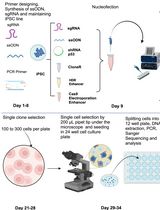
Graphical overview
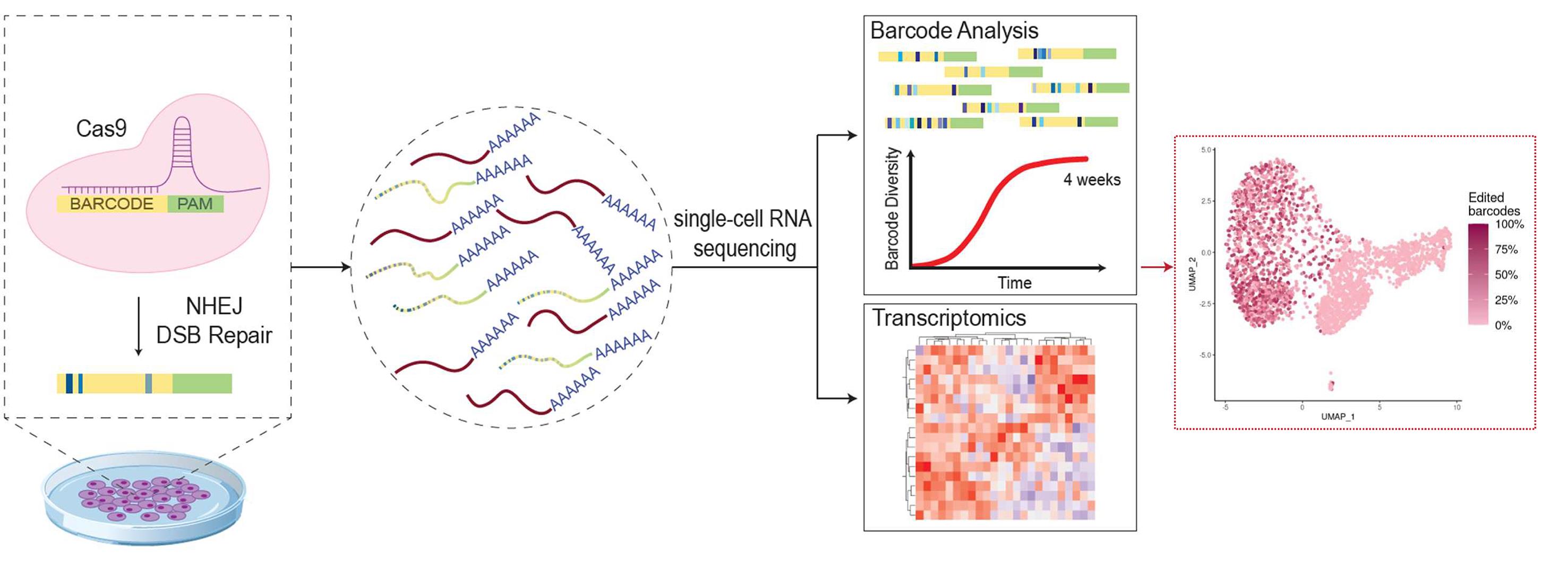
Graphical overview of the scDynaBar workflow
Background
Cellular behavior is inherently dynamic and changes in response to developmental programs and environmental signals. Capturing these time-resolved processes remains challenging because widely used approaches trade temporal resolution for scalability and molecular depth. Live-cell fluorescence microscopy can provide direct temporal measurements, but long-term imaging is constrained by phototoxicity/photobleaching and by practical limits in throughput and downstream analysis, particularly in complex or in vivo contexts [1,2]. In parallel, computational approaches that infer dynamics from single-cell RNA sequencing (scRNA-seq), such as RNA velocity and pseudotime methods, show limited temporal resolution [3,4].
DNA-based cellular “memory” systems have therefore emerged as powerful tools to record transient biological signals as permanent genomic changes that can be retrospectively decoded [5,6]. Many CRISPR-enabled recorders implement a “write” operation by inducing mutations or programmable edits at defined loci, thereby generating genetic barcodes that store information about cell history, lineage relationships, or stimulus exposure [5–7]. Importantly, CRISPR-based recording strategies can be coupled to sequencing-based readouts to integrate recorded information with single-cell profiling to jointly interrogate cellular state and history [8]. Together, these advances have led to a growing repertoire of molecular recording systems [6–15].
A specific goal within this space is to encode elapsed time through continuous or progressive mutagenesis [16,17]. Self-targeting guide RNA designs and related “DNA clock” strategies can generate mutations that accumulate over time, enabling retrospective estimation of event timing or duration [16,17]. However, this strategy is not readily compatible with standard 3′ scRNA-seq workflows, as the mutational barcodes are not polyadenylated, complicating joint analysis of transcriptomes and barcodes in the same cells and increasing experimental overhead [16]. As a result, there is a need for recording systems that (i) accumulate edits progressively over extended periods and (ii) are directly compatible with widely used scRNA-seq platforms.
This protocol describes the implementation of scDynaBar, a CRISPR-based recording strategy that supports long-term, tunable accumulation of mutational barcodes while remaining compatible with standard scRNA-seq capture [18]. In practical terms, the approach is designed to integrate into common single-cell workflows, enabling simultaneous profiling of transcriptomes and temporal barcodes at single-cell resolution. Compared with microscopy-based longitudinal tracking, this method is scalable and applicable to systems where imaging is impractical; compared with purely inference-based trajectory methods, it generates a physical record of prior activity encoded in DNA. Key limitations include not controlling the copy number, the need for efficient delivery of CRISPR components, calibration of editing rates to the cell type of interest, and accounting for locus- and context-dependent biases in editing outcomes [5,17]. Finally, the system can be adapted to record a wide range of stimuli or signals that can be coupled to Cas9 activity (e.g., via signal-responsive promoters) [7,15].
In the associated study, scDynaBar was implemented using both Cas9 nuclease-based editing and base-editing strategies [10], which both serve the same overall purpose of generating sequence-diversified barcodes that can be recovered by sequencing. Here, we focus on Cas9-based implementation of scDynaBar in mouse embryonic stem cells using both bulk amplicon sequencing and single-cell 10x Genomics 3′ RNA-seq, including barcode-enrichment libraries. We further describe the computational pipeline used to analyze data generated from both experimental setups. Example applications also include 3D gastruloids and a Zscan4-dependent Cas9 induction system, illustrating the use of scDynaBar to track the transition of mouse embryonic stem cells (mESCs) into the 2C-like state.
Materials and reagents
Biological materials
1. E14 mESC line
Reagents
Cell culture
1. DMEM high glucose, pyruvate (Gibco, catalog number: 11995040)
2. Fetal bovine serum (Gibco, catalog number: A5256701)
3. GlutaMax (Gibco, catalog number: 35050061)
4. Pen Strep (Gibco, catalog number: 15140122)
5. Non-essential aminoacids (Gibco, catalog number: 11140050)
6. β-mercaptoethanol (Gibco, catalog number: 31350010)
7. mLif (Stem Cell Institute, Cambridge)
8. DMEM/F12 (Thermo Fisher Scientific, catalog number: 11320033)
9. Neurobasal (Thermo Fisher Scientific, catalog number: 21103049)
10. N2 supplement (Cell Therapy Systems, catalog number: A1370701)
11. B-27 supplement (Thermo Fisher Scientific, catalog number: 17504044)
12. PBS (Thermo Fisher Scientific, catalog number: 14190144)
13. Trypsin-EDTA (Thermo Fisher Scientific, catalog number: 25200056)
14. Accutase (StemPro, catalog number: A1110501)
15. Trypan blue (0.4%) (Gibco, catalog number: 15250061)
16. Gelatin (Sigma, catalog number: G9391)
17. BSA (Gibco, catalog number: 15260037)
18. Fugene (Promega, catalog number: E2311)
19. Cre recombinase Gesicles (Takara, catalog number: 631449)
20. Polybrene (Sigma, catalog number: H9268)
21. 4-hydroxytamoxifen (Sigma, catalog number: H7904)
22. CHIR99021 (Department of Biochemistry, University of Cambridge)
23. Opti-MEMTM I reduced serum medium (Thermo Fisher Scientific, catalog number: 31985062)
RNA sequencing reagents
23. RNeasy Micro Kit (Qiagen, catalog number: 74004)
24. SuperScriptTM II, SuperScriptTM II first-strand buffer (5×) and DTT (100 mM) (Thermo Fisher Scientific, catalog number: 18064014)
25. Betaine (5 M) (Merck, catalog number: B0300)
26. MgCl2 (Promega, catalog number: A3511)
27. dNTPs (10 mM) (Thermo Fisher Scientific, catalog number: 18427013)
28. RNase inhibitor (Promega, catalog number: N2111)
29. KAPA HiFi HotStart ReadyMix (KAPA Biosystems, catalog number: KK2502)
30. AMPure XP beads (Beckman Coulter, catalog number: A63881)
31. 10× Single-Cell 3’ Library & Gel Bead kit v2 (10x Genomics, catalog number: PN120237)
32. Bulk sequencing primers:
a. Reverse transcription: GTGACTGGAGTTCAGACGTGTGCTCTTCCGATCTT(30)
b. First amplicon PCR:
Forward: 5′-ACACTCTTTCCCTACACGACGCTCTTCCGATCT(N/NN/NNN)TCTTGTGGAAAGGACGAAACAC-3′
Reverse: 5′-CAAGCAGAAGACGGCATACGAGATXXXXXXGTGACTGGAGTTCAGACGTGTGCTCTTCCGATCT-3′
c. Second amplicon PCR:
Forward: 5′-AATGATACGGCGACCACCGAGATCTACACTCTTTCCCTACACGACGCTCTTCCGATCT-3′
Reverse: 5′-CAAGCAGAAGACGGCATACGAGAT-3′
33. Single-cell sequencing primers:
a. First amplicon PCR:
Forward: 5′-ACACTCTTTCCCTACACGACGCTCTTCCGATCT(N/NN/NNN)TCTTGTGGAAAGGACGAAACAC-3′
Reverse: 5′-AATGATACGGCGACCACCGAGATCTACACTCTTTCCCTACACGACGCTCTTCCGATCT-3′
b. Second amplicon PCR:
Forward: 5′-CAAGCAGAAGACGGCATACGAGATXXXXXXXXGTGACTGGAGTTCAGACGTGTGCTCTTCCGATCT-3′
Reverse: 5′-AATGATACGGCGACCACCGAGATCTACACTCTTTCCCTACACGACGCTCTTCCGATCT-3′
Solutions
1. Base media for mESCs (see Recipes)
2. Gastruloid media (N2B27) (see Recipes)
Recipes
1. Base media for mESCs
| Component | Initial concentration | Volume (mL) | Final concentration |
|---|---|---|---|
| DMEM high glucose, pyruvate | 100% | 409.5 | 82% |
| Fetal bovine serum | 100% | 75 | 15% |
| GlutaMax | 200 mM | 5 | 2 mM |
| Pen Strep | 100× | 5 | 1× |
| Non-essential aminoacids | 100× | 5 | 1× |
| β-mercaptoethanol | 50 mM | 0.5 | 50 μM |
Add 50 μL of mLif to 50 mL of medium in a 50 mL Falcon to use as the working stock (to avoid repeated heating/cooling cycles of unused media). Use within a week.
2. Gastruloid media (N2B27)
| Component | Initial concentration | Volume (mL) | Final concentration |
|---|---|---|---|
| DMEM/F12 | 100% | 240.75 | 48% |
| Neurobasal | 100% | 240.75 | 48% |
| N2 supplement | 100× | 2.5 | 0.5× |
| B-27 supplement | 50× | 5 | 0.5× |
| GlutaMax | 200 mM | 5 | 2 mM |
| Pen Strep | 100× | 5 | 1× |
| β-mercaptoethanol | 50 mM | 1 | 0.1 mM |
Laboratory supplies
1. 6-well plate, tissue culture treated (Falcon, catalog number: 38016)
2. U-bottom 96-well suspension culture plate (Greiner Bio-One, catalog number: 650185)
3. Serological pipettes and pipette aid
4. Micropipettes, variable volume
5. Pipette tips, variable volume
6. 15 mL Falcon tubes
7. 50 mL Falcon tubes
8. 1.5 mL tubes
9. CountessTM cell counting chamber slides (Thermo Fisher, catalog number: C10228)
10. 50 μm strainer (Sysmex, catalog number: 1050553)
Equipment
1. Incubator with regulated temperature and humidity (37 °C, 5% CO2)
2. Centrifuges
3. Biological safety cabinet
4. 4 °C fridge, -20 °C freezer, and -80 °C freezer
5. Countess II automated cell counter (Thermo Fisher Scientific)
6. BD Aria III or BD Influx High-Speed Cell Sorter (BD Biosciences)
7. 10× Chromium device (10x Genomics, CAS 1000204)
Software and datasets
| Type | Software/dataset/resource | Version | Date | License | Access (free or paid) |
|---|---|---|---|---|---|
| Data | Raw sequencing data (FASTQ; scRNA-seq + single-cell barcode libraries + bulk barcodes) from the paper where this protocol is used [18] are deposited in NCBI GEO (accession: GSE280613 and GSE280614) | GEO terms | Free | ||
| Dataset/resource | Mouse reference genome mm10 (Cell Ranger reference) + GFP sequence (custom reference build) | Free | |||
| Software 1 | Cell Ranger (10x Genomics) | 10.0.0 | 10x Genomics | Free | |
| Software 2 | R | 4.3.2 | Free | ||
| Software 3 | Seurate (CRAN) | 5.4.0 | Free | ||
| Software 4 | ShortRead (Bioconductor) | 1.68.0 | Free | ||
| Software 5 | Biostrings (Bioconductor) | 2.78.0 | Free | ||
| Software 6 | data.table (CRAN) | 1.18.0 | Free | ||
| Code S1 | Bulk barcode extraction/QC: https://github.com/socyol/scDynaBar/blob/main/Bioprotocols/A_bulk_data_analysis/A1_fastq_to_csv.R | main branch | MIT License | Free | |
| Code S2 | Bulk metrics (uncuts/divergence): https://github.com/socyol/scDynaBar/blob/main/Bioprotocols/A_bulk_data_analysis/A2_metrics.R | main branch | MIT License | Free | |
| Code S3 | scRNA-seq processing in Seurat: https://github.com/socyol/scDynaBar/tree/main/Bioprotocols/B_singlecell-data_analysis | main branch | MIT License | Free | |
| Code S4 | Single-cell barcode processing + merge: https://github.com/socyol/scDynaBar/tree/main/Bioprotocols/B_singlecell-data_analysis | main branch | MIT License | Free |
1. R software (R version 4.3.2, 2023-10-31)
2. RStudio Desktop [Version 2023.03.1+446 (2023.03.1+446)]
3. Cell Ranger, free under 10x Genomics (Cell Ranger version 10.0.0, 2025-11-13)
4. Seurat R package (free) (Seurat version 5.4.0)
5. ShortRead Bioconductor package (free) (ShortRead version 1.68.0)
6. Biostrings Bioconductor package (free) (Biostrings version 2.78.0)
7. data.table R package (free) (data.table version 1.18.0)
8. All raw sequencing data have been deposited in GEO (accession numbers GSE280613 and GSE280614). All analysis scripts (bulk and single-cell) are available on GitHub (https://github.com/socyol/scDynaBar/tree/main/Bioprotocols).
Procedure
登录/注册后免费查看全文
文章信息
稿件历史记录
提交日期: May 25, 2026
接收日期: Jul 14, 2026
在线发布日期: Jul 30, 2026
出版日期: Sep 5, 2026
版权信息
© 2026 The Author(s); This is an open access article under the CC BY-NC license (https://creativecommons.org/licenses/by-nc/4.0/).
如何引用
Andres-Lopez, Y., El Khouri-Gonzalez, C. and Hernando-Herraez, I. (2026). scDynaBar: A Step-By-Step Experimental and Computational Guide for Time-Resolved CRISPR Barcoding at Single-Cell Resolution. Bio-protocol 16(17): e5793. DOI: 10.21769/BioProtoc.5793.

 Download Citation in RIS Format
分类
生物信息学与计算生物学
生物科学 > 生物技术 > CRISPR/Cas9
细胞生物学 > 细胞工程 > 条形码技术
您对这篇实验方案有问题吗?
在此处发布您的问题,我们将邀请本文作者来回答。同时,我们会将您的问题发布到Bio-protocol Exchange,以便寻求社区成员的帮助。
 发布问题
发布问题


