


A Luciferase-Based Assay for Assessing Cap-Independent Translation in Wheat Germ Extract
基于荧光素酶检测小麦胚芽提取物中的非帽依赖性翻译活性

(§Technical contact: Max.Cortot@ur.de) 发布: 2026年08月20日第16卷第16期 DOI: 10.21769/BioProtoc.5791 浏览次数: 455
评审: Anonymous reviewer(s)
 PDF
PDF  Q&A
Q&A




Abstract
Efficient protein synthesis in eukaryotic cells typically requires a 5′ cap structure on messenger RNAs (mRNAs). However, under stress conditions or in viral infection, translation can also occur independently of the cap via internal ribosomal entry sites (IRES). IRES elements are therefore key regulators of protein expression in both viral and cellular contexts. Here, we describe a cell-free protocol to quantitatively assess cap-independent translation using wheat germ extract (WGE) and a firefly luciferase (FLuc) reporter. The protocol includes template preparation, RNA synthesis, and luminescence measurement following in vitro translation in WGE. This method enables rapid and robust comparison of translation activity under controlled conditions and can additionally be applied to evaluate mRNA modifications designed to enhance translation efficiency.
Key features
• Stringent in vitro workflow from DNA template preparation through RNA synthesis and protein synthesis to reporter readout, including quality controls.
• Evaluation of cap-independent translation suitable for testing combinations of IRES and CDS.
• Translation analysis without radioactive labeling.
Keywords: Cap-independent translation (非帽依赖性翻译) Internal ribosomal entry site (内部核糖体进入位点)
IRES (IRES)
In vitro translation (体外翻译)
Translation efficiency (翻译效率)
Firefly luciferase reporter (萤火虫荧光素酶报告基因)
Wheat germ extract (小麦胚芽提取物)
mRNA modification (mRNA修饰)
Internal ribosomal entry site (内部核糖体进入位点)
IRES (IRES)
In vitro translation (体外翻译)
Translation efficiency (翻译效率)
Firefly luciferase reporter (萤火虫荧光素酶报告基因)
Wheat germ extract (小麦胚芽提取物)
mRNA modification (mRNA修饰)
Graphical overview
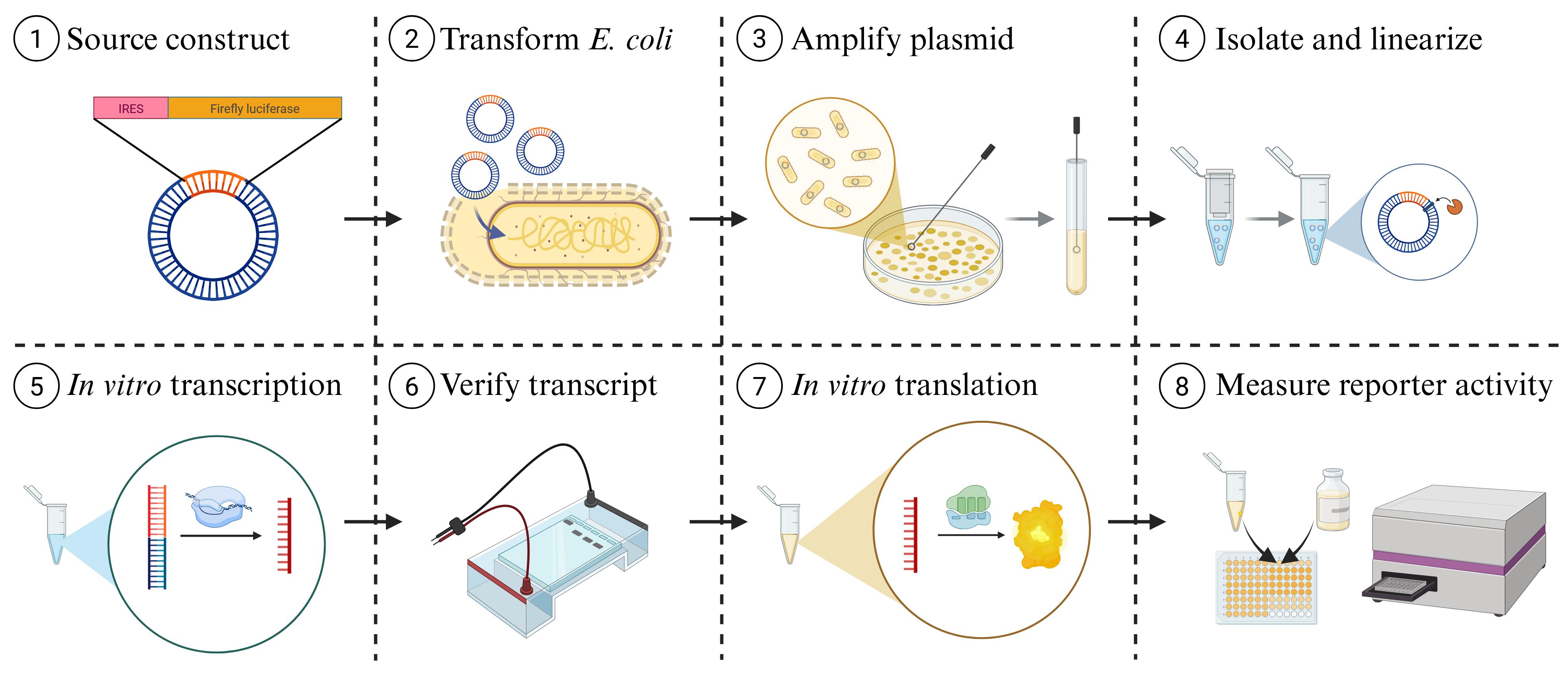
Pipeline for the production and evaluation of internal ribosomal entry sites (IRES)–firefly luciferase constructs using wheat germ extract. (1–4) Preparation: IRES-firefly luciferase constructs are amplified in E. coli and isolated from bacterial cells. Plasmids are linearized to prepare for in vitro transcription. (5, 6) Transcript synthesis and verification: In vitro transcription is followed by electrophoretic validation to confirm integrity and correct molecular weight. (7, 8) Translation and detection: Translation is executed in wheat germ extract and quantified by measuring reporter activity in a luminometer. Created in BioRender: Schlemmer, T. (2026) https://BioRender.com/jakvubo.
Background
Viruses have evolved several strategies to harness the host translational machinery. One such strategy is the development of internal ribosomal entry sites (IRES), typically located in the 5′ untranslated region (5′ UTR) of a viral mRNA. IRES are cis-acting RNA elements with complex secondary structures that enable cap-independent translation initiation [1]. In hosts, cap-dependent translation is more efficient under normal conditions; on the other hand, IRES-mediated translation becomes increasingly relevant during cellular stress [2]. This enables cap-independent translation of some cellular stress response mRNAs containing IRES sequences, such as the transcript encoding maize heat shock protein 101 [3,4]. Beyond natural stress responses, IRES sequences are typically utilized for the translation of circular RNAs, which lack free ends required for canonical, cap-dependent translation [5]. Because IRES activity can vary depending on their viral or cellular origin and the host organism, evaluating different IRES sequences is critical for optimizing translation efficiency in biotechnological applications [6]. The nine IRES elements assessed in this work were selected because they have been previously described and characterized as functional IRES elements in various plant viruses [7–12]. Wheat germ extract (WGE) is a cell-free system for protein synthesis. WGE possesses eukaryotic translation machinery, can translate a variety of eukaryotic transcripts with high yield, and does not require codon optimization [13]. Another advantage is the very high solubility and bioactivity of the expressed proteins, increasing the amount of functional proteins for downstream applications [14]. Computational predictions showed a 90.9% solubility rate of the human proteome in the WGE system, compared to 35.5% in E. coli expression systems [15]. The cell-free environments allow controlling the experimental conditions through additives such as surfactants, detergents, peptides, or amphipols [14]. This, combined with the easily quantifiable reporter outputs, makes WGE an ideal system to compare relative cap-independent translation activity.
Firefly luciferase (FLuc) is routinely used as a reporter in biological assays. The luciferase gene, which originates from the firefly Photinus pyralis, was first cloned and expressed in mammalian cells in the late 80s [16,17]. The enzyme has a molecular weight of 62 kDa and requires D-luciferin, ATP, and oxygen as substrates and a metal cation (such as Mg2+) as a cofactor [18]. Luciferase enzymes have the advantage of illuminating the dynamic changes in reporter transcription, contrary to fluorescent protein reporters, which have longer intracellular protein half-lives [18,19]. In the case of the endpoint measurement described in this protocol, ease of detection and the large linear dynamic range are the key advantages of the FLuc reporter.
Here, we provide a step-by-step protocol for the generation of IRES-containing plasmids, followed by plasmid purification and linearization for in vitro transcription, in vitro translation in wheat germ extract, and quantification of cap-independent translation activity using a firefly luciferase reporter assay. We provide guidance for control experiments at each step for self-control for future users. Altogether, this protocol provides a streamlined and standardized workflow optimized for the relative quantification of different cap-independent translation elements, allowing for a rapid, parallel setup for in vitro translation and highly reproducible reporter activity measurements. Our plasmid set functions as a positive control and a resource for testing combinations of plant-viral IRES elements in plants.
Materials and reagents
Biological materials
1. Luciferase T7 Control DNA (Promega, catalog number: L4821)
2. NEB® Stable Competent E. coli (high efficiency) (New England Biolabs, catalog number: C3040)
3. pUC19mut_circIRES1_FLuc_3HA (Addgene ID: 249684)
4. pUC19mut_circIRES2_FLuc_3HA (Addgene ID: 249685)
5. pUC19mut_circIRES3_FLuc_3HA (Addgene ID: 249686)
6. pUC19mut_circIRES4_FLuc_3HA (Addgene ID: 249687)
7. pUC19mut_circIRES5_FLuc_3HA (Addgene ID: 249688)
8. pUC19mut_circIRES6_FLuc_3HA (Addgene ID: 249689)
9. pUC19mut_circIRES7_FLuc_3HA (Addgene ID: 249690)
10. pUC19mut_circIRES9_FLuc_3HA (Addgene ID: 249691)
11. pUC19mut_circIRES10_FLuc_3HA (Addgene ID: 249692)
Reagents
Note: Basic reagents can be substituted with equivalent options from alternative manufacturers without affecting the protocol’s execution.
1. 1 kb Plus DNA ladder (New England Biolabs, catalog number: N3200)
2. 2-Propanol (Thermo Scientific, CAS number: 67-63-0)
3. 3′-O-Me-m7G(5′)ppp(5′)G RNA Cap Structure Analog (New England Biolabs, catalog number: S1411S)
4. AfeI (New England Biolabs, catalog number: R0652S)
5. Agar-agar, Kobe I (Carl Roth, CAS number: 9002-18-0)
6. Agarose NEEO ultra-quality (Carl Roth, catalog number: 2267.4)
7. Amino acid mixture, complete (Promega, catalog number: L446A)
8. Ammonium peroxydisulfate (Carl Roth, catalog number: 9592.2)
9. Ampicillin (Sigma-Aldrich, CAS number: 69-52-3)
10. Bis-Tris (Carl Roth, catalog number: 9140.3)
11. Boric acid (Carl Roth, catalog number: 6943.6)
12. Bovine serum albumin (BSA) (Carl Roth, catalog number: 3737.1)
13. Bromophenol blue (Carl Roth, catalog number: T116.3)
14. Clarity Western ECL substrate (Bio-Rad, catalog number: 1705061)
15. DNase I (New England Biolabs, catalog number: M0303S)
16. DraIII-HF® (New England Biolabs, catalog number: R3510)
17. EDTA, 0.5 M solution (Thermo Fisher Scientific, catalog number: J15694.AP)
18. EDTA, sodium salt (Carl Roth, catalog number: 8043.2)
19. Ethanol, ≥99.8%, p.a. (Carl Roth, catalog number: 9065.4)
20. Formamide deionized (Carl Roth, catalog number: P040.1)
21. Glacial acetic acid (Merck, catalog number: 33209)
22. Glycerol formal (Carl Roth, catalog number: 0798.3)
23. Glycine (Merck, catalog number: 33226)
24. HA Tag Recombinant monoclonal antibody (Proteintech, catalog number: 81290-1-RR)
25. HiScribe® T7 Quick High Yield RNA Synthesis kit (New England Biolabs, catalog number: E2050S)
26. Lithium chloride (Carl Roth, CAS number: 7447-41-8)
27. Methanol (Thermo Fisher Scientific, CAS number: 67-56-1)
28. Monarch® Plasmid Miniprep kit (New England Biolabs, catalog number: T1010)
29. Nuclease-free water, prepared using a Milli-Q® Advantage A10 with a Biopak® Endfilter (Merck Millipore, models: Z00Q0V0T0 and CDUFBI001)
30. ONE-GloTM luciferase assay system (Promega, catalog number: E6110)
31. Peroxidase IgG fraction monoclonal mouse anti-rabbit IgG, light chain specific (Jackson Immuno Research, catalog number: 211-032-171)
32. PIPES (Carl Roth, catalog number: 9156.3)
33. Ponceau S (Carl Roth, catalog number: 5938.1)
34. Potassium acetate (Merck, CAS number: 127-08-2)
35. Powdered milk (Carl Roth, catalog number: T145.3)
36. Precision Plus ProteinTM Dual Xtra prestained protein standards (Bio-Rad, catalog number: 1610377)
37. QubitTM RNA Broad Range Assay kit (Thermo Fisher Scientific, catalog number: Q10210)
38. rCutsmartTM buffer (New England Biolabs, catalog number: B6004S)
39. RiboRuler high-range RNA ladder (Thermo Fisher Scientific, catalog number: SM1821)
40. RiboRuler low-range RNA ladder (Thermo Fisher Scientific, catalog number: SM1831)
41. RNA broad-range assay mixture (Thermo Fisher Scientific, catalog number: Q10210)
42. RNase inhibitor, murine (New England Biolabs, catalog number: M0314)
43. ROTI® GelStain (Carl Roth, catalog number: 3865.1)
44. ROTIPHORESE® Gel 40 (37.5:1) (Carl Roth, catalog number: T802.1)
45. SDS ultra-pure (Carl Roth, catalog number: 2326.2)
46. Sodium acetate (Carl Roth, CAS number: 127-09-3)
47. Sodium chloride (Carl Roth, catalog number: 0601.3)
48. TEMED (Carl Roth, catalog number: 2367.3)
49. Tris (Carl Roth, catalog number: 4855.2)
50. Tris hydrochloride (Carl Roth, catalog number 9090.4)
51. Tryptone (Carl Roth, catalog number: 8952.2)
52. Tween® 20 (Sigma-Aldrich, catalog number: P1379-100ML)
53. Wheat germ extract (Promega, catalog number: L418A)
54. Xylene cyanole (Carl Roth, catalog number: A513.1)
55. Yeast extract (Carl Roth, catalog number: 2326.2)
Solutions
1. LB medium (see Recipes)
2. 10× TBE buffer (see Recipes)
3. Tris hydrochloride 1 M stock solution (pH 6.8) (see Recipes)
4. 6× DNA loading dye (see Recipes)
5. Sodium acetate solution (3 M) (pH 5.2) (see Recipes)
6. Lithium chloride solution (8 M) (see Recipes)
7. 70% ethanol (see Recipes)
8. 10× BPTE buffer (see Recipes)
9. 2× RNA loading dye (see Recipes)
10. Tris hydrochloride 500 mM stock solution (pH 6.8) (see Recipes)
11. Tris hydrochloride 1.5 M stock solution (pH 8.8) (see Recipes)
12. 10% SDS stock solution (see Recipes)
13. 2× SDS-PAGE sample loading buffer (see Recipes)
14. 10% Ammonium peroxydisulfate stock solution (see Recipes)
15. Transfer buffer (semi-dry) (see Recipes)
16. Ponceau S staining solution (see Recipes)
17. 10× TBS buffer (see Recipes)
18. TBS-T buffer (see Recipes)
19. Blocking buffer (see Recipes)
Recipes
1. LB medium
| Reagent | Final concentration | Quantity or volume |
|---|---|---|
| Yeast extract | 10 g/L | 50 g |
| Tryptone | 5 g/L | 25 g |
| Sodium chloride | 10 g/L | 50 g |
| Nuclease-free water | n/a | Fill to 5,000 mL |
| Total | n/a | 5,000 mL |
Aliquot and autoclave immediately.
2. 10× TBE buffer
| Reagent | Final concentration | Quantity or volume |
|---|---|---|
| Tris | 890 mM | 107.82 g |
| Boric acid | 889 mM | 54.97 g |
| EDTA, sodium salt | 25 mM | 9.31 g |
| Nuclease-free water | n/a | Fill to 1,000 mL |
| Total | n/a | 1,000 mL |
3. Tris hydrochloride 1 M stock solution (pH 6.8)
| Reagent | Final concentration | Quantity or volume |
|---|---|---|
| Tris hydrochloride | 1 M | 157.6 g |
| Nuclease-free water | n/a | Fill to 1,000 mL |
| Total | n/a | 1,000 mL |
Adjust pH to 6.8 by titrating with NaOH.
4. 6× DNA loading dye
| Reagent | Final concentration | Quantity or volume |
|---|---|---|
| Tris hydrochloride 1 M stock solution | 10 mM | 10 mL |
| Glycerol formal | 60% (v/v) | 6 mL |
| Bromophenol blue | 0.03% (w/v) | 3 mg |
| Xylene cyanole | 0.03% (w/v) | 3 mg |
| Nuclease-free water | n/a | Fill to 10 mL |
| Total | n/a | 10 mL |
5. Sodium acetate solution (3 M) (pH 5.2)
| Reagent | Final concentration | Quantity or volume |
|---|---|---|
| Sodium acetate | 3 M | 24.6 g |
| Nuclease-free water | n/a | Fill to 100 mL |
| Total | n/a | 100 mL |
Adjust pH to 5.2 by titrating with glacial acetic acid.
6. Lithium chloride solution (8 M)
| Reagent | Final concentration | Quantity or volume |
|---|---|---|
| Lithium chloride | 8 M | 33.92 g |
| Nuclease-free water | n/a | 100 mL |
| Total | n/a | 100 mL |
7. 70% Ethanol
| Reagent | Final concentration | Quantity or volume |
|---|---|---|
| Ethanol, ≥99.8%, p.a. | 70% (v/v) | 70 mL |
| Nuclease-free water | 30% (v/v) | 30 mL |
| Total | n/a | 100 mL |
Store at -20 °C.
8. 10× BPTE buffer
| Reagent | Final concentration | Quantity or volume |
|---|---|---|
| PIPES | 3 g/L | 30 g |
| Bis-Tris | 6 g/L | 60 g |
| EDTA, 0.5 M solution | 10 mM | 200 mL |
| Nuclease-free water | n/a | Fill to 1,000 mL |
| Total | n/a | 1,000 mL |
9. 2× RNA loading dye
| Reagent | Final concentration | Quantity or volume |
|---|---|---|
| Formamide, deionized | 70% (v/v) | 7 mL |
| 10× BPTE buffer | 10% (v/v) | 1 mL |
| Bromophenol blue | 0.025% (w/v) | 2.5 mg |
| Xylene cyanole | 0.025% (w/v) | 2.5 mg |
| Nuclease-free water | n/a | Fill to 10 mL |
| Total | n/a | 10 mL |
10. Tris hydrochloride 500 mM stock solution (pH 6.8)
| Reagent | Final concentration | Quantity or volume |
|---|---|---|
| Tris hydrochloride | 500 mM | 78.8 g |
| Nuclease-free water | n/a | Fill to 1,000 mL |
| Total | n/a | 1,000 mL |
Adjust pH to 6.8 by titrating with NaOH.
11. Tris hydrochloride 1.5 M stock solution (pH 8.8)
| Reagent | Final concentration | Quantity or volume |
|---|---|---|
| Tris hydrochloride | 1.5 M | 236.4 g |
| Nuclease-free water | n/a | Fill to 1,000 mL |
| Total | n/a | 1,000 mL |
Adjust pH to 8.8 by titrating with NaOH.
12. 10% SDS stock solution
| Reagent | Final concentration | Quantity or volume |
|---|---|---|
| SDS ultra-pure | 10% (w/v) | 100 g |
| Nuclease-free water | n/a | Fill to 1,000 mL |
| Total | n/a | 1,000 mL |
13. 2× SDS-PAGE sample loading buffer
| Reagent | Final concentration | Quantity or volume |
|---|---|---|
| Tris hydrochloride 1 M stock solution | 100 mM | 100 mL |
| Glycerol formal | 20% (v/v) | 2 mL |
| Bromophenol blue | 0.03% (w/v) | 3 mg |
| 10% SDS stock solution | 2% (v/v) | 2 mL |
| Nuclease-free water | n/a | Fill to 10 mL |
| Total | n/a | 10 mL |
14. 10% ammonium peroxydisulfate stock solution
| Reagent | Final concentration | Quantity or volume |
|---|---|---|
| Ammonium peroxydisulfate | 10% (w/v) | 100 g |
| Nuclease-free water | n/a | Fill to 1,000 mL |
| Total | n/a | 1,000 mL |
15. Transfer buffer (semi-dry)
| Reagent | Final concentration | Quantity or volume |
|---|---|---|
| Tris | 48 mM | 5.8 g |
| Glycine | 39 mM | 2.9 g |
| 10% SDS stock solution | 0.04% | 4 mL |
| Nuclease-free water | n/a | Fill to 800 mL, adjust pH to 9.2 by titrating with NaOH |
| Methanol | 20% (v/v) | 200 mL |
| Total | n/a | 1000 mL |
16. Ponceau S staining solution
| Reagent | Final concentration | Quantity or volume |
|---|---|---|
| Ponceau S | 0.5% (w/v) | 0.5 g |
| Glacial acetic acid | 5% (v/v) | 5 mL |
| Nuclease-free water | n/a | Fill to 100 mL |
| Total | n/a | 100 mL |
17. 10× TBS buffer
| Reagent | Final concentration | Quantity or volume |
|---|---|---|
| Sodium chloride | 1.5 M | 87.7 g |
| Tris hydrochloride | 100 mM | 15.8 g |
| Nuclease-free water | n/a | Fill to 1,000 mL |
| Total | n/a | 1,000 mL |
Adjust pH to 7.5 by titrating with HCl.
18. TBS-T buffer
| Reagent | Final concentration | Quantity or volume |
|---|---|---|
| 10× TBS buffer | 1× | 100 mL |
| Nuclease-free water | n/a | Fill to 999.5 mL |
| Tween® 20 | n/a | 500 μL |
| Total | n/a | 1,000 mL |
19. Blocking buffer
| Reagent | Final concentration | Quantity or volume |
|---|---|---|
| Powdered milk | 5% (w/v) | 25 g |
| BSA | 2.5% (w/v) | 12.5 g |
| TBS-T buffer | n/a | Fill to 500 mL |
| Total | n/a | 500 mL |
Laboratory supplies
1. AmershamTM ProtranTM 0.45 μm NC nitrocellulose western blotting membrane (Cytiva, catalog number: 10600007)
2. NuncTM MicroWellTM 96-wells, NuclonTM Delta surface, white, flat bottom (Thermo Fisher Scientific, catalog number: 136101)
3. QubitTM Flex assay tube strip (Thermo Fisher Scientific, catalog number: Q33252)
4. Whatman paper (GE Healthcare, catalog number: 3030-917)
Equipment
Note: Standard laboratory hardware can be substituted with equivalent models from alternative manufacturers without affecting the protocol’s execution.
1. ChemiDoc Imaging System (Bio-Rad, catalog number: 12003153)
2. Duomax 1030 gyratory shaker (Carl Roth, catalog number: H836.1)
3. Eppendorf 5417R Refrigerated Centrifuge (Eppendorf, catalog number: 5429000133)
4. Eppendorf ThermoMixer® (Eppendorf, catalog number: 5382000015)
5. Innova® 44R Shaker (New Brunswick, catalog number: M1282-0006)
6. Mini-PROTEAN Tetra Vertical Electrophoresis Cell (Bio-Rad, catalog number: 1658006FC)
7. NanoDropTM OneC (Thermo Fisher Scientific, catalog number: 13400519)
8. PowerPacTM Universal Power Supply (Bio-Rad, catalog number: 1645070)
9. QubitTM Flex Fluorometer (Thermo Fisher Scientific, catalog number: Q33327)
10. SparkTM Multimode Microplate Reader (Tecan, catalog number: 735-0399)
11. Sub-Cell GT Horizontal Electrophoresis System (Bio-Rad, catalog number: 1704401)
12. Trans-Blot Turbo Transfer System (Bio-Rad, catalog number: 1704150)
13. Vortex-Genie® 2 mixer (Scientific Industries, catalog number: Z258423)
Software and datasets
1. GraphPad Prism (Graphpad Software, version 8.0.1)
2. SparkControl (Tecan, version 2.1)
Procedure
登录/注册后免费查看全文
文章信息
稿件历史记录
提交日期: Apr 23, 2026
接收日期: Jul 2, 2026
在线发布日期: Jul 27, 2026
出版日期: Aug 20, 2026
版权信息
© 2026 The Author(s); This is an open access article under the CC BY-NC license (https://creativecommons.org/licenses/by-nc/4.0/).
如何引用
Cortot, M., Stehlik, T., Koch, A. and Schlemmer, T. (2026). A Luciferase-Based Assay for Assessing Cap-Independent Translation in Wheat Germ Extract. Bio-protocol 16(16): e5791. DOI: 10.21769/BioProtoc.5791.

 Download Citation in RIS Format
分类
植物科学 > 植物生物化学 > 蛋白质 > 活性
分子生物学 > RNA > mRNA 转译
生物化学 > RNA > mRNA翻译
您对这篇实验方案有问题吗?
在此处发布您的问题,我们将邀请本文作者来回答。同时,我们会将您的问题发布到Bio-protocol Exchange,以便寻求社区成员的帮助。
 发布问题
发布问题


