


A Step-by-Step Protocol for Efficient Global Accuracy Estimation of Protein Complex Structural Models with MViewEMA
利用MViewEMA高效评估蛋白质复合物结构模型整体准确性的分步操作方法

发布: 2026年08月20日第16卷第16期 DOI: 10.21769/BioProtoc.5785 浏览次数: 466
评审: Prashanth N SuravajhalaGowri V SubramanianRenuka Suravajhala
 PDF
PDF  Q&A
Q&A
参见作者原研究论文
The authors used this protocol in:

Feb 2026




Abstract
Estimation of model accuracy (EMA) is a critical step in protein structure prediction, enabling the ranking and selection of models in the absence of experimental structures. EMA methods aim to function independently of modeling approaches, ensuring broad applicability across diverse prediction workflows. Recent state-of-the-art EMA methods often improve estimation accuracy by incorporating consensus information from model pools, multiple sequence alignments (MSAs), structural templates, or protein language model representations. However, these strategies typically incur substantial computational cost or rely on information derived from the modeling process itself, which may introduce bias and compromise the independence of the assessment. This protocol describes the use of MViewEMA for global accuracy estimation of protein complex models from a single input structure. MViewEMA extracts residue–residue interaction features from complementary micro-, meso-, and macro-environmental perspectives and integrates multi-scale structural representations through a multi-view representation learning framework to predict global confidence scores. The protocol provides detailed procedures for input structure preparation, feature extraction, model inference, and global confidence score output, together with a tutorial for using the MViewEMA web server. The protocol provides a workflow based solely on structural information from the input model, achieving a balance between computational efficiency and estimation accuracy. It enables large-scale evaluation and selection of predicted models for protein structure prediction and downstream structural analysis applications.
Key features
• Provides an efficient and accurate single-model EMA framework for protein complex accuracy estimation.
• Integrates residue–residue interaction features across micro-, meso-, and macro-environmental views through multi-view representation learning.
• Performs independent protein structural model assessment without requiring MSAs, templates, protein language models, or consensus information from model ensembles.
• Supports large-scale protein complex model ranking and selection for downstream structural analysis applications.
Keywords: MViewEMA (MViewEMA) Estimation of model accuracy (模型准确性评估)
Deep learning (深度学习)
Multi-view representation learning (多视图表征学习)
Single-model method (单模型方法)
Estimation of model accuracy (模型准确性评估)
Deep learning (深度学习)
Multi-view representation learning (多视图表征学习)
Single-model method (单模型方法)
Graphical overview
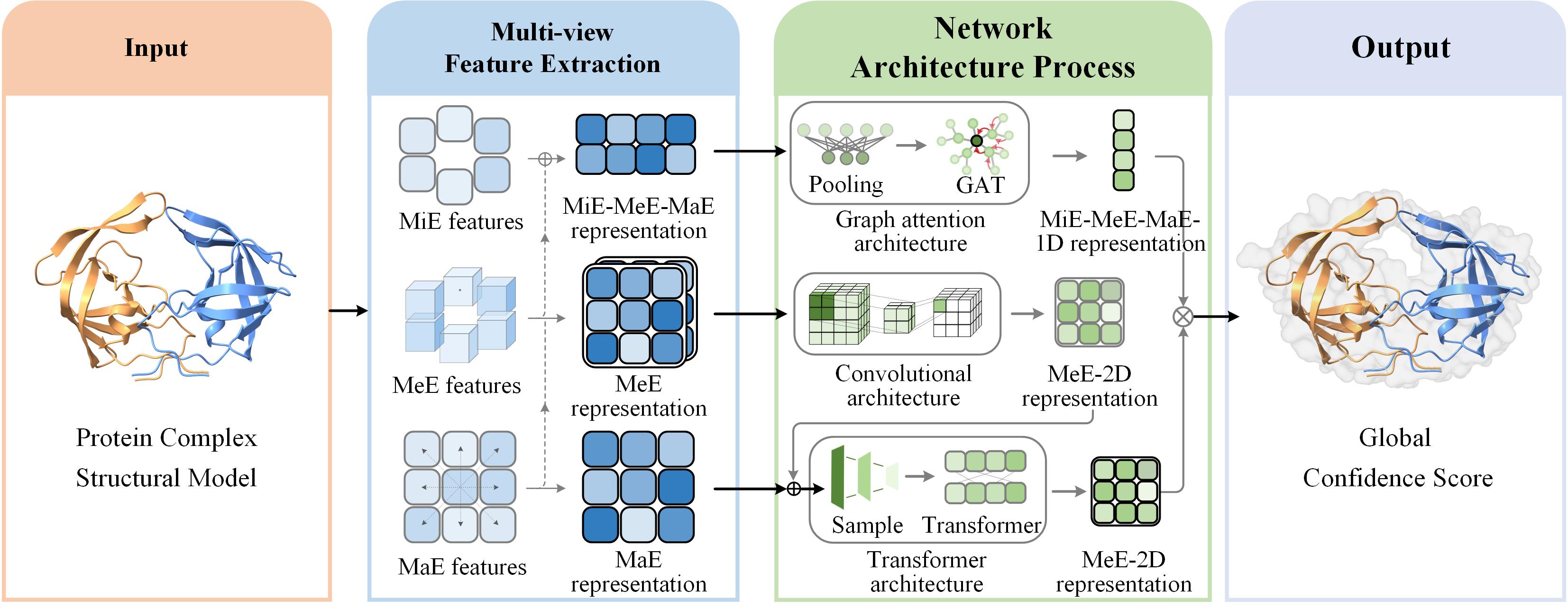
Schematic illustration of the MViewEMA workflow for protein complex structure model accuracy estimation. An input protein complex model is first subjected to multi-view feature extraction, including micro-environment (MiE), meso-environment (MeE), and macro-environment (MaE) representations. Each view is processed by a dedicated neural network module employing graph attention, convolutional, and Transformer architectures. The resulting multi-view representations are integrated to yield a final global confidence score.
Background
The rapid development of protein structure prediction methods, particularly recent advances in protein complex prediction, has generated vast numbers of computationally predicted protein structural models [1–4]. This rapid expansion has created a key challenge: reliable identification of high-quality structures from large candidate model pools [5]. Protein structure model accuracy estimation (EMA), also referred to as model quality assessment (MQA), aims to evaluate the reliability of predicted structures in the absence of experimentally determined reference structures, which is critical for downstream model ranking and selection in structural biology applications [6].
Existing EMA methods can be broadly categorized into three classes: consensus-based methods, quasi-single-model methods, and single-model methods [7–9]. Consensus-based approaches estimate model accuracy by comparing a set of candidate structures and exploiting structural agreement among models [10–13]. These methods often achieve high accuracy when a sufficiently large and diverse model pool is available, but their performance is influenced by the quality of the input models [9]. Quasi-single-model methods use externally derived structural references to augment single-model features, improving robustness through additional structural context [14–16], but their effectiveness may be influenced by the quality of external references and incur additional computational cost [9]. In contrast, single-model methods directly estimate model accuracy from an individual structure [17–23], but a substantial number of these methods rely on computationally expensive feature generation procedures, such as multiple sequence alignment (MSA), template search, or protein language model-based feature extraction.
This protocol describes a step-by-step workflow for applying MViewEMA [20] to global accuracy estimation of protein complex structural models. MViewEMA is a single-model framework based on multi-view representation learning, which enables global accuracy estimation from a single input protein complex structure [20]. Specifically, MViewEMA characterizes residue–residue interaction features from three complementary perspectives, namely micro-environmental (MiE), meso-environmental (MeE), and macro-environmental (MaE) views. These views are processed using graph attention, convolutional, and Transformer architectures and integrated via cross-view integration to generate a global confidence score [20].
This protocol operates directly on a single protein complex structure and is independent of structure prediction pipelines, enabling evaluation across models generated by different methods. By avoiding reliance on model ensembles, external structural references, and computationally intensive feature generation, this protocol facilitates efficient large-scale evaluation [20], being applicable to downstream structural biology tasks. In protein structure prediction, it can support confidence scoring and quality annotation of models, facilitating functional annotation and protein–protein interaction analysis. In high-throughput settings, it enables rapid screening of large-scale structural model collections, supporting automated prioritization workflows. The implementation is specifically designed for global quality assessment of protein complex structural models. Its applicability is currently limited to protein-only complex structural models and does not extend to protein–ligand or protein–nucleic acid complexes. Furthermore, the protocol focuses on global model accuracy estimation rather than interface-level or residue-level local quality assessment.
Equipment
1. Local execution workflow
a. Linux system (Ubuntu 18.04 or later)
b. x86-64 architecture CPU (≥8 cores; recommended for inference on large protein complexes with >2,000 residues)
c. NVIDIA GPU with CUDA support (≥16 GB VRAM; recommended for accelerating inference on protein complexes with ≤2,000 residues)
d. System memory (RAM) (≥16 GB)
Note: GPU-based inference is suitable for small-to-medium-sized protein complexes with ≤2,000 residues. For complexes with >2,000 residues, CPU-based inference is recommended to avoid GPU memory overflow.
2. Web server workflow: Desktop or laptop computer with stable internet access and a modern operating system (Windows, macOS, or Linux)
Software and datasets
1. Web browser (Google Chrome, Microsoft Edge, or Mozilla Firefox)
2. MViewEMA, http://zhanglab-bioinf.com/MViewEMA/ (accessed July 6, 2026); MViewEMA source code is open-source and available at https://github.com/iobio-zjut/MViewEMA (accessed July 6, 2026)
3. Python (version ≥ 3.8)
4. PyTorch (version 1.11.0)
5. PyTorch Geometric (PyG) (version 2.0.4; https://pytorch-geometric.readthedocs.io, accessed July 6, 2026; PyTorch-based geometric deep learning library)
6. PyRosetta (version ≥ 2021.38+release.4d5a969; https://www.pyrosetta.org, accessed July 6, 2026; Rosetta license required for academic and commercial use; [24])
7. (Optional) Singularity container environment for dependency-free execution; available at http://zhanglab-bioinf.com/DeepUMQA-X/static/env.sif (7.31 GB; accessed July 6, 2026). This container is a shared software environment maintained by our laboratory and includes all dependencies required for MViewEMA.
Procedure
登录/注册后免费查看全文
文章信息
稿件历史记录
提交日期: Jun 3, 2026
接收日期: Jul 14, 2026
在线发布日期: Jul 21, 2026
出版日期: Aug 20, 2026
版权信息
© 2026 The Author(s); This is an open access article under the CC BY-NC license (https://creativecommons.org/licenses/by-nc/4.0/).
如何引用
Xie, L., Ye, E., Liu, D. and Zhang, G. (2026). A Step-by-Step Protocol for Efficient Global Accuracy Estimation of Protein Complex Structural Models with MViewEMA. Bio-protocol 16(16): e5785. DOI: 10.21769/BioProtoc.5785.

 Download Citation in RIS Format
分类
生物信息学与计算生物学
生物化学 > 蛋白质 > 结构
生物物理学 > 大分子模拟
您对这篇实验方案有问题吗?
在此处发布您的问题,我们将邀请本文作者来回答。同时,我们会将您的问题发布到Bio-protocol Exchange,以便寻求社区成员的帮助。
 发布问题
发布问题


