


Measurement of Net NH4+ Fluxes Using the Non-invasive Micro-Test Technology (NMT) System in Rice
利用非损伤微测技术(NMT)测定水稻净NH₄⁺流速


(*contributed equally to this work) 发布: 2026年08月05日第16卷第15期 DOI: 10.21769/BioProtoc.5773 浏览次数: 175
评审: Kangquan YinAnonymous reviewer(s)
 PDF
PDF  Q&A
Q&A
参见作者原研究论文
The authors used this protocol in:
Sep 2025
Advertisement





Abstract
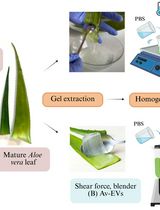
Ammonium (NH4+) is the primary inorganic nitrogen source for rice (Oryza sativa L.). Substantial progress has been made in characterizing the functions of ammonium transporters (AMTs) in roots; however, the regulatory dynamics governing subcellular ammonium compartmentation after its entry into cells, particularly its vacuolar sequestration and efflux back to the external environment, remain poorly understood. This knowledge gap stems mainly from two factors: the difficulty of applying conventional detection methods at the organellar scale and interference caused by nonspecific ion adsorption to the cell wall of intact roots. To address these challenges, we present a detailed and reproducible protocol for real-time measurement of net NH4+ fluxes in rice roots, root protoplasts, and isolated vacuoles using non-invasive micro-test technology (NMT). The protocol covers the preparation of protoplasts and vacuoles from rice roots, the configuration and calibration of the NMT system, and the step-by-step measurement of net NH4+ fluxes at three distinct biological levels (intact roots, protoplasts, and vacuoles). By employing a unified sample preparation and measurement strategy, this protocol enables quantification of net uptake fluxes across the plasma membrane, characterization of net efflux dynamics under specific conditions, and indirect estimation of vacuolar sequestration capacity using the isolated vacuole system. Overall, this protocol provides a flexible and robust framework for studying NH4+ homeostasis in plants and is readily adaptable to different crop species, treatment conditions, and experimental objectives. Owing to its modular design and compatibility with standard NMT equipment, it can be readily adopted by laboratories seeking to investigate nitrogen transport mechanisms in plants.
Key features
• Allows for testing of NH4+ fluxes in roots, protoplasts, and vacuoles.
• Applicable to plants grown under different culture systems, including Arabidopsis thaliana grown in dishes and rice grown in hydroponic systems.
• Supports both long-term and transient stress treatments.
• Real-time monitoring.
Keywords: NH4+ fluxes (NH₄⁺流速) NMT (NMT)
Root (根)
Protoplast (原生质体)
Vacuole (液泡)
NMT (NMT)
Root (根)
Protoplast (原生质体)
Vacuole (液泡)
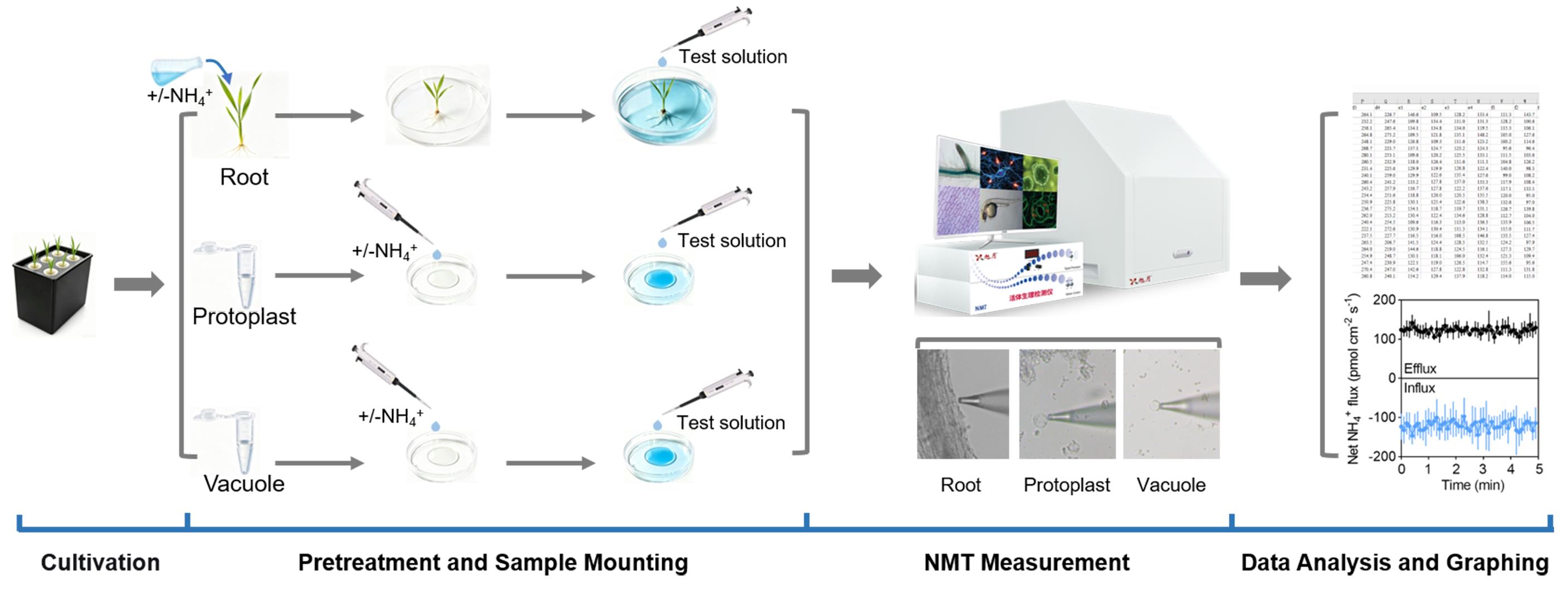
Graphical overview
Background
Ammonium (NH4+) is the primary inorganic nitrogen source for rice (Oryza sativa L.) [1]. The root system acts as the main gateway for NH4+ entry, where plasma membrane–localized ammonium transporters (AMTs) facilitate its efficient uptake into root cells [2,3]. Much of what we know about net NH4+ uptake at the whole-root level and AMT function comes from physiological and molecular genetic studies. By contrast, the regulatory mechanisms that control subcellular NH4+ compartmentation, especially vacuolar storage and efflux back out of the cell, are still largely obscure [4].
The vacuole is the largest organelle in mature rice root cells, often occupying >80% of the total cell volume [5]. Vacuolar NH4+ storage not only buffers cytoplasmic free NH4+ to prevent toxicity but also contributes critically to nitrogen storage, remobilization, and stress adaptation [6,7]. However, owing to the limitations of conventional methods at the organellar scale, quantifying the dynamic partitioning of NH4+ between the cytoplasm and the vacuole has posed a persistent technical challenge. Consequently, direct evidence is still lacking for how vacuolar compartmentation coordinates with cytoplasmic NH4+ detoxification and plasma membrane efflux.
Futile NH4+ efflux is a key electrophysiological mechanism underlying NH4+ toxicity in plants [8–10]. Existing evidence indicates that the magnitude of NH4+ efflux is negatively correlated with NH4+ tolerance, uptake efficiency, and nitrogen use efficiency in rice, suggesting that restricting efflux may be an effective strategy to concurrently improve these traits [10–12]. Thus, elucidating the regulatory mechanisms of NH4+ efflux is of major theoretical importance, which depends heavily on accurate quantification of transmembrane net NH4+ fluxes. Dissecting how regulatory proteins influence net efflux phenotypes requires a technique capable of real-time net flux measurement. A major obstacle, however, is the nonspecific adsorption of ions by the cell wall of intact roots, which severely compromises measurement accuracy. Therefore, in addition to measuring net NH4+ fluxes in intact roots, a system that eliminates cell wall interference is needed, specifically the direct measurement of net NH4+ fluxes around protoplasts. Of note, non-invasive micro-test technology (NMT) measures net ion fluxes, which primarily reflect net efflux dynamics [13]. For precise resolution of unidirectional fluxes, complementary approaches such as isotopic tracing or patch-clamp electrophysiology are required [14].
To address these technical bottlenecks, we developed an integrated analytical pipeline combining rice roots, root protoplasts, and isolated vacuoles. Protoplasts, plant cells that retain intact plasma membrane and tonoplast after cell wall removal, eliminate the physical barrier of the cell wall to solute exchange and enable precise control over the ionic composition and osmotic pressure of the external solution. By comparing NH4+ transport characteristics across the three levels (intact roots, protoplasts, isolated vacuoles), we can quantify net uptake across the plasma membrane, assess net efflux dynamics under defined conditions (e.g., transient high external NH4+), and indirectly evaluate vacuolar compartmentation capacity using the isolated vacuole system. Here, we provide detailed procedures for preparing protoplasts and vacuoles from rice roots, along with a method for real-time net NH4+ flux measurement based on NMT. By preserving the integrity and activity of each membrane system, this protocol allows independent dissection of net NH4+ transport events at distinct cellular levels, offering a robust methodological platform for elucidating the NH4+ homeostasis network in rice and laying a technical foundation for improving nitrogen use efficiency and NH4+ tolerance in crops.
Materials and reagents
Biological materials
1. Rice seedlings
Reagents
1. Yoshida rice nutrient salts (Coolaber, catalog number: NSP1040)
2. Tris(hydroxymethyl)aminomethane (Tris) (Sinopharm Chemical Reagent, catalog number: 69097-20-7)
3. Hydrochloric acid (HCl) (Sinopharm Chemical Reagent, catalog number: 7647-01-0)
4. 2-(N-morpholino)ethanesulfonic acid (MES) (BioFroxx, catalog number: 145224-94-8)
5. 4-(2-hydroxyethyl)-1-piperazineethanesulfonic acid (HEPES) (Yuanye, catalog number: 7365-45-9)
6. Sodium hydroxide (NaOH) (Sinopharm Chemical Reagent, catalog number: 1310-73-2)
7. Ammonium chloride (NH4Cl) (Sinopharm Chemical Reagent, catalog number: 12125-02-9)
8. Ammonium nitrate (NH4NO3) (Sinopharm Chemical Reagent, catalog number: 6484-52-2)
9. Calcium chloride (CaCl2) (Sinopharm Chemical Reagent, catalog number: 10043-52-4)
10. Mannitol (Sinopharm Chemical Reagent, catalog number: 69-65-8)
11. Dipotassium EDTA (K2EDTA·2H2O) (Sinopharm Chemical Reagent, catalog number: 2001-94-7)
12. Protoplast Isolation Kit [Real-Times (Beijing) Biotechnology Co., Ltd., catalog number: RTU4082]
13. Hydrogen peroxide 30% (H2O2) (Sinopharm Chemical Reagent, catalog number: 7722-84-1)
Solutions
1. Rice culture solution (see Recipes)
2. Protoplast storage solution (see Recipes)
3. Vacuolar storage solution (see Recipes)
4. Test solution for NH4+ influx (see Recipes)
5. Calibration solution for NH4+ influx (see Recipes)
6. Test solution for NH4+ efflux (see Recipes)
7. Calibration solution for NH4+ efflux (see Recipes)
8. NH4+-free treatment solution (see Recipes)
9. High NH4+ treatment solution (see Recipes)
10. Tris solution (see Recipes)
11. HCl solution (see Recipes)
12. NaOH solution (see Recipes)
13. Hypotonic lysis buffer (see Recipes)
Recipes
1. Rice culture solution
| Reagent | Final concentration | Quantity or volume |
|---|---|---|
| Yoshida rice nutrient salts | n/a | 0.535 g |
| Double-distilled water (ddH2O) | n/a | To 1 L |
| Total | n/a | 1 L |
Adjust pH to 5.5 using NaOH and HCl.
2. Protoplast storage solution
| Reagent | Final concentration | Quantity or volume |
|---|---|---|
| Mannitol | 500 mM | 9.1085 g |
| MES | 2 mM | 0.4265 g |
| ddH2O | n/a | To 100 mL |
| Total | n/a | 100 mL |
Adjust pH to 6.0 using Tris and HCl.
3. Vacuolar storage solution
| Reagent | Final concentration | Quantity or volume |
|---|---|---|
| Mannitol | 500 mM | 9.1085 g |
| HEPES | 10 mM | 0.2383 g |
| ddH2O | n/a | To 100 mL |
| Total | n/a | 100 mL |
Adjust pH to 7.0 using Tris and HCl.
4. Test solution for NH4+ influx
a. For roots
| Reagent | Final concentration | Quantity or volume |
|---|---|---|
| NH4NO3 | 1.5 mM | 1.5 mL of 100 mM stock |
| CaCl2 | 0.1 mM | 0.1 mL of 100 mM stock |
| MES | 0.2 mM | 0.2 mL of 100 mM stock |
| ddH2O | n/a | To 100 mL |
| Total | n/a | 100 mL |
Adjust pH to 5.8 using Tris and HCl. The solution should be prepared immediately before use.
b. For protoplasts
| Reagent | Final concentration | Quantity or volume |
|---|---|---|
| NH4Cl | 1.5 mM | 1.5 mL of 100 mM stock |
| CaCl2 | 0.1 mM | 0.1 mL of 100 mM stock |
| Mannitol | 500 mM | 9.1085 g |
| MES | 0.2 mM | 0.2 mL of 100 mM stock |
| ddH2O | n/a | To 100 mL |
| Total | n/a | 100 mL |
Adjust pH to 6.0 using Tris and HCl. The solution should be prepared immediately before use.
c. For vacuoles
| Reagent | Final concentration | Quantity or volume |
|---|---|---|
| NH4Cl | 4.0 mM | 4 mL of 100 mM stock |
| Mannitol | 500 mM | 9.1085 g |
| HEPES | 0.2 mM | 0.2 mL of 100 mM stock |
| ddH2O | n/a | To 100 mL |
| Total | n/a | 100 mL |
Adjust pH to 7.0 using Tris and HCl. The solution should be prepared immediately before use.
5. Calibration solution for NH4+ influx
a. For roots
| Reagent | Final concentration | Quantity or volume |
|---|---|---|
| NH4NO3 | 0.15 mM | 0.15 mL of 100 mM stock |
| CaCl2 | 0.1 mM | 0.1 mL of 100 mM stock |
| MES | 0.2 mM | 0.2 mL of 100 mM stock |
| ddH2O | n/a | To 100 mL |
| Total | n/a | 100 mL |
Adjust pH to 5.8 using Tris and HCl. The solution should be prepared immediately before use.
b. For protoplasts
| Reagent | Final concentration | Quantity or volume |
|---|---|---|
| NH4NO3 | 0.15 mM | 0.15 mL of 100 mM stock |
| CaCl2 | 0.1 mM | 0.1 mL of 100 mM stock |
| Mannitol | 500 mM | 9.1085 g |
| MES | 0.2 mM | 0.2 mL of 100 mM stock |
| ddH2O | n/a | To 100 mL |
| Total | n/a | 100 mL |
Adjust pH to 5.8 using Tris and HCl. The solution should be prepared immediately before use.
c. For vacuoles
| Reagent | Final concentration | Quantity or volume |
|---|---|---|
| NH4Cl | 0.4 mM | 0.4 mL of 100 mM stock |
| Mannitol | 500 mM | 9.1085 g |
| HEPES | 0.2 mM | 0.2 mL of 100 mM stock |
| ddH2O | n/a | To 100 mL |
| Total | n/a | 100 mL |
Adjust pH to 7.0 using Tris and HCl. The solution should be prepared immediately before use.
6. Test solution for NH4+ efflux
a. For roots
| Reagent | Final concentration | Quantity or volume |
|---|---|---|
| NH4Cl | 0.2 mM | 0.2 mL of 100 mM stock |
| CaCl2 | 0.1 mM | 0.1 mL of 100 mM stock |
| MES | 0.2 mM | 0.2 mL of 100 mM stock |
| ddH2O | n/a | To 100 mL |
| Total | n/a | 100 mL |
Adjust pH to 5.8 using Tris and HCl. The solution should be prepared immediately before use.
b. For protoplasts
| Reagent | Final concentration | Quantity or volume |
|---|---|---|
| NH4Cl | 0.2 mM | 0.2 mL of 100 mM stock |
| CaCl2 | 0.1 mM | 0.1 mL of 100 mM stock |
| Mannitol | 500 mM | 9.1085 g |
| MES | 0.2 mM | 0.2 mL of 100 mM stock |
| ddH2O | n/a | To 100 mL |
| Total | n/a | 100 mL |
Adjust pH to 6.0 using Tris and HCl. The solution should be prepared immediately before use.
c. For vacuoles
| Reagent | Final concentration | Quantity or volume |
|---|---|---|
| NH4Cl | 0.2 mM | 0.2 mL of 100 mM stock |
| Mannitol | 500 mM | 9.1085 g |
| HEPES | 0.2 mM | 0.2 mL of 100 mM stock |
| ddH2O | n/a | To 100 mL |
| Total | n/a | 100 mL |
Adjust pH to 7.0 using Tris and HCl. The solution should be prepared immediately before use.
7. Calibration solution for NH4+ efflux
a. For roots
| Reagent | Final concentration | Quantity or volume |
|---|---|---|
| NH4Cl | 2.0 mM | 2.0 mL of 100 mM stock |
| CaCl2 | 0.1 mM | 0.1 mL of 100 mM stock |
| MES | 0.2 mM | 0.2 mL of 100 mM stock |
| ddH2O | n/a | To 100 mL |
| Total | n/a | 100 mL |
Adjust pH to 5.8 using Tris and HCl. The solution should be prepared immediately before use.
b. For protoplasts
| Reagent | Final concentration | Quantity or volume |
|---|---|---|
| NH4Cl | 2.0 mM | 2.0 mL of 100 mM stock |
| CaCl2 | 0.1 mM | 0.1 mL of 100 mM stock |
| Mannitol | 500 mM | 9.1085 g |
| MES | 0.2 mM | 0.2 mL of 100 mM stock |
| ddH2O | n/a | To 100 mL |
| Total | n/a | 100 mL |
Adjust pH to 6.0 using Tris and HCl. The solution should be prepared immediately before use.
c. For vacuoles
| Reagent | Final concentration | Quantity or volume |
|---|---|---|
| NH4Cl | 2.0 mM | 2.0 mL of 100 mM stock |
| Mannitol | 500 mM | 9.1085 g |
| HEPES | 0.2 mM | 0.2 mL of 100 mM stock |
| ddH2O | n/a | To 100 mL |
| Total | n/a | 100 mL |
Adjust pH to 7.0 using Tris and HCl. The solution should be prepared immediately before use.
8. NH4+-free treatment solution
| Reagent | Final concentration | Quantity or volume |
|---|---|---|
| CaCl2 | 0.1 mM | 0.1 mL of 100 mM stock |
| Mannitol | 500 mM | 9.1085 g |
| MES | 0.2 mM | 0.2 mL of 100 mM stock |
| ddH2O | n/a | To 100 mL |
| Total | n/a | 100 mL |
Adjust pH to 6.0 using Tris and HCl. The solution should be prepared immediately before use.
9. High NH4+ treatment solution
| Reagent | Final concentration | Quantity or volume |
|---|---|---|
| NH4Cl | 10 mM | 10 mL of 100 mM stock |
| CaCl2 | 0.1 mM | 0.1 mL of 100 mM stock |
| Mannitol | 500 mM | 9.1085 g |
| MES | 0.2 mM | 0.2 mL of 100 mM stock |
| ddH2O | n/a | To 100 mL |
| Total | n/a | 100 mL |
10. Tris solution
| Reagent | Final concentration | Quantity or volume |
|---|---|---|
| Tris | 1 M | 12.11 g |
| ddH2O | n/a | To 100 mL |
| Total | n/a | 100 mL |
11. HCl solution
| Reagent | Final concentration | Quantity or volume |
|---|---|---|
| HCl | 1 M | 8.3 mL |
| ddH2O | n/a | To 100 mL |
| Total | n/a | 100 mL |
12. NaOH solution
| Reagent | Final concentration | Quantity or volume |
|---|---|---|
| NaOH | 1 M | 4 g |
| ddH2O | n/a | To 100 mL |
| Total | n/a | 100 mL |
13. Hypotonic lysis buffer
| Reagent | Final concentration | Quantity or volume |
|---|---|---|
| HEPES | 5 mM | 0.119 g |
| Mannitol | 100 mM | 1.822 g |
| K2EDTA·2H2O | 1 mM | 0.0405 g |
| ddH2O | n/a | To 100 mL |
| Total | n/a | 100 mL |
Adjust pH to 7.0 using Tris and KOH. The solution should be prepared immediately before use.
Laboratory supplies
1. Petri dish (Biosharp, catalog number: BS-100-SD)
2. Culture pot (Taobao, Zesheng)
3. 50 mL centrifuge tube (Axygen, catalog number: SCT-50ML-25-S)
4. 1.5 mL centrifuge tube (Axygen, catalog number: MCT-150-C-S)
5. Cell strainer (Loikaw, catalog number: S-016802)
6. Cell culture coverslip (BKMAM, catalog number: 130213002)
7. 10–1,000 μL pipette tips (Kirgen, catalog numbers: KG1011, KG1212, KG1313)
8. Forceps
9. Blade
10. Purified water
11. Ice
12. Resin block (Taobao, catalog number: n/a)
Equipment
1. Non-invasive micro-test system (Xuyue, model number: NMT Physiolyzer®)
2. NH4+ flux microsensor (Xuyue, model number: XY-STZ-NH4-C)
3. Centrifuge (Eppendorf, model number: 5804R)
4. Shaker (SHIPING, model number: DJS-2020)
5. Weighing balance with 0.0001 g accuracy (Metter Toledo, model: XS204)
6. Vacuum pump [YUHUA, model number: SHZ-D(III)]
7. Water bath (JINGHONG, model number: XMTD-8222)
8. pH meter (METTER TOLEDO, model number: 30997001)
Software and datasets
1. imFluxes V3.0 software (Xuyue)
Procedure
登录/注册后免费查看全文
文章信息
稿件历史记录
提交日期: May 27, 2026
接收日期: Jun 29, 2026
在线发布日期: Jul 7, 2026
出版日期: Aug 5, 2026
版权信息
© 2026 The Author(s); This is an open access article under the CC BY license (https://creativecommons.org/licenses/by/4.0/).
如何引用
Di, D., Liu, Y., Ye, B. and Shi, W. (2026). Measurement of Net NH4+ Fluxes Using the Non-invasive Micro-Test Technology (NMT) System in Rice. Bio-protocol 16(15): e5773. DOI: 10.21769/BioProtoc.5773.

 Download Citation in RIS Format
分类
植物科学 > 植物生理学 > 离子分析
植物科学 > 植物生理学 > 营养
植物科学 > 植物细胞生物学 > 细胞器分离
您对这篇实验方案有问题吗?
在此处发布您的问题,我们将邀请本文作者来回答。同时,我们会将您的问题发布到Bio-protocol Exchange,以便寻求社区成员的帮助。
 发布问题
发布问题


