


Coupled Enzyme Assay for Measuring Ornithine Decarboxylase Activity in Cell Lysates Using a Liquid-Stable CO2 Detection Reagent
采用液态稳定型CO₂检测试剂的偶联酶法测定细胞裂解液中鸟氨酸脱羧酶活性

发布: 2026年08月05日第16卷第15期 DOI: 10.21769/BioProtoc.5768 浏览次数: 173
评审: Joyce ChiuKannapiran PonrajNishya Mohamed Raseek
 PDF
PDF  Q&A
Q&A
参见作者原研究论文
The authors used this protocol in:

Oct 2025
Advertisement





Abstract
Ornithine decarboxylase (ODC) is a rate-limiting enzyme in polyamine biosynthesis that plays a critical role in cell proliferation and tumorigenesis. Reliable quantification of ODC activity is essential for mechanistic and therapeutic studies. Traditional assays often rely on radiolabeled substrates or discontinuous endpoint measurements. Here, we describe a non-radioactive, continuous spectrophotometric assay for measuring ODC activity in cell lysates using a commercially available liquid-stable CO2 detection reagent. In this assay, CO2 generated by ODC is captured as bicarbonate and utilized in a coupled enzymatic system containing phosphoenolpyruvate carboxylase (PEPC) and malate dehydrogenase (MDH), leading to oxidation of thio-NADH. The decrease in absorbance at 405 nm due to thio-NADH oxidation is monitored in real time and is proportional to ODC activity. The protocol is performed in a 96-well plate format, requires minimal reagent preparation, and is suitable for medium- to high-throughput applications.
Key features
• Non-radioactive, continuous assay for measuring ODC activity.
• Utilizes a commercially available liquid-stable CO2 detection reagent, requiring minimal preparation and enabling improved reproducibility.
• Real-time monitoring at 405 nm using a standard microplate reader.
• Adaptable to a high-throughput 96-well format.
Keywords: Ornithine decarboxylase (ODC) (鸟氨酸脱羧酶(ODC)) Enzyme assay (酶活性测定)
Phosphoenolpyruvate carboxylase (PEPC) (磷酸烯醇式丙酮酸羧化酶(PEPC))
Malate dehydrogenase (MDH) (苹果酸脱氢酶(MDH))
Thionicotinamide adenine dinucleotide (硫代烟酰胺腺嘌呤二核苷酸)
Reduced form (thio-NADH) (还原型硫代烟酰胺腺嘌呤二核苷酸(thio-NADH))
CO2 detection (CO₂检测)
Polyamine metabolism (多胺代谢)
Enzyme assay (酶活性测定)
Phosphoenolpyruvate carboxylase (PEPC) (磷酸烯醇式丙酮酸羧化酶(PEPC))
Malate dehydrogenase (MDH) (苹果酸脱氢酶(MDH))
Thionicotinamide adenine dinucleotide (硫代烟酰胺腺嘌呤二核苷酸)
Reduced form (thio-NADH) (还原型硫代烟酰胺腺嘌呤二核苷酸(thio-NADH))
CO2 detection (CO₂检测)
Polyamine metabolism (多胺代谢)
Graphical overview
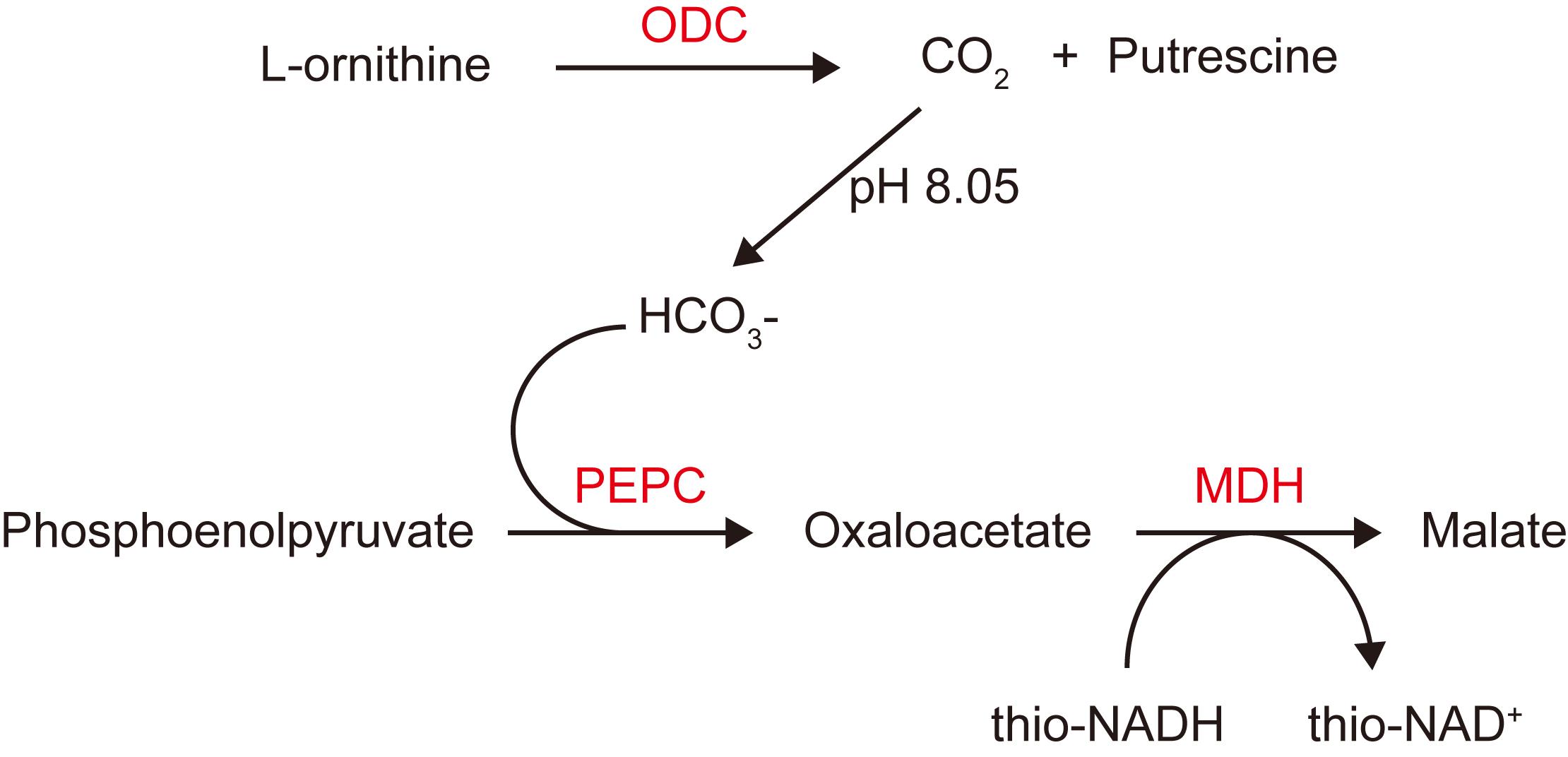
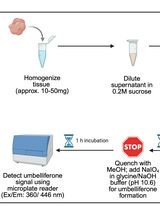
Schematic overview of the coupled enzyme assay for measuring ornithine decarboxylase (ODC) activity. ODC-catalyzed decarboxylation of L-ornithine releases CO2, which is converted to bicarbonate at pH 8.05 and channeled through a phosphoenolpyruvate carboxylase (PEPC)–malate dehydrogenase (MDH) coupled reaction, resulting in stoichiometric oxidation of thio-NADH. The consequent decrease in absorbance at 405 nm provides a continuous, quantitative readout of ODC activity.
Background
Ornithine decarboxylase (ODC) catalyzes the decarboxylation of L-ornithine to generate putrescine and CO2, representing the first and rate-limiting step in polyamine biosynthesis [1]. Elevated ODC activity is associated with increased cellular proliferation and is frequently observed in cancer [2–4]. Beyond oncology, enhanced ODC activity has also been reported in parasitic infections [5], alcohol-associated liver pathologies [6], and immune activation and inflammatory responses [7,8], underscoring the broad relevance of reliable ODC activity quantification across multiple disease contexts and biological systems.
Traditional ODC assays rely on radiolabeled substrates to detect released CO2, which requires specialized handling and limits throughput [9,10]. Coupled enzymatic assays provide a safer and more accessible alternative by linking CO2 production to oxidation of reduced pyridine nucleotides [11,12]. In such systems, CO2 is converted to bicarbonate and utilized by phosphoenolpyruvate carboxylase (PEPC) to generate oxaloacetate, which is subsequently reduced by malate dehydrogenase (MDH), resulting in oxidation of NADH or an analog thereof [11,12].
In this protocol, we employ a commercially available liquid-stable CO2 detection reagent that contains PEPC, MDH, phosphoenolpyruvate, magnesium ions, and thio-NADH, an NADH analog. This simplifies assay setup and improves reproducibility by eliminating the need for manual enzyme preparation. The decrease in absorbance at 405 nm is monitored continuously and provides a direct readout of ODC activity in cell lysates.
Materials and reagents
Biological materials
1. Cell lysates (prepared as described below)
Reagents
1. Liquid-stable CO2 reagents (Pointe Scientific, catalog number: 22-666-300), containing 6 mM PEP, 10 mM magnesium ions, thio-NADH, MDH (≥1,200 U/L), PEPC (≥200 U/L), and buffer (pH 7.4)
2. L-Ornithine (Selleckchem, catalog number: S4857)
3. Pyridoxal-5′-phosphate (PLP) (Sigma-Aldrich, catalog number: 82870)
4. Dithiothreitol (DTT) (Sigma-Aldrich, catalog number: D9779)
5. Tris base (VWR, catalog number: 0497)
6. Sodium chloride (NaCl) (VWR, catalog number: 0241)
7. Magnesium sulfate (MgSO4) (Sigma-Aldrich, catalog number: M7506)
8. Triton X-100 (Sigma-Aldrich, catalog number: T8787)
9. Phosphate-buffered saline (PBS) (Hyclone, catalog number: SH30258.02)
10. Bradford reagent or equivalent protein assay kit (Thermo Scientific, catalog number: 23227)
11. HCl (Honeywell-Fluka, catalog number: 30721-1L-GL)
12. NaOH (UniRegion Bio-Tech, catalog number: UR-7708-500G)
Solutions
1. Assay buffer (see Recipes)
2. Cell lysis buffer (see Recipes)
3. Substrate mix (see Recipes)
Recipes
1. Assay buffer
| Reagent | Concentration |
|---|---|
| Tris | 66 mM |
| NaCl | 25 mM |
| MgSO4 | 8 mM |
| Triton X-100 | 0.01% |
Note: Adjust pH to 8.05 with HCl. Prepare fresh before use.
2. Cell lysis buffer
Assay buffer supplemented with 5.7 mM DTT.
3. Substrate mix
| Reagent | Concentration |
|---|---|
| L-Ornithine | 5 mM |
| PLP | 10 μM |
| DTT | 5.7 mM |
Notes:
1. Prepare the substrate mix in assay buffer immediately before use. After adding DTT, verify that the pH remains at 8.05 ± 0.1 using a calibrated pH meter or pH indicator strip, and re-adjust with diluted NaOH if necessary. This is particularly important when preparing small volumes (<1 mL), where the buffering capacity of Tris may be less robust.
2. DTT is included at 5.7 mM in both the lysis buffer and substrate mix to maintain the reduced state of ODC active site cysteine residues in crude cell lysates, where competing thiol-oxidizing species may be present. If reduced signal quality or nonlinear kinetics are observed, we recommend performing a DTT titration (1–10 mM) to empirically determine the optimal concentration for the specific cell lysate being tested. A working range of 2–5 mM DTT is appropriate for lysates with lower oxidative burden.
Laboratory supplies
1. 96-well clear-bottom microplate (JET BIOFIL, catalog number: TCP-011-096)
2. Plate sealer
Equipment
1. Microplate reader capable of measuring absorbance at 405 nm with temperature control (BioTek, model: Synergy H1)
2. Centrifuge capable of reaching 12,000× g with temperature control (Thermo Scientific, model: Fresco 21)
3. Sonicator (Sonics & Materials, model: VCX130PB)
Procedure
登录/注册后免费查看全文
文章信息
稿件历史记录
提交日期: May 10, 2026
接收日期: Jun 21, 2026
在线发布日期: Jul 2, 2026
出版日期: Aug 5, 2026
版权信息
© 2026 The Author(s); This is an open access article under the CC BY-NC license (https://creativecommons.org/licenses/by-nc/4.0/).
如何引用
Readers should cite both the Bio-protocol article and the original research article where this protocol was used:
- Hsu, J. (2026). Coupled Enzyme Assay for Measuring Ornithine Decarboxylase Activity in Cell Lysates Using a Liquid-Stable CO2 Detection Reagent. Bio-protocol 16(15): e5768. DOI: 10.21769/BioProtoc.5768.
- Hsu, J. M., Liu, C., Xia, W., Chen, C. Y., Cheng, W. C., Hou, J. and Hung, M. C. (2025). MTAP deficiency confers resistance to cytosolic nucleic acid sensing and STING agonists. Science. 390(6769): eadl4089. https://doi.org/10.1126/science.adl4089

 Download Citation in RIS Format
分类
生物化学 > 蛋白质 > 活性
细胞生物学 > 基于细胞的分析方法 > 酶学测定
生物化学 > 其它化合物 > NAD+/NADH
您对这篇实验方案有问题吗?
在此处发布您的问题,我们将邀请本文作者来回答。同时,我们会将您的问题发布到Bio-protocol Exchange,以便寻求社区成员的帮助。
 发布问题
发布问题


