


One-Step Affinity Purification of MarathonRT Reverse Transcriptase for RNA Sequencing Applications
用于 RNA 测序的 MarathonRT 逆转录酶一步亲和纯化方法

(§Technical contact: jenni.pedor@helsinki.fi) 发布: 2026年06月20日第16卷第12期 DOI: 10.21769/BioProtoc.5703 浏览次数: 535
评审: Sébastien GillotinWeiqi qiuSreesankar Easwaran
 PDF
PDF  Q&A
Q&A
参见作者原研究论文
The authors used this protocol in:

Mar 2026
Advertisement







Abstract
Transfer RNAs (tRNAs) are important regulators of translation and cellular function. Several high-throughput sequencing methods have been developed to quantitatively analyze tRNA isoacceptors in cells. However, the strong secondary structures and extensive post-transcriptional modification of most tRNA molecules present significant challenges for many reverse transcriptases, negatively impacting sequencing library preparation and causing quantification biases. Currently, the field utilizes processive next-generation reverse transcriptases (ngRTs), such as Induro (New England Biolabs) and UltraMarathonRT (RNAConnect), to address these issues. Despite being used in multiple protocols, these commercial products face little competition and remain costly. However, non-commercial alternatives, such as the original MarathonRT (MRT), are available from gene repositories. MRT is a next-generation reverse transcriptase derived from the Eubacterium rectale group II intron maturase, which can read through RNA secondary structures and chemical modifications. Here, we present a simplified expression and purification protocol for producing highly active MRT that is stable over 1 year. This cost-effective protocol yields a heterogeneous protein preparation with no discernible competing enzymatic activities; it mitigates previously reported precipitation issues, saving one day of laboratory work and eliminating two chromatography-based purification steps. Moreover, the use of the resulting protein preparation has been verified in the mim-tRNAseq pipeline, where it was shown to perform equally to the commercial alternatives Induro and UltraMarathonRT. In addition, we have developed a simple and cost-effective assay for measuring the enzymatic activity of MRT, allowing for batch comparison.
Key features
• Simplified expression and purification of next-generation reverse transcriptase MarathonRT.
• Simple colorimetric assay for measuring the specific activity of MarathonRT, thus enabling the enzyme unit definition.
• Reproducible MarathonRT batches with good storability (at least 12 months) and stable activity.
• Suitable for RNA-sequencing applications and other methods requiring reverse transcription.
Keywords: MarathonRT (MarathonRT) Next-generation reverse transcriptase (新一代逆转录酶)
Reverse transcription (逆转录)
Enzyme purification (酶纯化)
tRNA (tRNA)
RNA-seq (RNA-seq)
Next-generation reverse transcriptase (新一代逆转录酶)
Reverse transcription (逆转录)
Enzyme purification (酶纯化)
tRNA (tRNA)
RNA-seq (RNA-seq)
Graphical overview
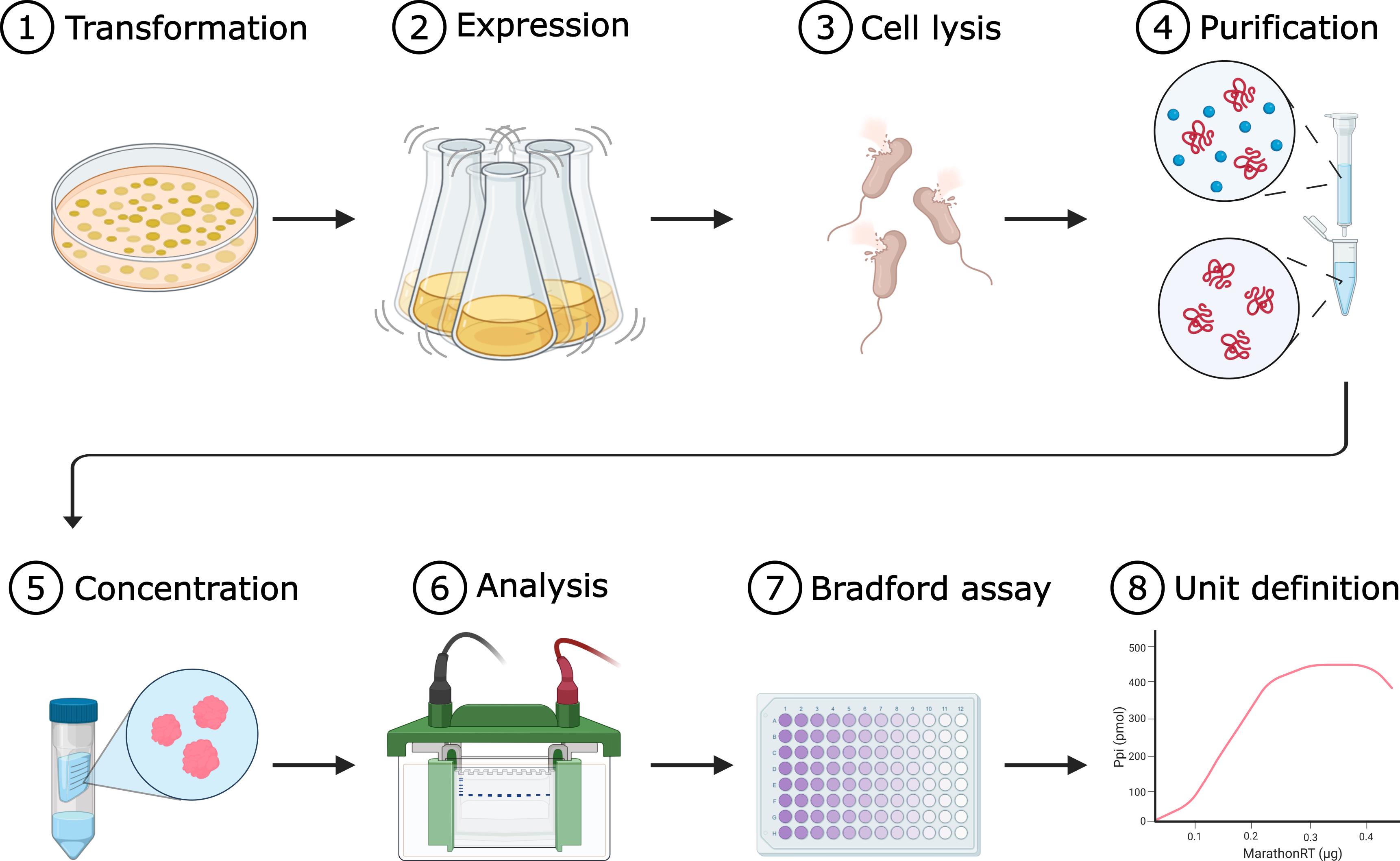
Simplified workflow for MarathonRT expression and purification (adapted from [1])
Background
Reverse transcriptases (RTs) are essential enzymes for converting RNA into cDNA, which have enabled key advances in RNA sequencing, structural probing, and mapping of chemical modifications [2–12]. Over the past decade, successful expression and purification of group II intron-encoded maturases have expanded the RT toolbox with the Thermostable Group II Intron RT (a.k.a. TGIRT) from Geobacillus stearothermophilus [7], MarathonRT (MRT) from Eubacterium rectale [13], and several engineered, commercial RTs, including UltraMarathonRT (uMRT; RNAConnect) and Induro (New England Biolabs, NEB). UltraMarathonRT is engineered from MarathonRT, but the specific origin of Induro is not publicly available. Unlike conventional retroviral RTs, such as the SuperScript series (Thermo Fisher Scientific), next-generation group II intron-encoded RTs (ngRTs) can efficiently reverse transcribe through strong secondary structures and post-transcriptional modifications (PTMs) [3,7–9,12,14]. Such features are commonplace on transfer RNA (tRNA) molecules [15,16], where they pose significant hurdles for conventional RTs, causing frequent stalling and dissociation from the template. This in turn generates truncated cDNA that hampers the mapping and accurate quantification of tRNAs [7,9,12,14].
Earlier tRNA-seq methods used various strategies to overcome these challenges (reviewed in [17]); these included demethylation of tRNAs prior to reverse transcription to increase the ratio of full-length cDNA, as well as hydrolysis of tRNAs to produce shorter, more manageable tRNA fragments for the RT to process [12,18]. More recently, ngRTs have been successfully used in library preparation without prior treatment of the tRNA, reducing chemical bias and enabling simultaneous readout of sequence and modification signatures [1,3,8]. In parallel, ngRTs have been adopted in direct RNA sequencing (DRS) workflows, where an RT is used to generate an RNA–cDNA duplex that reduces secondary structures [6]. Induro is currently recommended in the SQK-RNA004 protocol by Oxford Nanopore Technologies, and recent work demonstrates similar applicability of uMRT [19].
Although the commercial ngRTs Induro and uMRT have been established as the go-to options for tRNA-seq library preparation workflows [8,9], they remain expensive with high per-reaction costs. Therefore, in-house production of MRT based on published protocols [4,13,14] using a publicly available plasmid presents a budget-conscious solution. Furthermore, it enables a higher degree of user-based customization of the workflow, which furthers the development and implementation of these molecular tools. However, the original MRT expression and purification protocol was developed for resolving the crystal structure of the enzyme, thus aiming for the highest possible purity while sacrificing yield. Here, we present a simplified expression and purification workflow to produce a stable and highly active MRT without contaminating enzymatic activities that is suitable for the RT reaction used in tRNA sequencing library preparation. To this end, we introduced a C-terminal CBD-tag (MRT-CBD), induced expression at lower culture density to reduce degradation by native bacterial proteases, omitted cleavage of N- and C-terminal protein tags (SUMO and CBD), and streamlined the original three-step purification (affinity, ion exchange, and gel filtration) to a single Ni-NTA affinity capture step. For ease of implementation, we also provide a simple and cost-effective colorimetric assay to define MRT and MRT-CBD activity, track storability, and monitor batch-to-batch variation. Under these conditions, we obtained MRT and MRT-CBD preparations of sufficient purity for tRNA-seq RT reactions at an estimated reaction cost of merely 0.0023 EUR and 0.0034 EUR (excluding labor costs) [1], respectively, making this protocol an attractive and widely accessible alternative to commercial ngRTs, where the cost-per-reaction ranges from 11.9 EUR to 19.7 EUR (correct at time of purchase). Moreover, this streamlined MRT production protocol provides the foundation for others to implement and pursue further enhancements to ngRT-related technologies.
While we have demonstrated the successful use of affinity-purified MRT and MRT-CBD in tRNA-seq [1], their suitability for other applications such as single-cell RNA-seq [20] and RT-qPCR [21] should be evaluated separately. An alternative approach could be to use the community-developed MashUp RT (https://pipettejockey.com/), which has been successfully used for reverse transcribing long RNA templates [22,23].
Materials and reagents
Note: Equivalent materials and reagents may be used as substitutes.
Biological materials
1. Escherichia coli Rosetta 2(DE3)pLysS chemically competent cells, prepared in-house (Merck, Novagen, catalog number: 71403)
2. Plasmid pLJSRSF7-T7-6xHis-SUMO-MarathonRT-CBD (MRT-CBD) (Addgene, catalog number: 253350) originally described in [1] or pET-6xHis-SUMO-MarathonRT (MRT) (Addgene, catalog number: 109029) originally described in [14]
3. Plasmid for RNA template generation (Addgene, catalog number: 101156) originally described in [24]
4. Reverse transcription primer (5′-TCACTGCATACGACGATTCTG-3′) used in the activity assay
Reagents
Antibiotics
1. Kanamycin sulfate (Thermo Fisher Scientific, Fisher Scientific, Fisher BioReagents, catalog number: BP906-5)
2. Chloramphenicol (Thermo Fisher Scientific, Fisher Scientific, Fisher BioReagents, catalog number: BP904-100)
Inducers and reducing agents
3. Isopropyl-B-D-thiogalactopyranoside (IPTG) (Thermo Fisher Scientific, Fisher Scientific, Thermo Scientific, catalog number: R0392)
4. Dithiothreitol (DTT) (Thermo Fisher Scientific, Fisher Scientific, Fisher BioReagents, catalog number: BP172-25)
5. β-Mercaptoethanol (Thermo Fisher Scientific, Fisher Scientific, Thermo Scientific Acros, catalog number: 125472500)
Buffers, acids, and bases
6. HEPES [4-(2-hydroxyethyl)-1-piperazineethanesulfonic acid] (Thermo Fisher Scientific, Fisher Scientific, Fisher BioReagents, catalog number: BP310-1)
7. Tris base [Tris(hydroxymethyl)aminomethane] (Thermo Fisher Scientific, Fisher Scientific, Fisher BioReagents, catalog number: BP152-1)
8. Hydrochloric acid (HCl) for pH adjustment (any)
9. Sulfuric acid (Thermo Fisher Scientific, Fisher Scientific, Fisher Chemicals, catalog number: S/9240/PB15)
10. Sodium hydroxide (NaOH) (Thermo Fisher Scientific, Fisher Scientific, Fisher Chemical, catalog number: S/4920/60)
11. Potassium hydroxide (KOH) (Thermo Fisher Scientific, Fisher Scientific, Fisher Chemical, catalog number: P/5560/60)
Salts
12. Sodium chloride (NaCl) (Thermo Fisher Scientific, Fisher Scientific, Fisher Chemical, catalog number: S/3120/63)
13. Potassium chloride (KCl) (Thermo Fisher Scientific, Fisher Scientific, Fisher Chemical, catalog number: P/4240/60)
14. Magnesium chloride (MgCl2) (Thermo Fisher Scientific, Fisher Scientific, Fisher BioReagents, catalog number: 10386743)
15. Sodium phosphate monobasic anhydrous (NaH2PO4) (Thermo Fisher Scientific, Fisher Scientific, Fisher BioReagents, catalog number: BP329500)
16. Sodium phosphate dibasic anhydrous (Na2HPO4) (Thermo Fisher Scientific, Fisher Scientific, Fisher BioReagents, catalog number: BP332-500)
17. Potassium phosphate, monobasic (KH2PO4) (Thermo Fisher Scientific, Fisher Scientific, Thermo Scientific Acros, catalog number: 205925000)
Amino acids/protein components
18. BSA (albumin, bovine) (Avantor, VWR Life Science, catalog number: 0332-100G)
Organic compounds and solvents
19. Glycerol, ≥99%, analytical reagent grade (Thermo Fisher Scientific, Fisher Scientific, Fisher Chemical, catalog number: G/0650/08)
20. Ethanol (EtOH), AA grade (Anora Group Oyj, Anora Industrial, Etax Aa, catalog number: 1025874)
21. Tween 20 (Thermo Fisher Scientific, Fisher Scientific, Fisher BioReagents, catalog number: BP337-500)
22. Orthophosphoric acid, >85%, extra pure, SLR 500 mL (Thermo Fisher Scientific, Fisher Scientific, Fisher Chemical, catalog number: 10122010)
23. Ethylene glycol diacetate (EGDA) (Thermo Fisher Scientific, Fisher Scientific, Thermo Scientific Acros, catalog number: 10022400)
Chaotropic agents and denaturants
24. Guanidine thiocyanate (Thermo Fisher Scientific, Fisher Scientific, Thermo Scientific Chemicals, catalog number: 411112500)
Imidazole derivatives
25. Imidazole (Thermo Fisher Scientific, Fisher Scientific, Thermo Scientific Acros, catalog number: 122025000)
Colorimetric reagents
26. Coomassie Blue G250 (Thermo Fisher Scientific, Fisher Scientific, Fisher BioReagents, catalog number: C/P541/46)
27. Malachite green (oxalate) (Thermo Fisher Scientific, Fisher Scientific, Fisher Chemical, catalog number: M/1245/46)
28. Ammonium molybdate (IV) tetrahydrate (Thermo Fisher Scientific, Fisher Scientific, Thermo Scientific Acros, catalog number: 205851000)
Media components
29. Tryptone (Neogen, catalog number: NCM0120A)
30. Yeast extract (Neogen, catalog number: NCM0218)
31. Agar (Neogen, catalog number: NCM0238A)
Enzymes
32. EcoRI (Thermo Fisher Scientific, Fisher Scientific, Thermo Scientific, catalog number: FD0274)
33. FastAP thermosensitive alkaline phosphatase (Thermo Fisher Scientific, Fisher Scientific, Thermo Scientific, catalog number: EF0654)
34. T7 polymerase (20 U/μL) (Thermo Fisher Scientific, Fisher Scientific, Thermo Scientific, catalog number: EP0111)
35. RQ1 RNase-free DNase (Promega, catalog number: M6101)
36. RNasin Plus ribonuclease inhibitor 10,000 U (Promega, catalog number: N2615)
37. Pyrophosphatase, inorganic (0.1 U/μL) (Thermo Fisher Scientific, Fisher Scientific, Thermo Scientific, catalog number: EF0221)
Nucleotides
38. dNTP set, 100 mM solutions (Thermo Fisher Scientific, Fisher Scientific, Thermo Scientific, catalog number: R0181)
39. NTP set, 100 mM solutions (Thermo Fisher Scientific, Fisher Scientific, Thermo Scientific, catalog number: R0481)
Gel electrophoresis
40. SDS-PAGE 10% gels, Tris-Glycine buffering system for proteins (any)
41. Urea-PAA 5% gel, TBE buffering system for RNA (any)
42. Agarose gel 1% gel, TBE or TAE buffering system for DNA (any)
43. Midori Green Advance (Nippon Genetics, catalog number: MG04)
44. SYBR Gold nucleic acid gel stain (10,000× concentrate in DMSO) (Thermo Fisher Scientific, Fisher Scientific, Invitrogen, catalog number: S11494)
45. InstantBlue Coomassie protein stain (ISB1L) (Abcam, catalog number: ab119211)
46. PageRuler Plus Prestained protein ladder, 10–250 kDa (Thermo Fisher Scientific, Fisher Scientific, Thermo Scientific, catalog number: 26619)
47. ssRNA ladder (New England Biolabs, catalog number: N0362S)
48. GeneRuler 1 kb DNA ladder (Thermo Fisher Scientific, Fisher Scientific, Thermo Scientific, catalog number: SM0311)
Specialized materials and kits:
49. Liquid nitrogen
50. NucleoSpin Gel and PCR Clean-up XS (Macherey-Nagel, catalog number: 740611.250)
51. NucleoSpin RNA Columns for RNA purification (Macherey-Nagel, catalog number: 740955.50S)
52. Qubit RNA Broad Range (BR) Assay kit (Thermo Fisher Scientific, Fisher Scientific, Invitrogen, catalog number: Q10211)
Solutions
1. Kanamycin, 50 mg/mL (see Recipes)
2. Chloramphenicol, 35 mg/mL (see Recipes)
3. IPTG, 1 M (see Recipes)
4. Glycerol, 80% (see Recipes)
5. Glycerol, 90% (see Recipes)
6. Imidazole, 1 M (see Recipes)
7. NaOH, 5 M (see Recipes)
8. KOH, 5 M (see Recipes)
9. NaCl, 5 M (see Recipes)
10. KCl, 3 M (see Recipes)
11. MgCl2, 4 M (see Recipes)
12. DTT, 1 M (see Recipes)
13. K-HEPES pH 7.5, 1 M (see Recipes)
14. Na-HEPES pH 7.5, 1 M (see Recipes)
15. Tris-HCl pH 8.3, 1 M (see Recipes)
16. Tris-HCl pH 7.5, 1 M (see Recipes)
17. Tris-HCl pH 7.0, 1 M (see Recipes)
18. BSA 10 μg/μL (see Recipes)
19. BSA 0.1 μg/μL (see Recipes)
20. Guanidine thiocyanate, 5 M (see Recipes)
21. Solutions for measuring MRT activity
a. Inorganic phosphate solution (Pi), 100 mM (see Recipes)
b. Malachite green reagent, 0.12% in 3 M H2SO4 (see Recipes)
c. Ammonium molybdate, 7.5% (w/v) (see Recipes)
d. Tween 20, 10% (v/v) (see Recipes)
22. Buffers for MRT expression
a. LB Miller broth (see Recipes)
b. LB Miller agar (see Recipes)
c. PBS, 10× (see Recipes)
d. PBS, 1× (see Recipes)
23. Buffers for MRT purification
a. Buffer A (see Recipes)
b. Buffer B (see Recipes)
c. Buffer C (see Recipes)
d. Buffer D (see Recipes)
e. Buffer G (-glycerol) (see Recipes)
f. Buffer G (+glycerol)/storage buffer (see Recipes)
24. Buffers for Bradford Assay
a. Bradford reagent (see Recipes)
25. Buffers for RNA template purification [25]
a. Lysis/binding buffer (LBB) (see Recipes)
b. Chaotropic wash (CW) (see Recipes)
c. Ethanol wash (EW) (see Recipes)
26. Buffers for MarathonRT unit definition
a. MRT 2× reaction buffer (see Recipes)
b. Pi dilutions (for standard curve) (see Recipes)
c. Malachite green detection solution (DS) (see Recipes)
Recipes
1. Kanamycin, 50 mg/mL (25 mL)
Weigh 1.25 g of kanamycin into a 50 mL conical centrifuge tube. Add nuclease-free water up to 20 mL and dissolve kanamycin using an end-over-end mixer. Adjust the volume to 25 mL and filter through a disposable 0.2 μm 150 mL filter into a sterile 100 mL glass bottle. Aliquot 1 mL into 1.5 mL microfuge tubes. Store at -20 °C indefinitely.
2. Chloramphenicol, 35 mg/mL (25 mL)
Weigh 0.88 g of chloramphenicol into a 50 mL conical centrifuge tube. Add nuclease-free water up to 20 mL and dissolve chloramphenicol using an end-over-end mixer. Adjust the volume to 25 mL and filter through a disposable 0.2 μm 150 mL filter into a sterile 100 mL glass bottle. Aliquot 1 mL into 1.5 mL microfuge tubes. Store at -20 °C indefinitely.
3. IPTG, 1 M (20 mL)
Weigh 4.77 g of IPTG into a 50 mL conical centrifuge tube. Add nuclease-free water up to 15 mL and dissolve IPTG using an end-over-end mixer. Adjust the volume to 20 mL in a volumetric bottle or cylinder and filter through a disposable 0.2 μm 150 mL filter into a sterile 100 mL glass bottle. Aliquot 1 mL into 1.5 mL microfuge tubes. Store at -20 °C for up to 2 years.
4. Glycerol, 80% (80 mL)
Weigh 64 g of glycerol into a 100 mL glass bottle. Add 16 g of nuclease-free water. Mix over the cap 5–10×. Autoclave in liquid cycle. Store at room temperature indefinitely.
5. Glycerol, 90% (80 mL)
Weigh 72 g of glycerol into a 100 mL glass bottle. Add 8 g of nuclease-free water. Mix over the cap 5–10×. Autoclave in liquid cycle. Store at room temperature indefinitely.
6. Imidazole, 1 M (100 mL)
Weigh 6.81 g of imidazole into a 100 mL beaker. Add nuclease-free water up to ~80 mL and dissolve imidazole using a magnetic stirrer. Adjust the volume to 100 mL in a volumetric bottle or cylinder and filter through a disposable 0.2 μm 150 mL filter into a sterile 100 mL glass bottle. Store at 4 °C protected from light for up to 2 years.
7. NaOH, 5 M (100 mL)
Weigh 20 g of NaOH pellets. Add NaOH slowly to water (do not add water to pellets) and stir in a 250–500 mL beaker with cooling if needed. Start with ~80 mL of nuclease-free water, dissolve, then adjust to 100 mL in a volumetric bottle or cylinder. Aliquot into 50 mL conical centrifuge tubes. Store at room temperature indefinitely.
8. KOH, 5 M (100 mL)
Weigh 28.06 g of KOH pellets. Add KOH slowly to water (do not add water to pellets) and stir in a 250–500 mL beaker with cooling if needed. Start with ~80 mL of nuclease-free water, dissolve, then adjust to 100 mL in a volumetric bottle or cylinder. Aliquot into 50 mL conical centrifuge tubes. Store at room temperature indefinitely.
9. NaCl, 5 M (100 mL)
Weigh 29.22 g of NaCl into a 250 mL beaker. Add nuclease-free water up to 80 mL and dissolve NaCl using a magnetic stirrer. Adjust the volume to 100 mL in a volumetric bottle or cylinder and filter through a disposable 0.2 μm 150 mL filter into a sterile 100 mL glass bottle. Store at room temperature indefinitely.
10. KCl, 3 M (100 mL)
Weigh 22.36 g of KCl into a 250 mL beaker. Add nuclease-free water up to 80 mL and dissolve KCl using a magnetic stirrer. Adjust the volume to 100 mL in a volumetric bottle or cylinder and filter through a disposable 0.2 μm 150 mL filter into a sterile 100 mL glass bottle. Store at room temperature indefinitely.
11. MgCl2, 4 M (100 mL)
Weigh 50.34 g of MgCl2 into a 250 mL beaker. Add ~80 mL of nuclease-free water. Use a magnetic mixer to dissolve MgCl2. Set the final volume to 100 mL with nuclease-free water using a volumetric bottle or a cylinder and filter through a disposable 0.2 μm 150 mL filter into a sterile 100 mL glass bottle. Store at room temperature indefinitely.
12. DTT, 1 M (25 mL)
Weigh 3.86 g of DTT into a 50 mL conical centrifuge tube. Add nuclease-free water up to 20 mL and dissolve DTT using an end-over-end mixer. Adjust the volume to 25 mL and filter through a disposable 0.2 μm 150 mL filter into a sterile 100 mL glass bottle. Aliquot 1 mL into 1.5 mL microfuge tubes. Store at -20 °C up to 2 years.
13. K-HEPES pH 7.5, 1 M (100 mL)
Weigh 23.83 g of HEPES into a 250 mL beaker. Add ~80 mL of nuclease-free water. Use a magnetic mixer to dissolve HEPES. Once dissolved, adjust the pH with 5 M KOH solution. Set the final volume to 100 mL with nuclease-free water using a volumetric bottle or a cylinder and filter through a disposable 0.2 μm 150 mL filter into a sterile 100 mL glass bottle. Aliquot 10 mL into 15 mL centrifuge tubes and store at -20 °C for up to 2 years.
Critical: HEPES buffers are light- and temperature-sensitive. HEPES solution is stable at 4 °C for up to a month when protected from light.
14. Na-HEPES pH 7.5, 1 M (100 mL)
Weigh 23.83 g of HEPES into a 250 mL beaker. Add ~80 mL of nuclease-free water. Use a magnetic mixer to dissolve HEPES. Once dissolved, adjust the pH with 5 M NaOH solution. Set the final volume to 100 mL with nuclease-free water using a volumetric bottle or a cylinder and filter through a disposable 0.2 μm 150 mL filter into a sterile 100 mL glass bottle. Aliquot 10 mL into 15 mL centrifuge tubes and store at -20 °C for up to 2 years.
Critical: HEPES buffers are light- and temperature-sensitive. HEPES solution is stable at 4 °C for up to a month when protected from light.
15. Tris-HCl pH 8.3, 1 M (100 mL)
Weigh 12.11 g of Tris base into a 250 mL beaker. Add ~80 mL of nuclease-free water. Use a magnetic mixer to dissolve Tris base. Once dissolved, adjust the pH with HCl solution. Set the final volume to 100 mL with nuclease-free water using a volumetric bottle or a cylinder and filter through a disposable 0.2 μm 150 mL filter into a sterile 100 mL glass bottle. Store at room temperature for up to 1 year.
16. Tris-HCl pH 7.5, 1 M (100 mL)
Weigh 12.11 g of Tris base into a 250 mL beaker. Add ~80 mL of nuclease-free water. Use a magnetic mixer to dissolve Tris base. Once dissolved, adjust the pH with HCl solution. Set the final volume to 100 mL with nuclease-free water using a volumetric bottle or a cylinder and filter through a disposable 0.2 μm 150 mL filter into a sterile 100 mL glass bottle. Store at room temperature for up to 1 year.
17. Tris-HCl pH 7.0, 1 M (100 mL)
Weigh 12.11 g of Tris base into a 250 mL beaker. Add ~80 mL of nuclease-free water. Use a magnetic mixer to dissolve Tris base. Once dissolved, adjust the pH with HCl solution. Set the final volume to 100 mL with nuclease-free water using a volumetric bottle or a cylinder and filter through a disposable 0.2 μm 150 mL filter into a sterile 100 mL glass bottle. Store at room temperature for up to 1 year.
18. BSA 10 μg/L (10 mL)
Weigh 0.1 g of BSA into a 50 mL tube. Add ~8 mL of nuclease-free water. Use an end-over-end mixer to dissolve BSA. Avoid foam. Set the final volume to 10 mL with nuclease-free water using a volumetric bottle or a cylinder and aliquot into microfuge tubes. Store at -20 °C for years. Avoid freeze-thaws.
19. BSA 0.1 μg/μL (1 mL)
Pipette 10 μL of 10 μg/μL BSA into 990 μL of nuclease-free water. Mix by pipetting up and down. Use immediately.
20. Guanidine thiocyanate, 5 M (10 mL)
Weigh 5.91 g of guanidine thiocyanate into a 50 mL tube. Add ~8 mL of nuclease-free water. Use a magnetic mixer with heating to dissolve it. Set the final volume to 10 mL with nuclease-free water using a volumetric bottle or a cylinder and transfer into a 15 mL tube. Store at room temperature protected from light for years.
21. Solutions for measuring MRT activity
Critical: Use only sterile plasticware for preparation of these solutions, except for malachite green reagent. Nuclease-free water must be taken directly from the water purification device into plasticware. Glassware might contain trace amounts of phosphate, which will interfere with the assay. Do not sterilize these solutions.
a. Inorganic phosphate solution (Pi), 100 mM (10 mL)
Dissolve 0.12 g of NaH2PO4 (119.98 g/mol) in 7–8 mL of nuclease-free water in a 15 mL tube. Adjust the final volume to 10 mL with nuclease-free water in the same tube. Do not filter-sterilize. Store at 4 °C for 1–2 months.
b. Malachite green reagent, 0.12% in 3 M H2SO4 (180 mL)
Prepare 3 M sulfuric acid by diluting 30 mL of concentrated sulfuric acid in 150 mL of nuclease-free water in a well-rinsed glass bottle. Add 0.22 g of malachite green and mix well. This yields a 0.12% malachite green solution in 3 M (6 N) sulfuric acid. Do not filter-sterilize. The solution is stable at room temperature for up to 1 year. Always store the solution in glassware!
c. Ammonium molybdate, 7.5% (w/v) (10 mL)
Dissolve 0.75 g of ammonium molybdate tetrahydrate in 5 mL of nuclease-free water in a 15 mL tube. Once dissolved, adjust the volume to 10 mL with nuclease-free water in the same tube. Do not filter-sterilize. The solution is stable indefinitely if stored in a plastic bottle. However, the solution may occasionally precipitate. If this happens, prepare a new solution.
d. Tween 20, 10% (v/v) (10 mL)
Dilute 1 mL of concentrated Tween 20 in 5–6 mL of nuclease-free water in a 50 mL tube. Mix properly on an end-over-end rotator. Adjust the volume to 10 mL with nuclease-free water. Store at room temperature. Do not filter-sterilize.
22. Buffers for MRT expression
a. LB Miller broth (1 L)
| Reagent | Final concentration | Quantity or volume |
|---|---|---|
| Tryptone | 10 g/L | 10 g |
| Yeast extract | 5 g/L | 5 g |
| NaCl | 10 g/L | 10 g |
| Reverse osmosis (RO) water | N/A | Up to 1 L |
| Total volume | 1 L |
Weigh all components into a 1 L beaker. Add RO water up to 900 mL and dissolve using a magnetic stirrer. Adjust the volume to 1 L in a volumetric cylinder or bottle. Dispense 500 mL into 1 L glass bottles and sterilize by autoclaving at 121 °C for 15 min. Store at room temperature for years.
b. LB Miller agar (250 mL)
| Reagent | Final concentration | Quantity or volume |
|---|---|---|
| Tryptone | 10 g/L | 2.5 g |
| Yeast extract | 5 g/L | 1.25 g |
| NaCl | 10 g/L | 2.5 g |
| Agar | 15 g/L | 3.75 g |
| Nuclease-free water | N/A | Up to 250 mL |
| Total volume | 250 mL |
Weigh all components into a 500 mL beaker. Add nuclease-free water up to 200 mL and dissolve using a magnetic stirrer. Adjust the volume to 250 L in a volumetric cylinder or bottle. Dispense 250 mL into 100 mL glass bottles and sterilize by autoclaving at 121 °C for 15 min. Store at room temperature for years.
c. PBS, 10× (100 mL)
| Reagent | Final concentration | Quantity or volume |
|---|---|---|
| NaCl | 1.37 M | 8 g |
| KCl | 27 mM | 0.2 g |
| Na2HPO4 | 100 mM | 1.42 g |
| KH2PO4 | 18 mM | 0.24 g |
| Nuclease-free water | N/A | Up to 100 mL |
| Total volume | 100 mL |
Weigh all components into a 250 mL beaker. Add nuclease-free water up to 90 mL and dissolve using a magnetic stirrer. Adjust the volume to 100 mL in a volumetric bottle or cylinder and filter through a disposable 0.2 μm 150 mL filter into a sterile 100 mL glass bottle. Store at room temperature indefinitely.
d. PBS, 1× (100 mL)
Pipette 10 mL of 10× PBS stock into a volumetric bottle or cylinder. Bring the volume to 100 mL and transfer to a 100 mL glass bottle. Mix over the cap. Store at room temperature indefinitely.
23. Buffers for MRT purification
The buffer nomenclature is the same as in the original publication [13].
We recommend that all buffers be prepared a day before the purification of the protein and always stored at 4 °C. Sterilize all solutions before making the buffers. We recommend filter-sterilizing all self-prepared solutions made of powders and only autoclaving glycerol. Add β-Mercaptoethanol and DTT to the buffers just before use. These components are unstable and will render the buffers not usable the next day.
a. Buffer A
| Reagent | Final concentration | Quantity or volume |
|---|---|---|
| Na-HEPES pH 7.5 (1 M) | 25 mM | 1.5 mL |
| NaCl, (5 M) | 1 M | 12 mL |
| Glycerol (80%) | 10% | 7.5 mL |
| β-Mercaptoethanol (14.3 M) | 2 mM | 8.4 μL |
| Nuclease-free water | N/A | 39 mL |
| Total volume | 60 mL |
b. Buffer B
| Reagent | Final concentration | Quantity or volume |
|---|---|---|
| Na-HEPES pH 7.5 (1 M) | 25 mM | 0.75 mL |
| NaCl (5 M) | 500 mM | 3 mL |
| Imidazole (1 M) | 20 mM | 0.6 mL |
| Glycerol (80%) | 10% | 3.75 mL |
| β-Mercaptoethanol (14.3 M) | 2 mM | 4.2 μL |
| Nuclease-free water | N/A | 21.9 mL |
| Total volume | 30 mL |
c. Buffer C
| Reagent | Final concentration | Quantity or volume |
|---|---|---|
| Na-HEPES pH 7.5 (1 M) | 25 mM | 0.75 mL |
| NaCl (5 M) | 500 mM | 3 mL |
| Imidazole (1 M) | 30 mM | 0.9 mL |
| Glycerol (80%) | 10% | 3.75 mL |
| β-Mercaptoethanol (14.3 M) | 2 mM | 4.2 μL |
| Nuclease-free water | N/A | 21.6 mL |
| Total volume | 30 mL |
d. Buffer D
| Reagent | Final concentration | Quantity or volume |
|---|---|---|
| Na-HEPES pH 7.5 (1 M) | 25 mM | 0.5 mL |
| NaCl (5 M) | 300 mM | 1.2 mL |
| Imidazole (1 M) | 300 mM | 6 mL |
| Glycerol (80%) | 10% | 2.5 mL |
| β-Mercaptoethanol (14.3 M) | 2 mM | 2.8 μL |
| Nuclease-free water | N/A | 9.8 mL |
| Total volume | 20 mL |
e. Buffer G (-glycerol)
| Reagent | Final concentration | Quantity or volume |
|---|---|---|
| K-HEPES pH 7.5 (1 M) | 56.25 mM | 1.69 mL |
| KCl (3 M) | 675 mM | 6.75 mL |
| DTT (1 M) | 2.25 mM | 67.5 μL |
| Nuclease-free water | N/A | 21.5 mL |
| Glycerol (90%) | N/A | N/A |
| Total volume | 30 mL |
f. Buffer G (+glycerol)/storage buffer
| Reagent | Final concentration | Quantity or volume |
|---|---|---|
| K-HEPES pH 7.5 (1 M) | 25 mM | 250 μL |
| KCl (3 M) | 300 mM | 1 mL |
| DTT (1 M) | 1 mM | 10 μL |
| Glycerol (90%) | 50% | 6.25 mL |
| Nuclease-free water | N/A | 2.49 mL |
| Total volume | 10 mL |
We recommend that the buffer be prepared fresh, aliquoted into 1.5 mL microfuge tubes, and stored at -20 °C. We have successfully used the buffer stored for 2 years.
24. Buffers for Bradford assay
a. Bradford reagent
| Reagent | Final concentration | Quantity or volume |
|---|---|---|
| Coomassie Brilliant Blue G250 | N/A | 0.1 g |
| EtOH (96%–100%) | 10% | 50 mL |
| Orthophosphoric acid | 20% | 100 mL |
| Nuclease-free water | N/A | 350 mL |
| Total volume | 500 mL |
Weigh 0.1 g of Coomassie Brilliant Blue G250. Use a magnetic mixer to dissolve it in 50 mL of ethanol in a 1 L beaker for 1 h. Add 100 mL of orthophosphoric acid and stir. Add 350 mL of nuclease-free water and stir. Aliquot into 50 mL glass bottles. Store at 4 °C protected from light.
25. Buffers for RNA template purification [25]
a. Lysis/binding buffer (LBB)
| Reagent | Final concentration | Quantity or volume |
|---|---|---|
| Guanidine thiocyanate | 5 M | 5.91 g |
| Tris-HCl pH 7.0 (1 M) | 50 mM | 0.5 mL |
| Nuclease-free water | N/A | Up to 10 mL |
| Total volume | 10 mL |
Weigh 5.91 g of guanidine thiocyanate into a 50 mL beaker. Add ~8 mL of nuclease-free water and 0.5 mL of Tris-HCl pH 7.0. Use a magnetic mixer with heating to dissolve guanidine thiocyanate. Once dissolved, adjust the final volume to 10 mL with nuclease-free water using a volumetric bottle or a cylinder. Transfer to a 15 mL tube and store at room temperature for up to 6 months.
b. Chaotropic wash (CW)
| Reagent | Final concentration | Quantity or volume |
|---|---|---|
| Tris-HCl pH 7.0 (1 M) | 20 mM | 200 μL |
| Guanidine thiocyanate (5 M) | 1.6 M | 3.2 mL |
| EtOH (99.6%) | 66% | 6.6 mL |
| Total volume | 10 mL |
c. Ethanol wash (EW)
| Reagent | Final concentration | Quantity or volume |
|---|---|---|
| Tris-HCl pH 7.5 (1 M) | 10 mM | 100 μL |
| EtOH (99.6%) | 80% | 8 mL |
| NaCl (5 M) | 20 mM | 40 μL |
| Nuclease-free water | N/A | 1.86 mL |
| Total volume | 10 mL |
Pipette the components in the following order: water, Tris-HCl, NaCl, and EtOH to avoid salt precipitation in ethanol.
26. Buffers for MarathonRT unit definition
a. MRT 2× reaction buffer
| Reagent | Final concentration | Quantity or volume | In 1× reaction |
|---|---|---|---|
| Tris-HCl pH 8.3 (1 M) | 100 mM | 1 mL | 50 mM |
| KCl (3 M) | 400 mM | 1.33 mL | 200 mM |
| MgCl2 (4 M) | 4 mM | 10 μL | 2 mM |
| DTT (1 M) | 10 mM | 100 μL | 5 mM |
| Glycerol (80%) | 40% | 5 mL | 20% |
| Nuclease-free water | N/A | 2.56 mL | N/A |
| Total volume | 10 mL |
We recommend that the buffer be prepared fresh, aliquoted into 1.5 mL microfuge tubes, and stored at -20 °C. We have successfully used the buffer stored for 2 years.
Note: This original MRT reaction buffer with 2 mM MgCl2 was used for establishing the assay. An optimized MRT reaction buffer with 4 mM MgCl2 was subsequently released (uMRT RT kit protocol by RNAConnect, previously available from Kerafast). However, we retained the original buffer composition in order to compare the activity of all protein batches. A new user may find it beneficial to use the optimized buffer with a higher MgCl2 concentration.
b. Pi dilutions (for standard curve)
| Plate row | Pi 50 μm (μL) | Ultrapure water (μL) | Amount in detection reaction |
|---|---|---|---|
| A | 0 μL | 80 μL | 0 pmol (0 μm) |
| B | 6 μL | 74 μL | 300 pmol (3 μm) |
| C | 12 μL | 68 μL | 600 pmol (6 μm) |
| D | 24 μL | 56 μL | 1,200 pmol (12 μm) |
| E | 40 μL | 40 μL | 2,000 pmol (20 μm) |
| F | 50 μL | 30 μL | 2,500 pmol (25 μm) |
| G | 64 μL | 16 μL | 3,200 pmol (32 μm) |
| H | 80 μL | 0 μL | 4,000 pmol (40 μm) |
Critical: Pi dilutions must be prepared just before use!
Prepare the Pi dilutions for the standard curve from the Pi stock (Recipe 21a). First, prepare 1 mM Pi by pipetting 990 μL of nuclease-free water into a 1.5 mL microfuge tube and adding 10 μL of 100 mM Pi. Mix by vortex and pulse-spin. Second, prepare 50 μM Pi by pipetting 950 μL of nuclease-free water into a 1.5 mL microfuge tube and adding 50 μL of 1 mM Pi from the previous step. Mix by vortex and pulse-spin. Next, prepare standard curve dilutions of the freshly prepared 50 μM Pi directly to the microplate. First, pipette ultrapure water; then, add Pi.
c. Malachite green detection solution (DS)
| Component | For 1 reaction | For 30 reactions | For 100 reactions |
|---|---|---|---|
| Malachite green reagent | 15.73 μL | 472 μL | 1,574 μL |
| Ammonium molybdate (7.5%) | 3.93 μL | 118 μL | 394 μL |
| Tween (10%) | 0.33 μL | 10 μL | 32 μL |
Critical: Malachite green DS must be prepared just before use!
Prepare the malachite green DS by mixing malachite green reagent (Recipe 21b) with 7.5% ammonium molybdate (Recipe 21c) and 10% Tween (Recipe 21d) into a 1.5 or 2 mL microfuge tube, as shown in the table above.
Critical: Always mix in the following order: malachite green, ammonium molybdate, and Tween-20. Otherwise, the solution will precipitate.
Laboratory supplies
1. MaxyClear Snaplock Microtubes, 1.5 mL (Thermo Fisher Scientific, Fisher Scientific, Axygen, catalog number: MCT150C) or equivalent
2. Screw cap tube, 15 mL, (L × Ø): 120 × 17 mm, PP, with print (Sarstedt, catalog number: 62.554.002) or equivalent
3. Screw cap tube, 50 mL, (L × Ø): 114 × 28 mm, PP, with print (Sarstedt, catalog number: 62.547.255) or equivalent
4. PCR tubes with 0.5 mL flat cap (Thermo Fisher Scientific, Fisher Scientific, Axygen, catalog number: PCR05C)
5. 0.2 mL PCR 8-well strips with single flat caps (Nippon Genetics, catalog number: FG-088WF)
6. 10 μL pipette tips nuclease-free (any)
7. 200 μL pipette tips nuclease-free (any)
8. 1 mL pipette tips nuclease-free (any)
9. Serological pipette, with tip, plugged, 10 mL, sterile, non-pyrogenic/endotoxin-free, non-cytotoxic, 1 piece(s)/blister (Sarstedt, catalog number: 86.1254.001) or equivalent
10. Serological pipette, with tip, plugged, 25 mL, sterile, non-pyrogenic/endotoxin-free, non-cytotoxic, 1 piece(s)/blister (Sarstedt, catalog number: 86.1685.001) or equivalent
11. Petri dishes (any)
12. Glass beads/cell spreader (any)
13. 250 mL Erlenmeyer flask (any)
14. 2 L Erlenmeyer flask (any)
15. Glass bottles for buffers and media (any)
16. Volumetric flasks for buffer preparation (any)
17. Glass beakers (any)
18. Sterile inoculation loops (any)
19. Disposable cuvettes PS semi-micro (Avantor, VWR, catalog number: 634-0676)
20. Fiberlite 1000 mL bottles (Thermo Fisher Scientific, Fisher Scientific, Thermo Scientific, catalog number: 010-1491) or Nalgene PPCO centrifuge bottles 500 mL (Thermo Fisher Scientific, Fisher Scientific, Thermo Scientific, catalog number: 3120-0500) or equivalent
21. Nalgene Oak Ridge Polysulfone centrifuge tubes w/sealing caps, 50 mL (Thermo Fisher Scientific, Fisher Scientific, Thermo Scientific, catalog number: 31370050) or equivalent
22. Pierce centrifuge columns, 10 mL (Thermo Fisher Scientific, Fisher Scientific, Thermo Scientific, catalog number: 89898)
23. Disposable PES bottle top filters 150 mL (Thermo Fisher Scientific, Fisher Scientific, Fisherbrand, catalog number: 15953307)
24. Disposable PES bottle top filters, 500 mL (Thermo Fisher Scientific, Fisher Scientific, Fisherbrand, catalog number: 15973307)
25. Amicon Ultra centrifugal filter, 50 kDa MWCO (Merck, catalog number: UFC905024)
26. HisPur Ni-NTA resin (Thermo Fisher Scientific, Fisher Scientific, Thermo Scientific, catalog number: 88221)
27. Nunc 96-well microplate (Thermo Fisher Scientific, Fisher Scientific, Thermo Scientific, catalog number: 260836)
28. (Optional) TapeStation Screentapes for RNA (Agilent)
29. (Optional) Multichannel reagent reservoir, any
Equipment
1. 4 °C fridge
2. Cold room
3. -70 °C freezer
4. -20 °C freezer
5. Ice box
6. Direct 8 Milli-Q Direct Water Purification System with filter Biopak Polisher (Merck, catalog number: CDUFBI001)
7. QB Series Dry Block Heating Systems (Grant, model: QBD2) or equivalent
8. XT96 Thermal Cycler XT96 Gradient (Avantor, VWR, catalog number: 732-3428) or equivalent
9. ThermoMixer C (Eppendorf, catalog number: 5382000015) or equivalent
10. Incubator shaker New BrunswickTM Excella E25 Shaker (Eppendorf) or equivalent temperature-controlled shaker that can fit a 2 L flask
11. Microbiological incubator (any)
12. NanoDrop 2000c Spectrophotometer (Thermo Fisher Scientific, Thermo Scientific, catalog number: ND-2000C) or equivalent
13. Superspeed Centrifuge Sorvall LYNX 4000 with rotors Fiberlite F20-12 × 50 LEX, Fiberlite F12-6 × 500 LEX or Fiberlite F10-4 × 1000 LEX (Thermo Fisher Scientific, Thermo Scientific, catalog number: 75006581) or equivalent
14. Centrifuge 5427 R with rotor FA-45-24-11 (Eppendorf, catalog number: 5429000010) or equivalent temperature-controlled centrifuge that fits 1.5/2 mL microfuge tubes
15. Centrifuge 5810 R with rotors fixed-angle FA-45-6-30 and optional: Swing-bucket rotor A-4-62 (Eppendorf, catalog number: 5811000015) or equivalent
16. Balance AB104-S/PH (Mettler Toledo, catalog number: 11135020) or equivalent
17. Top-loading balance (Sartorius, model: CP2202S) or equivalent
18. Stripettor Ultra Pipet Controller (Corning, catalog number: 4099) or equivalent
19. Electrophoresis Power Supply (CBS Scientific, model: EPS-600) or equivalent
20. Agarose gel electrophoresis equipment (any)
21. Open Air Rocker (Thermo Fisher Scientific, Fisher Scientific, Fisherbrand, catalog number: 88861026) or equivalent
22. ChemiDoc MP Imaging System (Bio-Rad, catalog number: 12003154) or equivalent
23. Mini-PROTEAN Tetra Vertical Electrophoresis Cell (Bio-Rad, catalog number: 1658004) or equivalent
24. Dual Adjustable Vertical System for polyacrylamide gel electrophoresis (CBS Scientific, catalog number: DASG-250) or equivalent
25. (Optional) Automatic gel electrophoresis equipment for DNA and RNA 4150 TapeStation System (Agilent, catalog number: G2992AA)
26. Research Plus 0.5–10 μL pipette (Eppendorf, catalog number: EP3123000020) or equivalent
27. Research Plus 10–100 μL pipette (Eppendorf, catalog number: EP3123000047) or equivalent
28. Research Plus 100–1,000 μL pipette (Eppendorf, catalog number: EP3123000063) or equivalent
29. (Optional) Elite Variable Volume, multichannel pipette 10–100 μL (Thermo Fisher Scientific, Fisher Scientific, Fisherbrand, catalog number: 11825772)
30. Ultrasonic processor UP400S (400 W, 24 kHz) with Sonotrode H7 or H14 (Hielscher Ultrasonics)
31. Diaphragm Vacuum Pump LABOPORT (KNF, type: N 810.3 FT.18) or equivalent for filter sterilization
32. End-over-end rotator (any model)
33. Multiskan FC Microplate Photometer (Thermo Fisher Scientific, Thermo Scientific, catalog number: 51119000) or equivalent
34. Denovix QFX or equivalent fluorophore measuring device
35. 744 pH Meter (Metrohm, model: 744) or equivalent
36. Vortexer (any model)
37. Isotemp RT Advanced Hotplate Stirrer, 350 °C, Ceramic, Aluminum (Thermo Fisher Scientific, Fisher Scientific, Fisherbrand, catalog number: 15326607)
38. Spectrophotometer (any)
Procedure
登录/注册后免费查看全文
文章信息
稿件历史记录
提交日期: Mar 12, 2026
接收日期: Apr 27, 2026
在线发布日期: May 9, 2026
出版日期: Jun 20, 2026
版权信息
© 2026 The Author(s); This is an open access article under the CC BY license (https://creativecommons.org/licenses/by/4.0/).
如何引用
Pedor, J. K., Gregorova, P., Kalaniemi, S. M. and Sarin, L. P. (2026). One-Step Affinity Purification of MarathonRT Reverse Transcriptase for RNA Sequencing Applications. Bio-protocol 16(12): e5703. DOI: 10.21769/BioProtoc.5703.

 Download Citation in RIS Format
分类
生物化学 > 蛋白质 > 分离和纯化
分子生物学 > RNA > 返转录
分子生物学 > 蛋白质 > 表达
您对这篇实验方案有问题吗?
在此处发布您的问题,我们将邀请本文作者来回答。同时,我们会将您的问题发布到Bio-protocol Exchange,以便寻求社区成员的帮助。
 发布问题
发布问题


