


A Step-by-Step GUI-Based Protocol for Molecular Dating Analysis Using PhyloSuite v2
基于 PhyloSuite v2 图形界面的分子定年分析分步操作流程

发布: 2026年05月20日第16卷第10期 DOI: 10.21769/BioProtoc.5688 浏览次数: 1054
评审: Migla MiskinyteAnonymous reviewer(s)
 PDF
PDF  Q&A
Q&A
参见作者原研究论文
The authors used this protocol in:

Nov 2025
Advertisement







Abstract
In current genomic research, molecular dating is challenged by both imperfect substitution modeling and analysis efficiency, as genome-scale datasets often exhibit substantial rate heterogeneity and complex patterns of sequence evolution, which can make divergence-time estimation sensitive to modeling assumptions and computational settings. Meanwhile, commonly used molecular dating workflows remain operationally demanding; preparing correctly formatted inputs, implementing model settings, configuring fossil calibrations, and performing basic diagnostics and visualization frequently require multiple tools and extensive manual steps, resulting in high hands-on time and avoidable operational errors. To facilitate the practical implementation of molecular dating analyses and lower the operational barrier for users, this protocol describes a GUI-based workflow in PhyloSuite v2 for molecular dating analysis. Using a dataset of fish nuclear genomes as an example, the tutorial covers multi-format data import, visual configuration of fossil calibrations, automatic selection and implementation of substitution models, automation of complex analytical procedures, and assessment of Markov chain Monte Carlo (MCMC) convergence, along with data visualization. Through this protocol, users can quickly master the full workflow—from input preparation and molecular dating to MCMC sample statistical assessment and timetree visualization—thus significantly enhancing the efficiency of molecular dating analysis and result verification.
Key features
• Guides users through a complete molecular dating workflow in PhyloSuite v2, from input preparation to final output.
• Specifies required inputs, intermediate files, and final outputs for molecular dating analyses.
• Provides a practical visual procedure for setting and checking fossil calibrations before analysis.
• Helps users configure reproducible runs and interpret diagnostic outputs to assess convergence and dating performance.
Keywords: Molecular dating (分子定年) timetree (时间树)
PhyloSuite v2 (PhyloSuite v2)
MCMCtree (MCMCtree)
r8s (r8s)
timetree (时间树)
PhyloSuite v2 (PhyloSuite v2)
MCMCtree (MCMCtree)
r8s (r8s)
Graphical overview
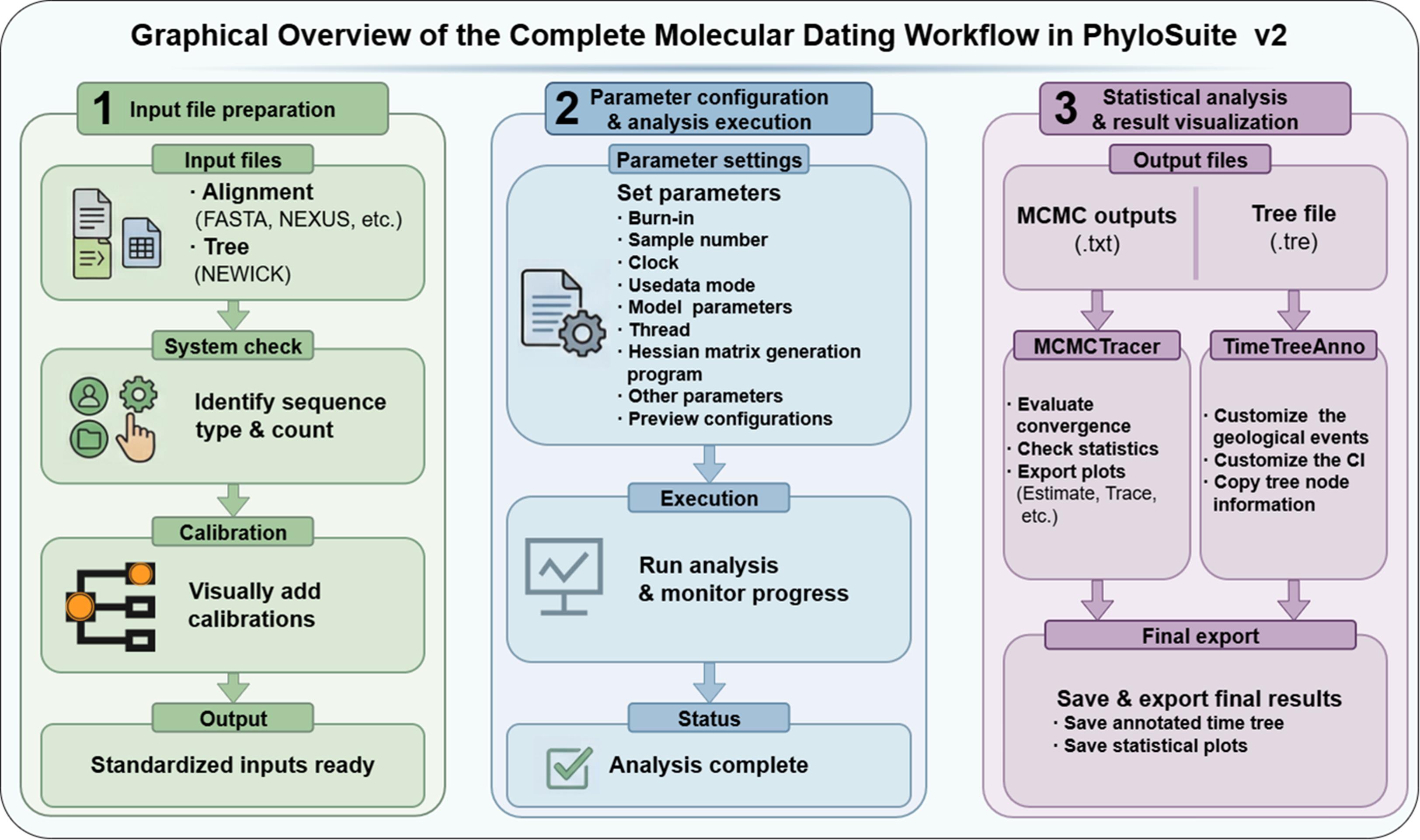
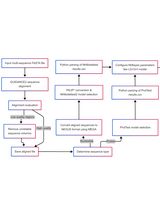
Overall molecular dating workflow implemented in PhyloSuite v2. Briefly, the procedure includes input preparation, fossil calibration setup, parameter configuration and molecular dating analysis in MDGUI, convergence assessment in MCMCTracer, and timetree annotation in TimeTreeAnno. This overview is intended to provide users, especially beginners, with a conceptual guide before proceeding to the detailed step-by-step instructions.
Background
Phylogenetic inference is a cornerstone of evolutionary biology because it provides explicit, testable hypotheses of evolutionary relationships from molecular sequence data [1]. Molecular dating extends phylogenetic inference by placing divergences on an absolute timescale, enabling evolutionary events to be compared with geological history and the fossil record [2]. In the phylogenomic era, molecular clock analyses must often accommodate complex patterns of rate variation and other challenges that become more prominent as data scale increases. Molecular dating is increasingly challenged by both model fit and analysis efficiency for genome-scale datasets. Genome-scale data commonly exhibit substantial rate heterogeneity, making divergence-time estimates sensitive to model specification, calibration strategy, and prior settings [3]. Moreover, because Bayesian dating relies on repeated likelihood calculations throughout Markov chain Monte Carlo (MCMC), phylogenomic datasets often impose substantial computational demands, motivating practical strategies to improve efficiency and stability [4].
A comprehensive molecular dating workflow typically involves interdependent steps, including complex multi-gene data preparation (e.g., sequence alignment, trimming, and concatenation), optimal model selection, rigorous application of clock models, and fossil calibrations [5]. In practice, this process relies heavily on specialized software such as MCMCtree and r8s [6,7]. MCMCtree uses a Bayesian framework to estimate divergence times by integrating sequence data with clock models and fossil calibration priors, whereas r8s uses a penalized likelihood approach that infers divergence times by smoothing rate variation across branches. Accordingly, MCMCtree is generally preferred when prior information and calibration uncertainty need to be modeled more explicitly, whereas r8s may be useful for relatively simpler or computationally lighter analyses. These tools typically operate via command-line interfaces, where parameter configuration is complex and error-prone, thereby representing a significant technical barrier [8]. For example, fossil calibration choices can strongly influence posterior time estimates, and best-practice guidelines stress that calibrations should be explicitly justified and that calibration-derived priors should be evaluated before analysis [9,10]. In addition, because Bayesian dating relies on MCMC sampling, routine convergence assessment (e.g., trace inspection and ESS summaries) is recommended before interpreting posterior estimates [11].
To reduce hands-on time and lower operational barriers for routine analyses, PhyloSuite was developed as an integrated GUI platform for streamlining sequence data management and phylogenetic workflows for multi-gene and genomic datasets [12]. Building on this framework, a major update in PhyloSuite v2 is the introduction of a molecular dating suite, comprising MDGUI (molecular dating analysis), TimeTreeAnno (Timetree annotation and visualization), and MCMCTracer (convergence diagnostics), which were not available in the previous version of the suite [13]. By integrating core programs such as MCMCtree, r8s, and IQ-TREE, this suite aims to provide users with a unified and visualized workflow for molecular dating analyses [14].
In the PhyloSuite v2 interface, the molecular dating workflow described here is mainly implemented through the modules under the Phylogeny menu, whereas other menus such as Flowchart, File, Alignment, and Mitogenome are primarily used for workflow organization, file management, sequence alignment-related operations, and mitogenome-oriented analyses, respectively. A more detailed introduction to these general functions can be found in our previous paper [15].
Using a dataset of fish nuclear genomes as a case study, this protocol provides a detailed tutorial demonstrating how to leverage PhyloSuite v2 to efficiently and accurately execute the entire analysis pipeline—from molecular dating to visualization—offering a user-friendly solution for the research community.
Users can locate three plugins—MDGUI, TimeTreeAnno, and MCMCTracer—by hovering over the Phylogeny menu in the main interface of PhyloSuite v2 (Figure 1).
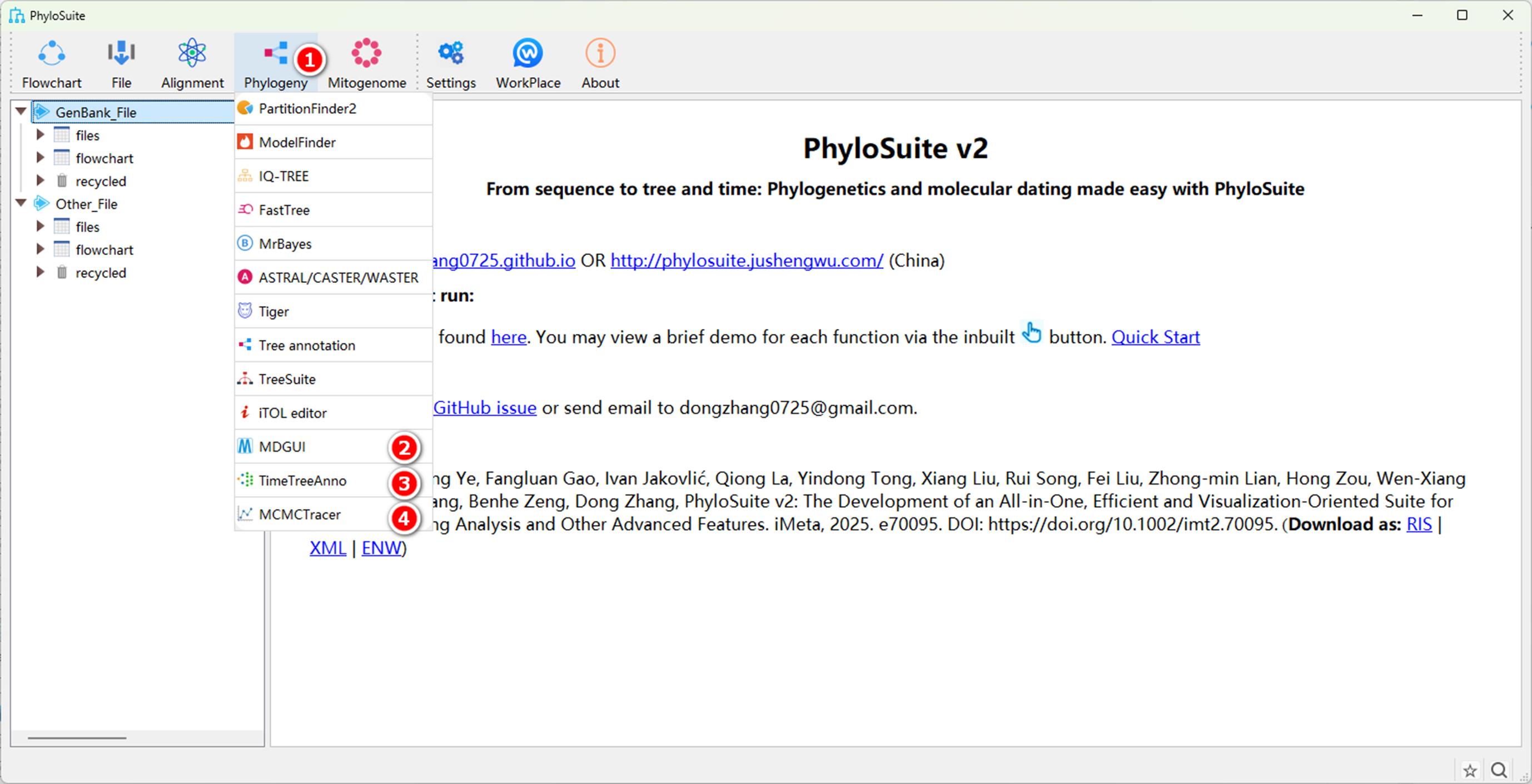
Figure 1. Entry point of the molecular dating analysis suite in PhyloSuite v2. Screenshot showing the location from which users can access the integrated molecular dating analysis suite within the PhyloSuite v2 main interface: (1) phylogeny option in the main interface; (2) entry point of MDGUI; (3) entry point of TimeTreeAnno; (4) entry point of MCMCTracer.
Software and datasets
1. PhyloSuite v2 (https://github.com/dongzhang0725/PhyloSuite, 2025/11/26)
2. Genomic data of Antarctic notothenioid fish (https://datadryad.org/dataset/doi:10.5061/dryad.80gb5mktn, 2022/12/09)
Note: The tutorial dataset used in this protocol was tested on a computer equipped with an Intel Ultra 5 125H CPU and 32 GB RAM. During routine execution, RAM usage was generally around 1.1 GB, with a peak of approximately 1.2 GB, while CPU usage was approximately 0.3%–2.7%. Considering that users may run other software simultaneously, we recommend that the local machine have at least 16 GB of RAM when running this tutorial dataset. Larger datasets may require additional memory.
Environment and download
PhyloSuite is primarily written in Python and has been compiled to run on Windows, macOS, and Linux operating systems. To ensure that all necessary dependencies are included, users are recommended to download the version with plugins (bundled version). The latest version of PhyloSuite can be downloaded at https://github.com/dongzhang0725/PhyloSuite.
Tip: Users can download example files from the official website (http://phylosuite.jushengwu.com/example.zip) for software testing and debugging purposes.
Procedure
登录/注册后免费查看全文
文章信息
稿件历史记录
提交日期: Feb 11, 2026
接收日期: Apr 2, 2026
在线发布日期: Apr 26, 2026
出版日期: May 20, 2026
版权信息
© 2026 The Author(s); This is an open access article under the CC BY-NC license (https://creativecommons.org/licenses/by-nc/4.0/).
如何引用
Zhao, D., Jakovlić, I., Liu, X., Wang, S., Zhang, D. and Ye, T. (2026). A Step-by-Step GUI-Based Protocol for Molecular Dating Analysis Using PhyloSuite v2. Bio-protocol 16(10): e5688. DOI: 10.21769/BioProtoc.5688.

 Download Citation in RIS Format
分类
生物信息学与计算生物学
系统生物学 > 基因组学 > 种系遗传学
您对这篇实验方案有问题吗?
在此处发布您的问题,我们将邀请本文作者来回答。同时,我们会将您的问题发布到Bio-protocol Exchange,以便寻求社区成员的帮助。
 发布问题
发布问题


