


Generation of Functional Patient-Specific Thymus Organoids From Human Pluripotent Stem Cells (hPSCs) Using Air–Liquid Interface Culture
利用气液界面培养从人多能干细胞(hPSCs)构建患者特异性功能性胸腺类器官

发布: 2026年05月05日第16卷第9期 DOI: 10.21769/BioProtoc.5684 浏览次数: 1077
评审: Anonymous reviewer(s)
 PDF
PDF  Q&A
Q&A
参见作者原研究论文
The authors used this protocol in:

Apr 2023
Advertisement







Abstract
The thymus is critical for the establishment of a functional and self-tolerant adaptive immune system, but it involutes with age, resulting in reduced naive T-cell output. Generation of a functional human thymus from human pluripotent stem cells (hPSCs) is an attractive regenerative medicine strategy. Direct differentiation of thymic epithelial progenitors (TEPs) from hPSCs has been demonstrated in vitro, but functional thymic epithelial cells (TECs) develop only after transplantation of TEPs in vivo. Functional human reaggregated thymic organoid cultures (RTOCs) and artificial thymic organoids (ATOs) cultured at the air–liquid interface support T-cell development in vitro and in vivo and permit the interrogation of human thymic function and T-cell development. However, these approaches require access to primary human tissues or murine bone marrow stromal cells, are allogeneic, and do not support negative selection. Recently, we reported the directed differentiation of induced PSCs (iPSCs) to functional thymic epithelial progenitors (TEPs) that support murine T-cell development after transplantation in nude mice. Here, we combined hPSC-derived TEPs, hematopoietic progenitor cells (HPCs), and mesenchymal cells, differentiated from the same hPSC line, and generated functional isogenic stem cell–derived thymic organoids (sTOs). Our revised protocol improves our TEP differentiation process and allows the generation of functional isogenic, patient-specific thymic organoids in vitro.
Key features
• This protocol offers a reproducible approach to generate functional multicellular stem cell–derived thymic organoids (sTOs).
• sTOs support human thymic epithelial cell development and maturation in vitro in a patient-specific manner.
• sTOs support human T-cell development from stem cell–derived hematopoietic progenitor cells.
• sTOs may facilitate positive and negative thymic selection of developing T cells in vitro.
Keywords: Stem cell–derived thymic organoids (干细胞来源胸腺类器官) Thymic epithelial cells (胸腺上皮细胞)
Human pluripotent stem cells (人多能干细胞)
Human T-cell development (人 T 细胞发育)
Positive and negative selection (正选择与负选择)
Cell therapy (细胞治疗)
Thymic epithelial cells (胸腺上皮细胞)
Human pluripotent stem cells (人多能干细胞)
Human T-cell development (人 T 细胞发育)
Positive and negative selection (正选择与负选择)
Cell therapy (细胞治疗)
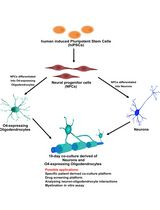
Graphical overview
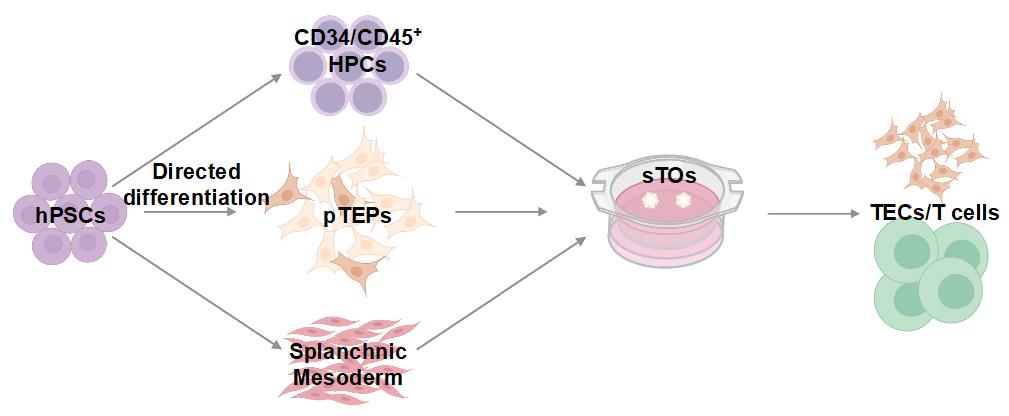
Generation of functional thymic organoids from hPSCs. Human pluripotent stem cells (hPSCs), hematopoietic progenitor cells (HPCs), patient-specific thymic epithelial progenitors (pTEPs), stem cell–derived thymic organoids (sTOs), thymic epithelial cells (TECs).
Background
The thymus is required for the development of a functional adaptive immune system, facilitating the generation of self-tolerant T cells that can respond to foreign antigens. Thymic epithelial cells (TECs) are divided into cortical and medullary (c/m) TECs, based on their location and function, and can be identified by the expression of KRTs 8 and 5, respectively. c- and mTECs originate from common bipotent progenitors, which first express KRT8 only and then co-express both keratins prior to bifurcating into c- and mTEC lineages [4]. Age-related involution of the thymus results in decreased thymic function and naive T-cell output and increased autoimmunity and disease risk [5,6]. Thymic dysfunction or absence can result from intrinsic or extrinsic factors, namely DiGeorge syndrome (DGS), FOXN1 deficiency, infection, or radiation therapy [7,8]. Complete athymia can be treated with an allogeneic thymus transplant; however, such treatment is associated with various complications and relies on limited donor tissue [8,9]. Thus, an experimental model system to interrogate the mechanisms of thymic insufficiency and function is necessary and could serve to further the development of cell-based treatments for thymic defects.
Thymic organoids cultured at the air–liquid interface allow the interrogation of thymic function and T-cell development [10–15]. Functional human reaggregated thymic organoid cultures (RTOCs) made with expanded primary (1°) TECs and thymic mesenchyme (TM) combined with allogeneic cord blood-derived hematopoietic stem cells (HSCs) support T-cell development in vitro and in vivo [16]. However, RTOCs require access to 1° tissue, utilize allogeneic components, and do not support negative selection.
TECs express Notch ligands, such as DLL4, which are critical for T-cell commitment and differentiation. In vitro, transgenic OP9 or MS5 murine bone marrow stromal cells expressing human DLL1 or DLL4 support positive selection of developing murine and human T-cell progenitors [17]. Combining primary HSCs [18] or human pluripotent stem cell (hPSC)-derived embryonic mesodermal progenitors (EMPs) [19] with MS5-DLL1/DLL4 cells, the Crooks group elegantly demonstrated T-cell development in artificial thymic organoids (ATOs) in vitro. Though OP9-DLL1 and ATO cultures eliminate the need for primary tissue, the lack of thymic stromal cells and class II major histocompatibility complex/human leukocyte antigen (MHC/HLA) expression on supporting stromal cells results in a skew toward CD8 T-cell development. Thus, we developed a thymic organoid model derived from isogenic hPSC-derived cell compartments that supports patient-specific TEC and T-cell development in vitro. This platform eliminates the need for primary human and/or mouse tissues and transgenic murine bone marrow stromal cell lines. Furthermore, our approach permits the study of aspects of thymic epithelial cell development, and potentially negative thymic selection, in the human context and in a patient-specific manner.
Materials and reagents
Biological materials
1. Embryonic stem cell (ESC) line (human MEL-1 INSGFP/W) [20]
2. ESC line (Human MEL-1 FOXN1GFP/W) [21]
3. Induced pluripotent stem cell (iPSC) line (human CB2) [1]
4. iPSC line (human CB3) [1]
5. iPSC line (human CUHM008) [1]
6. iPSC line (human CUHM009) [1]
Reagents
1. 2-phospho-L-ascorbic acid trisodium salt (Sigma-Aldrich, catalog number: 49752-10G)
2. 2-Mercaptoethanol (Thermo Fisher Scientific, catalog number: 21985023)
3. A83-A8301 (MedChem Express, catalog number: HY-10432)
4. Activin A (R&D Systems, catalog number: 338-AC-01M)
5. AccutaseTM (STEMCELL Technologies, catalog number: 07920)
6. Advanced DMEM/F12 (Thermo Fisher Scientific, catalog number: 12634010)
7. BMP-4 (R&D Systems, catalog number: 314-BPE-050)
8. C59 (Cellagen Technologies, catalog number: C76412S)
9. CellAdhereTM dilution buffer (STEMCELL Technologies, catalog number: 07183)
10. CHIR99021 (STEMCELL Technologies, catalog number: 72054)
11. Collagenase D (Millipore Sigma, catalog number: 11088858001)
12. Collagenase/dispase (Millipore Sigma, catalog number: 10269638001)
13. CryoStor® cell cryopreservation media (Millipore Sigma, catalog number: C2874)
14. Dulbecco’s phosphate buffered saline (D-PBS) (Thermo Fisher Scientific, catalog number: 14190144)
15. DMEM, high glucose (Thermo Fisher Scientific, catalog number: 11965092)
16. DNase I (Roche, catalog number: 10104159001)
17. Ethylenediaminetetraacetic acid, (EDTA), 0.5 M solution, molecular biology grade, ultrapure (Thermo Fisher Scientific, catalog number: J15694.AP)
18. EGF (R&D Systems, catalog number: 236-EG-01M)
19. Fetal bovine serum (FBS) (Thermo Fisher Scientific, catalog number: A5670801)
20. FGF2 (R&D Systems, catalog number: 233-FB-500)
21. FGF8b (PeproTech/Thermo Fisher Scientific, catalog number: 100-25-250UG)
22. FLT-3L (PeproTech/Thermo Fisher Scientific, catalog number: 300-19-250UG)
23. GlutaMAX (Gibco, catalog number: 35050-061)
24. Ham’s F-12 Nutrient Mix (Thermo Fisher Scientific, catalog number: 11765054)
25. Heparin (Sigma-Aldrich, catalog number: H3149-250KU)
26. HEPES (Thermo Fisher Scientific, catalog number: 15630080)
27. Human serum (Gemini, catalog number: 100-512)
28. Human TruStain FcXTM (BioLegend, catalog number: 422302)
29. Hybridoma mix (Thermo Fisher Scientific, catalog number: 12045084)
30. Hydrocortisone (Sigma-Aldrich, catalog number: H0888-1G)
31. IGF-II (PeproTech/Thermo Fisher Scientific, catalog number: AF-100-12-250UG)
32. IL-7 (PeproTech, catalog number: AF-200-07-250UG)
33. IMDM/F12 (Thermo Fisher Scientific, catalog number: 12440053)
34. ITSE AF (Invitria, catalog number: 777ITS091)
35. Insulin-transferrin-selenium (ITS) (Gibco, catalog number: 41400-045)
36. Knockout DMEM/F12 (Thermo Fisher Scientific, catalog number: 12660012)
37. LDN193189 (Stemcell Technologies, catalog number: 72149)
38. LiberaseTM (Roche, catalog number: 5401127001)
39. Lipid mixture 1 (Sigma-Aldrich, catalog number: L0288-100 mL)
40. LY364947 (R&D Systems, catalog number: 2718)
41. Matrigel (Corning, catalog number: 354277)
42. Methyl cellulose (Sigma-Aldrich, catalog number: M7027-100G)
43. mTeSR Plus (STEMCELL Technologies, catalog number: 05826)
44. N21-MAX media supplement (R&D Systems, catalog number: AR008)
45. Non-essential amino acids (Gibco, catalog number: 11140-050)
46. Paraformaldehyde 16% aqueous solution EM grade (Electron Microscopy Sciences, catalog number: 15710)
47. Penicillin-streptomycin (Thermo Fisher Scientific, catalog number: 15140122)
48. Phosphate buffered saline (PBS) (Thermo Fisher Scientific, catalog number: 10010023)
49. PIK90 (Cayman Chemical Company, catalog number: 10010749)
50. Polyvinyl alcohol (Sigma-Aldrich, catalog number: P1763-250G)
51. Propidium iodide (Thermo Fisher Scientific, catalog number: P1304MP)
52. ReLeSRTM (STEMCELL Technologies, catalog number: 100-0483)
53. Rock inhibitor Y-27632 (R&D Systems, catalog number: 1254-50)
54. SAG (R&D Systems, catalog number: 4366/10)
55. SANT1 (Tocris, catalog number: 1974)
56. SB431542 (STEMCELL Technologies, catalog number: 100-1051)
57. SCF (PeproTech/Thermo Fisher Scientific, catalog number: 300-07-250UG)
58. Sucrose, molecular biology grade (Thermo Fisher Scientific, catalog number: J65148.36)
59. TheraPEAKTM X-VIVOTM 10 (Lonza Bioscience, catalog number: BP04-743Q)
60. TrypLE (Gibco, catalog number: 12-604-021)
61. Trolox (Millipore Sigma, catalog number: 648471)
62. TTNPB (R&D Systems, catalog number: 0761)
63. VEGF (PeproTech/Thermo Fisher Scientific, catalog number: AF-100-20-250UG)
64. Vitronectin XFTM (STEMCELL Technologies, catalog number: 07180)
65. Wnt-3a (R&D Systems and Bio-Techne: 5036-WN-010)
66. Antibodies (flow cytometry)
a. CD3 (BioLegend, catalog numbers: 317308 and 344818), 1:100
b. CD4 (BioLegend, catalog number: 300520), 1:100
c. CD5 (BioLegend, catalog number: 364010), 1:180
d. CD7 (BioLegend, catalog numbers: 343104 and 343114), 1:60
e. CD8 (BioLegend, catalog numbers: 300916 and 300910), 1:100
f. CD25 (BioLegend, catalog number: 302614), 1:20
g. CD34 (BioLegend, catalog number: 343610), 1:40
h. CD45 (BioLegend, catalog numbers: 304036 and 304017), 1:180
i. CD104 (BioLegend, catalog number: 327806 and 327808), 1:50
j. CD127 (BioLegend, catalog number: 351344), 1:50
k. CD205 (BioLegend, catalog number: 342210), 1:50
l. EPCAM (eBioscience, catalog number: 56-9326-42), 1:50
m. PD-1 (R&D Systems, catalog number: 1615114), 1:50
n. HLA-DR (BioLegend, catalog number: 307636), 1:50
67. Primers (HPLC-purified from IDT):
ACTB F: CATGTACGTTGCTATCCAGGC
ACTB R: CTCCTTAATGTCACGCACGAT
Pro-Insulin F: GCAGCCTTTGTGAACCAACAC
Pro-Insulin R: CCCCGCACACTAGGTAGAGA
Islet Antigen 2 F: CGGGACACATGATTCTGGCAT
Islet Antigen 2 R: CTGCTTGGTAGGCACAGAGG
GAD1 F: GCGGACCCCAATACCACTAAC
GAD1 R: CACAAGGCGACTCTTCTCTTC
MBP F: GGCCGGACCCAAGATGAAAA
MBP R: CCCCAGCTAAATCTGCTCAGG
TG F: AGACACCTCCTACCTCCCTCA
TG R: TCCTTGGACATCGCTTTGGC
68. qPCR iTAQ probes:
AIRE (Bio-Rad, qHsaCIP0029272)
DLL4 (Bio-Rad, qHsaCEP0051500)
FOXN1 (ThermoFisher, Hs00919266_m1)
HLA-DRA (Bio-Rad, qHsaCEP0040019)
KRT5 (Bio-Rad, qHsaCEP0055058)
KRT8 (Bio-Rad, qHsaCEP0041467)
OAZ1 (ThermoFisher, Hs00427923_m1)
Solutions
1. Digestion buffer (see Recipes)
2. Fluorescence-activated cell sorting (FACS) buffer (see Recipes)
3. mTeSR Plus complete medium (see Recipes)
4. Quench media (see Recipes)
5. SMD base media (see Recipes)
6. SMD-1 (see Recipes)
7. SMD-2 (see Recipes)
8. SMD-3 (see Recipes)
9. Thymic epithelial progenitor cell differentiation medium (TCD)-1 (see Recipes)
10. TCD-2 (see Recipes)
11. TCD-3 (see Recipes)
12. TCD-4 (see Recipes)
13. TCD-5 (see Recipes)
14. Hematopoietic progenitor cell differentiation (HCD) base media (see Recipes)
15. HCD-1 (see Recipes)
16. HCD-2 (see Recipes)
17. HCD-3 (see Recipes)
18. HCD-4 (see Recipes)
19. HCD-5 (see Recipes)
Recipes
1. Digestion buffer
| Reagent | Final concentration | Volume for 15 mL |
|---|---|---|
| DMEM (high glucose) | N/A | 15 mL |
| FBS | 2% (v/v) | 300 μL |
| DNase I (100 mg/mL) | 100 μg/mL | 15 μL |
| LiberaseTM (5 mg/mL) | 96 μg/mL | 288 μL |
| Collagenase D | 1.25 mg/mL | 13.2 mg |
| Collagenase/Dispase | 0.88 mg/mL | 18.8 mg |
Prepare fresh.
2. FACS buffer
| Reagent | Final concentration | Volume for 500 mL |
|---|---|---|
| PBS | 1× | 493 mL |
| FBS | 2% (v/v) | 10 mL |
| EDTA | 2 mM | 2 mL |
If not used immediately, store at 2–8 °C for up to 2 weeks.
3. mTeSR Plus complete medium
| Reagent | Final concentration | Volume for 500 mL |
|---|---|---|
| mTeSR Plus basal medium | 80% (v/v) | 400 mL |
| mTeSR Plus 5× supplement | 20% (v/v) | 100 mL |
If not used immediately, store mTeSR Plus complete medium at 2–8 °C for up to 2 weeks.
4. Quench media
| Reagent | Final concentration | Volume for 50 mL |
|---|---|---|
| DMEM (high glucose) | N/A | 40 mL |
| FBS | 10% (v/v) | 10 mL |
If not used immediately, store at 2–8 °C for up to 2 weeks.
5. SMD base media
| Reagent | Final concentration | Volume for 100 mL |
|---|---|---|
| Advanced DMEM/F12 | N/A | 472.5 mL |
| N21-MAX Media supplement (50×) | 1× | 10 mL |
| GlutaMAX (100×) | 1× | 5 mL |
| HEPES (1 M) | 15 mM | 7.5 mL |
| Penicillin-streptomycin (100×) | 1× | 5 mL |
If not used immediately, store at 2–8 °C for up to 2 weeks.
6. SMD-1
| Reagent | Final concentration | Volume for 100 mL |
|---|---|---|
| SMD base media | N/A | 100 mL |
| Activin A (50 μg/mL) | 30 ng/mL | 60 μL |
| BMP-4 (50 μg/mL) | 40 ng/mL | 80 μL |
| CHIR99021 (4 mM) | 6 μM | 150 μL |
| FGF2 (50 μg/mL) | 20 ng/mL | 40 μL |
| PIK90 (100 mM) | 100 nM | 100 μL |
If not used immediately, store at 2–8 °C for up to 2 weeks.
7. SMD-2
| Reagent | Final concentration | Volume for 100 mL |
|---|---|---|
| SMD base media | N/A | 100 mL |
| A83-A8301 (10 mM) | 1 μM | 10 μL |
| BMP-4 (50 μg/mL) | 30 ng/mL | 60 μL |
| C59 (10 mM) | 1 μM | 10 μL |
If not used immediately, store at 2–8 °C for up to 2 weeks.
8. SMD-3
| Reagent | Final concentration | Volume for 100 mL |
|---|---|---|
| SMD base media | N/A | 100 mL |
| A83-A8301 (10 mM) | 1 μM | 10 μL |
| BMP-4 (50 μg/mL) | 30 ng/mL | 60 μL |
| C59 (10 mM) | 1 μM | 10 μL |
| FGF2 (50 μg/mL) | 20 ng/mL | 40 μL |
| TTNPB (30 μM) | 6 nM | 20 μL |
If not used immediately, store at 2–8 °C for up to 2 weeks.
9. TCD-1
| Reagent | Final concentration | Volume for 100 mL |
|---|---|---|
| TheraPEAKTM X-VIVOTM 10 | N/A | 100 mL |
| Activin A (50 μg/mL) | 100 ng/mL | 200 μL |
| Wnt-3a (25 μg/mL) | 50 ng/mL | 200 μL |
| ITS (100×) | 0.02% (v/v) | 20 μL |
If not used immediately, store at 2–8 °C for up to 2 weeks.
10. TCD-2
| Reagent | Final concentration | Volume for 100 mL |
|---|---|---|
| TheraPEAKTM X-VIVOTM 10 | N/A | 100 mL |
| Activin A (50 μg/mL) | 100 ng/mL | 200 μL |
| ITS (100×) | 0.05%(v/v) | 50 μL |
If not used immediately, store at 2–8 °C for up to 2 weeks.
11. TCD-3
| Reagent | Final concentration | Volume for 100 mL |
|---|---|---|
| TheraPEAKTM X-VIVOTM 10 | N/A | 100 mL |
| Activin A | 100 ng/mL | 200 μL |
| TTNPB (30 μM) | 6 nM | 20 μL |
| ITS (100×) | 0.05% (v/v) | 50 μL |
If not used immediately, store at 2–8 °C for up to 2 weeks.
12. TCD-4
| Reagent | Final concentration | Volume for 100 mL |
|---|---|---|
| TheraPEAKTM X-VIVOTM 10 | N/A | 100 mL |
| BMP-4 (50 μg/mL) | 20 ng/mL | 40 μL |
| LY364947 (10 mM) | 5 μM | 50 μL |
| TTNPB (30 μM) | 6 nM | 20 μL |
| SAG (100 μg/mL) | 100 ng/mL | 100 μL |
If not used immediately, store at 2–8 °C for up to 2 weeks.
13. TCD-5
| Reagent | Final concentration | Volume for 100 mL |
|---|---|---|
| TheraPEAKTM X-VIVOTM 10 | N/A | 100 mL |
| Activin A (50 μg/mL) | 20 ng/mL | 40 μL |
| EGF (200 μg/mL) | 20 ng/mL | 10 μL |
| FGF-8b (100 μg/mL) | 50 ng/mL | 50 μL |
| LDN193189 (1.25 mM) | 500 nM | 40 μL |
| SANT-1 (2.5 mM) | 250 nM | 20 μL |
| TTNPB (30 μM) | 6 nM | 20 μL |
| Wnt-3a (25 μg/mL) | 50 ng/mL | 200 μL |
| 2-phospho-L-ascorbic acid (50 mg/mL) | 50 μg/mL | 1:1,000 of working volume |
| Heparin (10 mg/mL) | 10 μg/mL | 1:1,000 of working volume |
| Hydrocortisone (50 μg/mL) | 0.5 μg/mL | 1:100 of working volume |
| ITS (100×) | 0.05% (v/v) | 1:2,000 of working volume |
| Non-essential amino acids (100×) | 1% (v/v) | 1:100 of working volume |
| Trolox (100 mM) | 0.1 mM | 1:1,000 of working volume |
2-phospho-L-ascorbic acid trisodium salt, heparin, and Trolox should be added to the medium immediately before use.
If not used immediately, store TCD-5 at 2–8 °C for up to 2 weeks.
14. Hematopoietic cell differentiation (HCD) base media
| Reagent | Final concentration | Volume for 500 mL |
| IMDM | N/A | 232 mL |
| Ham’s F12 Nutrient Mix | N/A | 232 mL |
| Hybridoma Mix | 4% (v/v) | 20 mL |
| GlutaMAX (100×) | 1× | 5 mL |
| Human serum | 0.1% (v/v) | 500 μL |
| ITSE AF | 0.1% (v/v) | 500 μL |
| Polyvinyl alcohol (100 mg/mL) | 1 mg/mL | 5 mL |
| Lipid Mix 1 | 1% (v/v) | 5 mL |
| 2-Mercaptoethanol (55 mM) | 22 μM | 200 μL |
| 2-phospho-L-ascorbic acid (50 mg/mL) | 50 μg/mL | 1:1,000 of working volume |
2-phospho-L-ascorbic acid trisodium salt should be added to the medium immediately before use.
If not used immediately, store HCD base media at 2–8 °C for up to 2 weeks.
15. HCD-1
| Reagent | Final concentration | Volume for 100 mL |
|---|---|---|
| HCD base media | N/A | 100 mL |
| Activin A (50 μg/mL) | 10 ng/mL | 20 μL |
| BMP-4 (50 μg/mL) | 20 ng/mL | 40 μL |
| CHIR99021 (4 mM) | 0.5 μM | 12.5 μL |
| FGF-2 (50 μg/mL) | 10 ng/mL | 20 μL |
| Rock inhibitor Y-27632 (10 mM) | 10 μM | 100 μL |
| SCF (100 μg/mL) | 20 ng/mL | 20 μL |
| VEGF (100 μg/mL) | 20 ng/mL | 20 μL |
If not used immediately, store at 2–8 °C for up to 2 weeks.
16. HCD-2
| Reagent | Final concentration | Volume for 100 mL |
|---|---|---|
| HCD base media | N/A | 100 mL |
| Activin A (50 μg/mL) | 10 ng/mL | 20 μL |
| BMP-4 (50 μg/mL) | 20 ng/mL | 40 μL |
| CHIR99021 (4 mM) | 0.5 μM | 12.5 μL |
| FGF-2 (50 μg/mL) | 10 ng/mL | 20 μL |
| SCF (100 μg/mL) | 20 ng/mL | 20 μL |
| VEGF (100 μg/mL) | 20 ng/mL | 20 μL |
If not used immediately, store at 2–8 °C for up to 2 weeks.
17. HCD-3
| Reagent | Final concentration | Volume for 100 mL |
|---|---|---|
| HCD base media | N/A | 100 mL |
| BMP-4 (50 μg/mL) | 20 ng/mL | 40 μL |
| CHIR99021 (4 mM) | 3 μM | 75 μL |
| FGF-2 (50 μg/mL) | 10 ng/mL | 20 μL |
| SB431542 (10 mM) | 3 μM | 30 μL |
| SCF (100 μg/mL) | 20 ng/mL | 20 μL |
| VEGF (100 μg/mL) | 20 ng/mL | 20 μL |
If not used immediately, store at 2–8 °C for up to 2 weeks.
18. HCD-4
| Reagent | Final concentration | Volume for 100 mL |
|---|---|---|
| HCD base media | N/A | 100 mL |
| BMP-4 (50 μg/mL) | 20 ng/mL | 40 μL |
| FGF-2 (50 μg/mL) | 10 ng/mL | 20 μL |
| IGF-II (50 μg/mL) | 20 ng/mL | 40 μL |
| SCF (100 μg/mL) | 50 ng/mL | 50 μL |
| VEGF (100 μg/mL) | 50 ng/mL | 50 μL |
If not used immediately, store at 2–8 °C for up to 2 weeks.
19. HCD-5
| Reagent | Final concentration | Volume for 100 mL |
|---|---|---|
| HCD base media | N/A | 100 mL |
| FGF-2 (50 μg/mL) | 10 ng/mL | 20 μL |
| FLT-3L (50 μg/mL) | 10 ng/mL | 20 μL |
| IL-7 (50 μg/mL) | 20 ng/mL | 20 μL |
| SCF (100 μg/mL) | 100 ng/mL | 100 μL |
| VEGF (100 μg/mL) | 50 ng/mL | 50 μL |
If not used immediately, store at 2–8 °C for up to 2 weeks.
Laboratory supplies
1. 70 μm reversible cell strainer (STEMCELL Technologies, catalog number: 27260)
2. 100 μm cell strainer (Millipore Sigma, catalog number: CLS431752)
3. Falcon® 5 mL round-bottom polystyrene test tube, with cell strainer snap cap (Corning, catalog number: 352235)
4. Standard tissue culture-treated 6-well multi-well plate (Corning, catalog number: 3516)
5. Millicell® standing cell culture inserts (Millipore Sigma, catalog number: PICM03050)
6. 6-well ultra-low adherent plate for suspension culture (Millipore Sigma, catalog number: CLS3471)
Equipment
1. Swing bucket centrifuge
2. Cytek Aurora 5-laser cytometer.
3. CountessTM 3 FL Automated Cell Counter (Thermo Fisher Scientific, catalog number: AMQAF2000)
Software and datasets
1. Prism v10.4.1 (GraphPad, 12/05/2024)
2. FlowJo v10.10 (FlowJo LLC, 11/16/2023)
Procedure
登录/注册后免费查看全文
文章信息
稿件历史记录
提交日期: Aug 26, 2025
接收日期: Mar 25, 2026
在线发布日期: Apr 27, 2026
出版日期: May 5, 2026
版权信息
© 2026 The Author(s); This is an open access article under the CC BY-NC license (https://creativecommons.org/licenses/by-nc/4.0/).
如何引用
Ramos, S. A. and Russ, H. A. (2026). Generation of Functional Patient-Specific Thymus Organoids From Human Pluripotent Stem Cells (hPSCs) Using Air–Liquid Interface Culture. Bio-protocol 16(9): e5684. DOI: 10.21769/BioProtoc.5684.

 Download Citation in RIS Format
分类
干细胞 > 类器官培养
干细胞 > 多能干细胞 > 细胞分化
免疫学 > 免疫细胞分化 > T 细胞
您对这篇实验方案有问题吗?
在此处发布您的问题,我们将邀请本文作者来回答。同时,我们会将您的问题发布到Bio-protocol Exchange,以便寻求社区成员的帮助。
 发布问题
发布问题


