


Reconstitution of Active Plant H+-ATPase AHA2 in Giant Unilamellar Vesicles
在巨大单层囊泡中重构具有活性的植物 H⁺-ATPase AHA2

发布: 2026年05月05日第16卷第9期 DOI: 10.21769/BioProtoc.5675 浏览次数: 517
评审: Willy R Carrasquel-UrsulaezAnonymous reviewer(s)
 PDF
PDF  Q&A
Q&A
参见作者原研究论文
The authors used this protocol in:

Mar 2025
Advertisement





Abstract
Membrane transporters mediate the selective movement of ions and molecules across biological membranes and are essential for cellular homeostasis. However, their functional characterization in living cells is often complicated by the complexity of the native membrane environment. Reconstitution into model membrane systems provides a powerful alternative by enabling precise control over lipid composition and experimental conditions. Giant unilamellar vesicles (GUVs) are particularly well suited for transporter studies, as their cell-sized dimensions allow direct microscopic observation and fluorescence-based measurements of protein activity. Here, we describe a two-step reconstitution protocol in which transport proteins are first incorporated into large unilamellar vesicles and then used to generate protein-containing giant unilamellar vesicles (proteo-GUVs) via the poly(vinyl alcohol) swelling method. This two-step approach enhances protein incorporation efficiency and preserves transporter functionality. The method is exemplified using the P3-type ATPase Arabidopsis thaliana plasma membrane H+-ATPase isoform 2 (AHA2). We further describe a fluorescence-based assay to assess proton transport activity in proteo-GUVs. Our approach provides a versatile and controlled platform for biochemical, biophysical, and single-molecule analysis of membrane transporters.
Key features
• Describes a SNAP-based labeling method.
• Provides a reconstitution approach based on detergent removal using size-exclusion chromatography and bio-beads.
• Introduces a gentle dehydration–rehydration strategy using gel-assisted swelling for the generation of proteo-GUVs.
• Measures proton pump activity in GUVs under a confocal microscope using the pH-sensitive dye pyranine.
Keywords: GUV (巨大单层囊泡) proteo-GUV (蛋白巨大单层囊泡)
Gel-assisted swelling (凝胶辅助溶胀法)
LUV (大单层囊泡)
PVA (PVA)
Proteoliposome (蛋白脂质体)
proteo-GUV (蛋白巨大单层囊泡)
Gel-assisted swelling (凝胶辅助溶胀法)
LUV (大单层囊泡)
PVA (PVA)
Proteoliposome (蛋白脂质体)
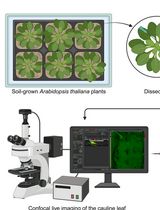
Graphical overview
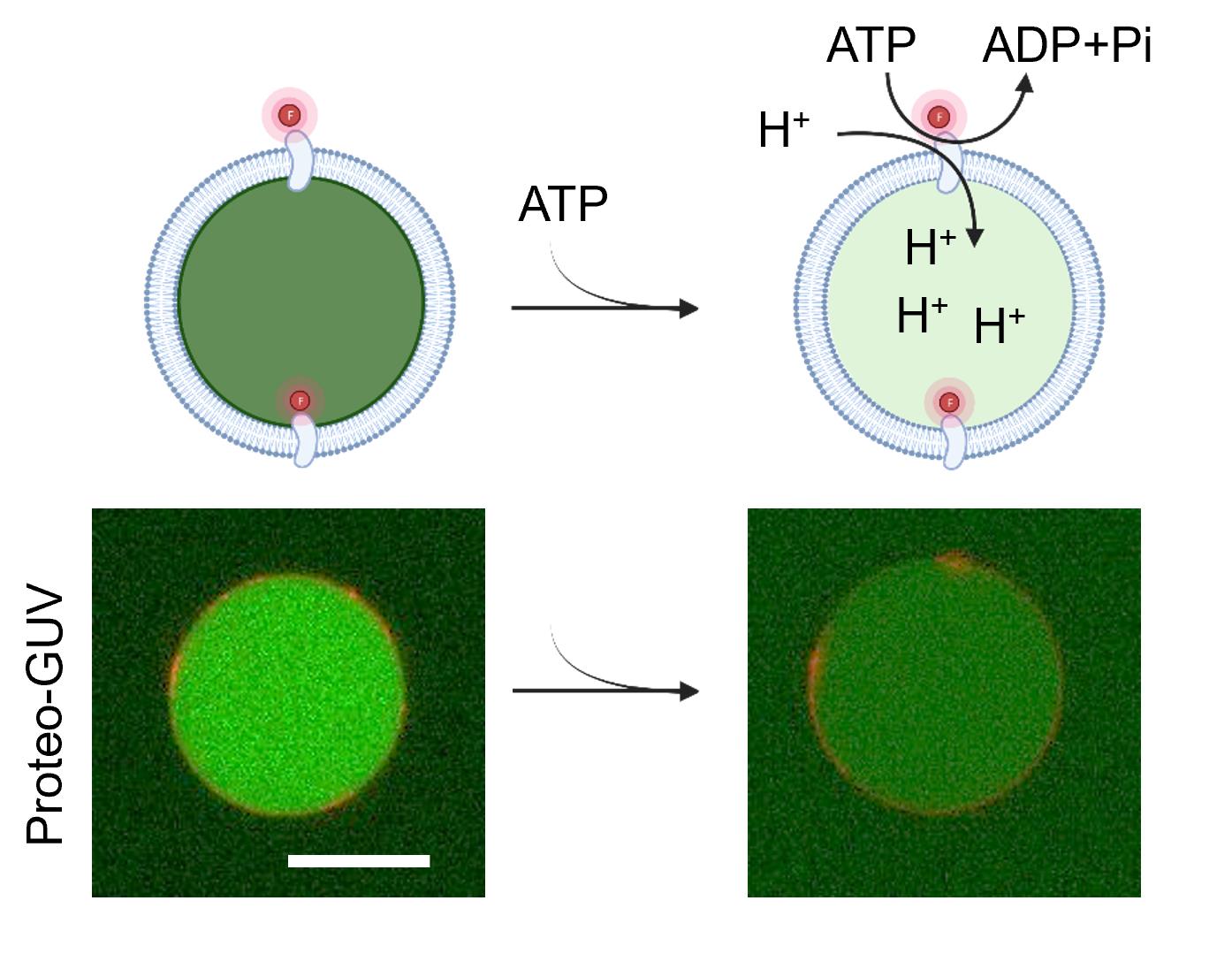
Functional SNAP-AHA2 in giant unilamellar vesicle (GUV)
Background
Membrane transporters are essential for cellular function by mediating the transport of ions and molecules across biological membranes. Studying them in cells is challenging due to the complexity of the cellular environment. Reconstitution into model membrane systems, such as liposomes, enables investigations under well-defined chemical conditions and supports detailed biochemical, biophysical, and single-molecule analyses [1]. This approach is particularly useful for studying P-type ATPases, exemplified here by the P3-ATPase Arabidopsis thaliana H+-ATPase isoform 2 (AHA2), which uses ATP hydrolysis to generate a proton gradient that drives processes such as nutrient uptake, pH regulation, stomatal opening, and cell growth [2,3]. Giant unilamellar vesicles (GUVs) extend these capabilities by offering cell-sized membranes amenable to direct microscopic observation and quantitative fluorescence analysis [4–6]. GUVs with defined lipid compositions allow systematic assessment of membrane protein activity using fluorophores [7]. Various strategies exist for generating membrane protein–containing GUVs (proteo-GUVs), including electroformation, swelling methods, charge-mediated fusion, and direct reconstitution [8–14]. Here, we employ the poly(vinyl alcohol) (PVA) swelling method to generate proteo-GUVs from proteoliposomes (protein–containing large unilamellar vesicles). The method is simple and compatible with both neutral and charged lipids, works under physiological ionic strength conditions, and preserves membrane protein integrity and activity.
Materials and reagents
Biological materials
1. Purified membrane protein
The C-terminally truncated Arabidopsis thaliana plasma membrane H+-ATPase isoform 2 (AHA2), containing an N-terminal hexahistidine tag for purification and a SNAP tag for fluorescent labeling (hereafter referred to as SNAP–AHA2), was used in this protocol. SNAP–AHA2 was heterologously expressed in Saccharomyces cerevisiae strain RS-72 (MATa, ade1-100 his4-519 leu2-3,112; the endogenous proton pump PMA1 gene is under the control of the GAL1 promoter) [15] and purified via the His-tag, resulting in protein concentrations of 5–10 mg/mL. Purified SNAP–AHA2 was stored in storage buffer composed of 50 mM MOPS-KOH (pH 7.0), 20% (w/v) glycerol, 50 mM KCl, 1 mM ethylenediaminetetraacetic acid, 1 mM dithiothreitol, and 0.04% (w/v) n-Dodecyl-β-D-maltoside (DDM). Aliquots were frozen in liquid nitrogen and stored at -80 °C [16].
2. Large unilamellar vesicles (LUVs)
LUVs were composed of lecithin (Sigma-Aldrich, catalog number: P5638-500G) and prepared according to previously published protocols [17,18]. Briefly, 15 mg of lecithin was dissolved in 1 mL of buffer (10 mM MOPS-KOH, pH 7.0, 50 mM K2SO4), yielding a lipid concentration of 15 mg/mL. The lipid solution was extruded 15 times through 200-nm polycarbonate membranes to obtain LUVs with a uniform size distribution.
Note: Lecithin is a heterogeneous mixture of phospholipids. For experiments requiring precise control over lipid composition, synthetic phospholipids can be used as an alternative. However, membrane proteins may display specific lipid requirements with respect to phospholipid headgroup identity and fatty acid chain length and/or degree of saturation. Consequently, empirical optimization of lipid composition may be necessary to achieve optimal protein stability and activity.
Reagents
1. Adenosine 5′-triphosphate disodium salt (ATP) (Roth, catalog number: HN35.3)
2. Bio-beads SM-2 resin (Bio-Rad Laboratories Inc., catalog number: 1523920)
3. Deionized water
4. Detergent/Soap
5. DMSO (Sigma-Aldrich, catalog number: 276855)
6. Dithiothreitol (Millipore, catalog number: 1.11474)
7. Ethanol (96%) (Sigma-Aldrich, catalog number: 64-17-5)
8. Ethylenediaminetetraacetic acid (EDTA) (Sigma, catalog number: E6758)
9. Glucose (Duchefa Biochemie, catalog number: G0802.5000)
10. Glycerol (VWR, catalog number: 24388.295)
11. HEPES (Carl Roth, catalog number: 6763.3)
12. Lecithin (Sigma-Aldrich, catalog number: 429415)
13. Magnesium sulfate heptahydrate (MgSO4·7H2O) (Merck, catalog number 10034-99-8)
14. Methanol (PROLABO® CHEMICALS, VWR, catalog number: 20834.291)
15. MOPS (Sigma-Aldrich, catalog number: M1254)
16. Mowiol®28-99, Poly(vinyl)alcohol) (PVA), MW 145,000 (Sigma-Aldrich, catalog number: 10849-250G)
17. n-Dodecyl-β-D-maltoside (DDM) (Glycon, catalog number: D97002)
18. Octyl β-D-glucopyranoside (OG) (Glycon, catalog number: D97002)
19. Potassium chloride (KCl) (Merck, catalog number: 7447-40-7)
20. Potassium hydroxide (KOH), 1 M (Sigma-Aldrich, catalog number: 1310-58-3)
21. Potassium sulfate (K2SO4) (Sigma-Aldrich, catalog number: P9458-250G)
22. Pyranine (8-Hydroxypyrene-1,3,6-trisulfonic acid trisodium salt) (Sigma-Aldrich, catalog number: H1529)
23. Sephadex G-50 fine (Sigma-Aldrich, catalog number: S5897)
24. SNAP-Surface® Alexa Fluor® 647 (New England Biolabs, catalog number: S9136S) dissolved in DMSO and stored at -20 °C
25. Sodium chloride (NaCl) (Carl Roth, catalog number: 7647-14-5)
26. Sucrose (Duchefa Biochemie, catalog number: S0809.5000)
27. Valinomycin (Thermo Fischer, catalog number: J62312.MC)
Solutions
1. ATP (0.5 M) (see Recipes)
2. DDM (20%) (see Recipes)
3. Ethanol (70%) (see Recipes)
4. HEPES-KOH pH 7.4 (0.5 M) (see Recipes)
5. KCl (1 M) (see Recipes)
6. K2SO4 (0.5 M) (see Recipes)
7. KOH (1 M) (see Recipes)
8. MgSO4 (1 M) (see Recipes)
9. Microscopic buffer (300 mM) (see Recipes)
10. MOPS-KOH pH 7 (0.5 M) (see Recipes)
11. NaCl (1 M) (see Recipes)
12. OG (1 M) (see Recipes)
13. PVA (5%) (see Recipes)
14. Pyranine (0.1 M) (see Recipes)
15. Reconstitution buffer (see Recipes)
16. Sephadex G-50 fine gel (see Recipes)
17. SNAP labeling buffer (see Recipes)
18. Swelling buffer (300 mM) (see Recipes)
19. Valinomycin (125 μM) (see Recipes)
Recipes
Note: All solutions are stored at 4 °C if not stated otherwise.
1. ATP (0.5 M)
| Reagent | Final concentration | Quantity or volume |
|---|---|---|
| ATP | 0.5 M | 2.25 g |
| ddH2O | n/a | Fill up to 10 mL |
| Total | n/a | 10 mL |
Before adjusting the solution to its final volume with ddH2O, check the pH and adjust it to 7 using 1 M KOH. Store in aliquots at -20 °C.
2. DDM (20%, w/v)
| Reagent | Final concentration | Quantity or volume |
|---|---|---|
| DDM | 20% | 2 g |
| ddH2O | n/a | 10 mL |
Aliquot into 1 mL portions and store at -20 °C.
3. Ethanol (70%, v/v)
| Reagent | Final concentration | Quantity or volume |
|---|---|---|
| Ethanol, 96% | 70% | 729.17 mL |
| ddH2O | n/a | 270.83 mL |
| Total | n/a | 1,000 mL |
Store at room temperature.
4. HEPES-KOH pH 7.4 (0.5 M)
| Reagent | Final concentration | Quantity or volume |
|---|---|---|
| HEPES | 0.5 M | 23.83 g |
| ddH2O | n/a | Fill up to 200 mL |
| Total | n/a | 200 mL |
Before adjusting the solution to its final volume with ddH2O, check the pH and adjust it to 7.4 using 1 M KOH.
5. KCl (1 M)
| Reagent | Final concentration | Quantity or volume |
|---|---|---|
| KCl | 1 M | 3.728 g |
| ddH2O | n/a | Fill up to 50 mL |
| Total | n/a | 50 mL |
Store at room temperature.
6. K2SO4 (0.5 M)
| Reagent | Final concentration | Quantity or volume |
|---|---|---|
| K2SO4 | 0.5 M | 17.43 g |
| ddH2O | n/a | Fill up to 200 mL |
| Total | n/a | 200 mL |
Store at room temperature.
7. KOH (1 M)
| Reagent | Final concentration | Quantity or volume |
|---|---|---|
| KOH | 1 M | 5.611 g |
| ddH2O | n/a | Fill up to 100 mL |
| Total | n/a | 100 mL |
8. MgSO4 (1 M)
| Reagent | Final concentration | Quantity or volume |
|---|---|---|
| MgSO4·7H2O | 1 M | 1.233 g |
| ddH2O | n/a | Fill up to 5 mL |
| Total | n/a | 5 mL |
Store at room temperature.
9. Microscopic buffer (300 mM)
| Reagent | Final concentration | Quantity or volume |
|---|---|---|
| MOPS-KOH pH 7, 0.5 M | 10 mM | 1 mL |
| K2SO4, 0.5 M | 50 mM | 5 mL |
| MgSO4, 1M | 4 mM | 0.2 mL |
| Valinomycin, 125 μM | 62.5 nM | 25 μL |
| Glucose | 132 mM | 1.189 g |
| ddH2O | n/a | Fill up to 50 mL |
| Total | n/a | 50 mL |
Filter-sterilize using a 0.2 μm Acrodisc® syringe filter.
10. MOPS-KOH pH 7 (0.5 M)
| Reagent | Final concentration | Quantity or volume |
|---|---|---|
| MOPS | 0.5 M | 20.93 g |
| ddH2O | n/a | Fill up to 200 mL |
| Total | n/a | 200 mL |
Before adjusting the solution to its final volume with ddH2O, check the pH and adjust it to 7 using 1 M KOH.
11. NaCl (1 M)
| Reagent | Final concentration | Quantity or volume |
|---|---|---|
| NaCl | 1 M | 2.922 g |
| ddH2O | n/a | Fill up to 50 mL |
| Total | n/a | 50 mL |
Store at room temperature.
12. OG (1 M)
| Reagent | Final concentration | Quantity or volume |
|---|---|---|
| OG | 1 M | 2.924 g |
| ddH2O | n/a | Fill up to 10 mL |
| Total | n/a | 10 mL |
Aliquot into 1 mL portions and store at -20 °C.
13. PVA (5%, w/v)
| Reagent | Final concentration | Quantity or volume |
|---|---|---|
| PVA | 5% | 2 g |
| ddH2O | n/a | Fill up to 40 mL |
| Total | n/a | 40 mL |
Dissolve 2 g of PVA in 40 mL of deionized water while stirring in a fume hood at ~90 °C for approximately 5 h. Cover the glass flask with aluminum foil to prevent water evaporation. Transfer the 5% PVA solution into a Falcon tube, seal with Parafilm, and store at 60 °C.
14. Pyranine (0.1 M)
| Reagent | Final concentration | Quantity or volume |
|---|---|---|
| Pyranine | 0.1 M | 0.5 g |
| ddH2O | n/a | 9.535 mL |
Aliquot into 1 mL portions and store at -20 °C.
15. Reconstitution buffer
| Reagent | Final concentration | Quantity or volume |
|---|---|---|
| MOPS-KOH pH 7, 0.5 M | 10 mM | 2 mL |
| K2SO4, 0.5 M | 50 mM | 10 mL |
| ddH2O | n/a | Fill up to 100 mL |
| Total | n/a | 100 mL |
Filter-sterilize using a 0.2 μm Acrodisc® syringe filter.
16. Sephadex G-50 fine gel
| Reagent | Final concentration | Quantity or volume |
|---|---|---|
| Sephadex G-50 fine | 4% | 2 g |
| Reconstitution buffer | n/a | Fill up to 50 mL |
| Total | n/a | 50 mL |
The gel has to swell overnight at room temperature.
17. SNAP labeling buffer
| Reagent | Final concentration | Quantity or volume |
|---|---|---|
| HEPES-KOH, pH 7.4, 0.5 M | 50 mM | 1.5 mL |
| KCl, 1 M | 100 mM | 1.5 mL |
| Dithiothreitol, 1 M | 1 mM | 1.5 μL |
| DDM, 20% | 0.04% | 30 μL |
| ddH2O | n/a | Fill up to 15 mL |
| Total | n/a | 15 mL |
Seal the falcon tube with parafilm.
18. Swelling buffer (300 mM)
| Reagent | Final concentration | Quantity or volume |
|---|---|---|
| MOPS-KOH pH 7, 0.5 M | 10 mM | 1 mL |
| K2SO4, 0.5 M | 50 mM | 5 mL |
| MgSO4, 1M | 4 mM | 0.2 mL |
| Pyranine, 0.1 M | 100 μM | 50 μL |
| Sucrose | 132 mM | 2.259 g |
| ddH2O | n/a | Fill up to 50 mL |
| Total | n/a | 50 mL |
Filter-sterilize using a 0.2 μm Acrodisc® syringe filter.
19. Valinomycin (125 μM)
| Reagent | Final concentration | Quantity or volume |
|---|---|---|
| Valinomycin | 125 μM | 1.39 mg |
| Ethanol, 96% | n/a | 10 mL |
Aliquot in 100 μL batches at -20 °C.
Laboratory supplies
1. 3 mL disposable syringes (Henry Schein, catalog number: 9003017)
2. Ice
3. Ice bucket (e.g., Magic Touch 2TM ice bucket with lid; Sigma-Aldrich, catalog number: BAM168072002)
4. Microcentrifuge tubes of 1.5 mL capacity (SARSTEDT AG & Co. KG, catalog number: 72.690.001)
5. Microcentrifuge tubes of 2 mL capacity (SARSTEDT AG & Co. KG, catalog number: 72.691)
6. Microscope glass slides (26 × 76 mm, #1.5) (Thermo Fisher Scientific, Life Technologies Corporation Eugene)
7. O-ring (28 × 1 mm) (Dichtelemente arcus GmbH, catalog number: CR-70)
8. Parafilm (Sigma-Aldrich, catalog number: P7793-1EA)
9. Polyethersulfone membrane with a pore size of 0.2 μm (Filtropur, SARSTEDT AG & Co. KG, catalog number: 83.1826.001)
10. Wipes (Precision Wipes, KIMTECH Science, Kimberly-Clark® Professional, catalog number: 7552)
11. Aluminum foil
12. Coverslips (26 × 76 × 0.16–0.19 mm, #1.5) (Epredia, catalog number: BC02600760AC40MNZO)
13. Detergents for cleaning glass slides
14. Disposable glass Pasteur pipettes (150 mm) (VWR, catalog number: 612-1701)
15. Falcon tubes, 15 and 50 mL (Thermo Fisher Scientific, catalog numbers: 10773501 and 10788561)
16. Glass beads, 3 mm (Merck, catalog number: 104015)
17. Glass pipettes (e.g., graduated pipettes BLAUBRAND® Type 3 Class AS, 10 mL, graduation: 10 mL; Carl Roth, catalog number: HXT8.1)
18. High vacuum grease (Dow Corning, catalog number: 0315)
Equipment
1. Analytical balance (e.g., Sartorius Entris-I II, 220 g/0.1 mg; Buch Holm, catalog number: 4669128)
2. Magnets
3. pH-meter (pH-Meter 761 Calimatic)
4. Pipette tips 20, 200, and 1,000 μL (SARSTEDT AG & Co. KG, catalog numbers: 70.3021, 70.760.002, and 70.3050.020)
5. Pipettes P20, P200, P1000 (GILSON®, catalog numbers: FD10001, FD10005, and FD10006)
6. Refrigerator (5 °C)
7. Rotavapor® R-100 Evaporator with I-100 Controller and V-100 vacuum pump (Flawil, Switzerland)
8. Scissors
9. Tabletop centrifuge (Eppendorf, model: 5810 R, rotor A-4-62)
10. Vortexer (Vortex Genie 2 TM, BENDER & HOBEIN AG)
11. Confocal laser scanning microscope
Note: For this protocol, a Leica TCS SP8 equipped with 63×/1.20, NA water objective was used. Images were acquired using a 400 Hz unidirectional scanner, a pixel size of 246.27 × 246.27 μm, a pinhole of 100 μm (1 AU) with Leica HyD detectors.
12. End-over-end rotator (INTELLI-MIXER, neoLab®, catalog number: 7-0045)
13. Flow cabinet to work with organic solvents
14. Freezer (-20 °C)
15. Glass desiccator (Boro 3.3 with a socket in the lid, 20 cm, including stopcock; BRAND GmbH, catalog number: 65238)
16. Heating block (Rotilabo®-Block-Heater H 250; CARL ROTH, catalog number: Y264.1)
17. Ice machine
18. Magnetic stirrer (e.g., IKAMAG®, DREHZAHL ELECTRONIC, IKA)
Software and datasets
1. ImageJ (Wayne, Rasband, S., U. S. National Institutes of Health, Bethesda, Maryland, USA, Version 2.16.0/1.54p Java 21.0.7)
2. Leica LAS X software (LAS AF, Leitz, Wetzlar, Germany)
3. Microsoft® Excel® for Microsoft 365 MSO (Version 2511)
Procedure
登录/注册后免费查看全文
文章信息
稿件历史记录
提交日期: Jan 16, 2026
接收日期: Mar 18, 2026
在线发布日期: Apr 3, 2026
出版日期: May 5, 2026
版权信息
© 2026 The Author(s); This is an open access article under the CC BY-NC license (https://creativecommons.org/licenses/by-nc/4.0/).
如何引用
Uzun, H. D. and Pomorski, T. G. (2026). Reconstitution of Active Plant H+-ATPase AHA2 in Giant Unilamellar Vesicles. Bio-protocol 16(9): e5675. DOI: 10.21769/BioProtoc.5675.

 Download Citation in RIS Format
分类
生物化学 > 蛋白质 > 活性
生物化学 > 脂质 > 膜脂
细胞生物学 > 细胞成像 > 共聚焦显微镜
您对这篇实验方案有问题吗?
在此处发布您的问题,我们将邀请本文作者来回答。同时,我们会将您的问题发布到Bio-protocol Exchange,以便寻求社区成员的帮助。
 发布问题
发布问题


