


A Feeder Cell-Free System for Chimeric Antigen Receptor Gene Transduction Into Natural Killer Cells
一种用于自然杀伤细胞嵌合抗原受体基因转导的无饲养细胞培养体系

(§Technical contact: nkubo@med.niigata-u.ac.jp) 发布: 2026年04月20日第16卷第8期 DOI: 10.21769/BioProtoc.5669 浏览次数: 512
评审: Alessandro DidonnaAnonymous reviewer(s)
 PDF
PDF  Q&A
Q&A
参见作者原研究论文
The authors used this protocol in:
Oct 2025
Advertisement





Abstract
Anti-CD19 chimeric antigen receptor (CAR)-natural killer (NK) cells are expected to demonstrate anti-CD19 CAR-T-cell-like efficacy against relapsed and refractory B-cell malignancies and autoimmune diseases, with fewer adverse events and the added advantage of permitting the use of allogeneic cells. However, the methodology for generating CAR-NK cells remains under development. Although various cell sources and expansion methods are available, feeder cells derived from cancerous tissue have been most commonly employed to promote ex vivo expansion of NK cells. In the protocol described herein, NK cells are expanded from adult peripheral blood mononuclear cells using CD2- and NKp46-specific stimulating antibodies in combination with multiple cytokines. The activated NK cells can be genetically modified using a retroviral vector. Subsequent culture of these cells yields large numbers of anti-CD19 CAR-NK cells. The current method, which enables feeder-free, large-scale generation of anti-CD19 CAR-NK cells, eliminates the risk of tumor cell contamination and may facilitate safer clinical application.
Key features
• This method for expanding human primary NK cells ex vivo uses stimulatory antibodies and multiple cytokines, without requiring feeder cells, usually derived from cancerous tissue.
• NK cells are selectively expanded from unsorted peripheral blood mononuclear cells.
• Retroviral vector efficiently mediates gene transfer into NK cells stimulated with the current method.
• Although the cells were not sorted, gene transfer into T cells is minimal.
Keywords: NK cell expansion (NK细胞扩增) CAR-NK cells (CAR-NK细胞)
Anti-NKp46 antibody (抗NKp46抗体)
Anti-CD2 antibody (抗CD2抗体)
Interleukin-12 (白细胞介素-12)
Interleukin-18 (白细胞介素-18)
Interleukin-21 (白细胞介素-21)
Off-the-shelf (现货型)
CAR-NK cells (CAR-NK细胞)
Anti-NKp46 antibody (抗NKp46抗体)
Anti-CD2 antibody (抗CD2抗体)
Interleukin-12 (白细胞介素-12)
Interleukin-18 (白细胞介素-18)
Interleukin-21 (白细胞介素-21)
Off-the-shelf (现货型)
Graphical overview
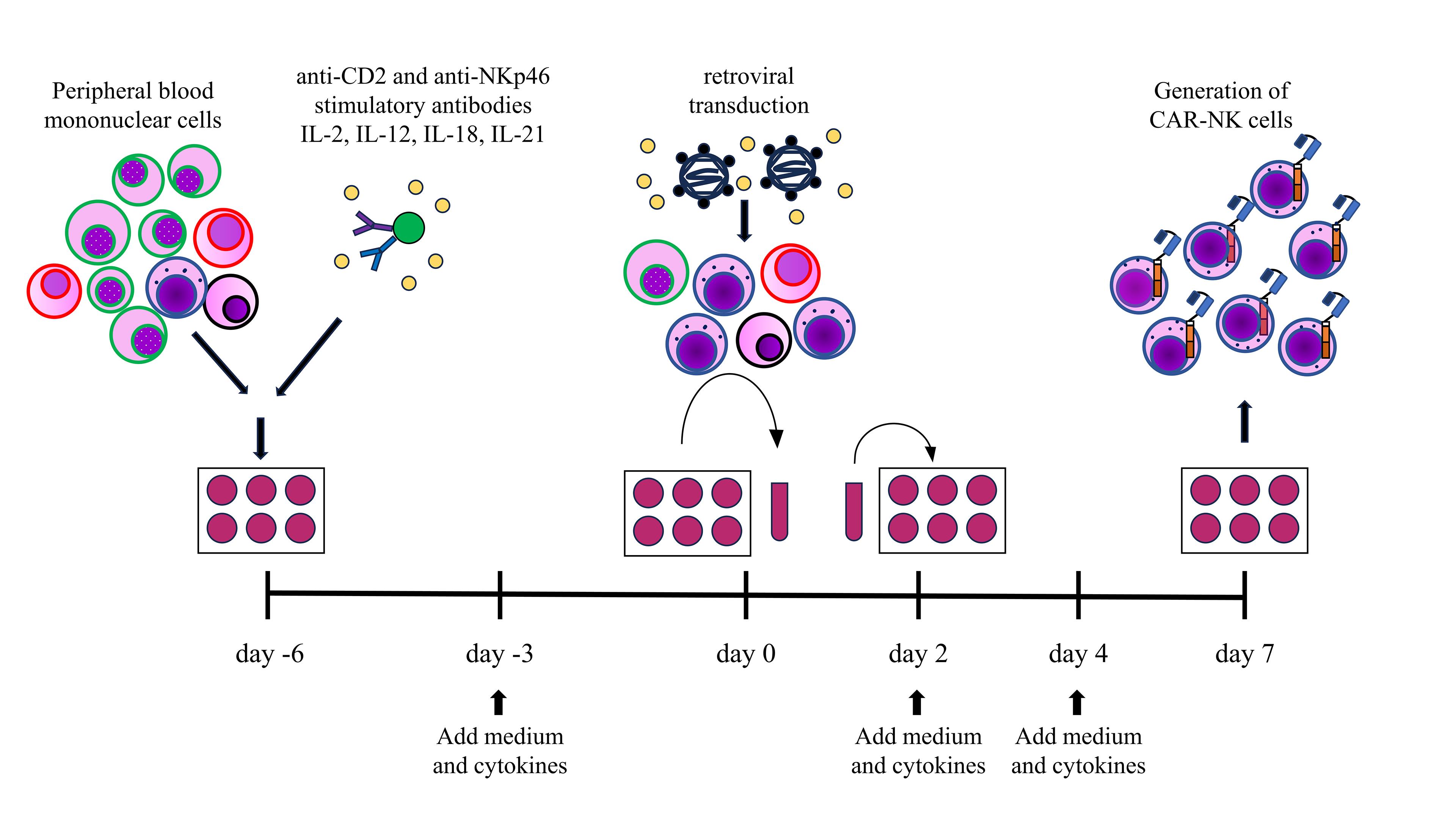
Schematic overview of the generation of chimeric antigen receptor (CAR)-natural killer (NK) cells. Peripheral blood mononuclear cells are collected and stimulated with anti-CD2 and anti-NKp46 stimulatory antibodies in the presence of interleukin (IL)-2, IL-12, IL-18, and IL-21. Cells are cultured in medium supplemented with cytokines, and gene transfer is performed using retroviral vectors after 6 days. The cells are then further cultured under the same conditions to generate CAR-NK cells.
Background
Extensive research continues to establish immune cell therapy as a treatment option for patients with recurrent and/or refractory malignant tumors. This approach has already been realized for certain types of blood cancers and sarcomas. Anti-CD19 chimeric antigen receptor (CAR)-T cells have demonstrated dramatic efficacy against B-cell malignancies [1]. In recent years, anti-CD19 CAR-T cells have also been reported to show promising results in patients with autoimmune diseases, in addition to their use in malignant tumors [2]. Because of allogeneic reactivity, the cell source is typically limited to the patient’s own cells. This approach carries several problems. Insufficient number and poor fitness of T cells collected from heavily treated patients with multiple lines of anti-cancer chemotherapy can result in manufacturing failure [3]. Also, during manufacturing time, which sometimes requires more than a month, progressive disease may result in deterioration of the patient’s performance status and loss of a chance to be infused with CAR-T cells. In addition, cytokine release syndrome (CRS), immune effector cell–associated neurotoxicity syndrome (ICANS), and other immune effector cell–associated complications remain significant concerns [4].
Like anti-CD19 CAR-T cells, anti-CD19 CAR-natural killer (NK) cells are expected to be effective against B-cell malignancies and autoimmune diseases. Furthermore, they offer additional advantages, including the safe use of allogeneic cells and a lower risk of CRS and ICANS [5]. However, the methodology for generating anti-CD19 CAR-NK cells remains insufficiently established. Multiple factors still require optimization, including the choice of cell source, the gene-transduction strategy, and the cell-expansion protocol. Various combinations of cytokines and culture media have been employed to expand NK cells for CAR-NK cell generation [6–8]. Achieving consistent results in expansion efficiency remains challenging. In addition to cytokines, activation with stimulatory antibodies may further enhance expansion efficiency.
We successfully generated anti-CD19 CAR-NK cells from adult peripheral blood mononuclear cells by expanding the cells using antibodies and cytokines, followed by gene transduction via retroviral vectors [9]. Various cell sources have been utilized for CAR-NK cell generation, including umbilical cord blood and induced pluripotent stem (iPS) cells [6,10]. Umbilical cord blood provides a limited volume per collection and contains a relatively small number of NK cells. Although iPS cells have the potential to generate a large number of homogeneous CAR-NK cells, the methodology for their production has not yet been fully established. In contrast, adult peripheral blood mononuclear cells can be collected with relative ease and low cost [11]. Genetically modified tumor cell lines have been used as feeder cells to support ex vivo expansion and genetic modification of NK cells, and this method remains the gold standard for the production of CAR-NK cells [12]. Eliminating the use of feeder cell lines in CAR-NK cell generation removes the risk of tumor cell contamination and enables the large-scale generation of homogeneous CAR-NK cells.
This protocol outlines the procedure for generating anti-CD19 CAR-NK cells from adult peripheral mononuclear cells without the use of feeder cell lines. This protocol can also be applied to the production of various types of engineered NK cells, including CAR-NK cells targeting alternative antigens.
Materials and reagents
Biological materials
1. 293T cell line (American Type Culture Collection, catalog number: CRL-3216)
2. HeLa cell line (American Type Culture Collection, catalog number: CRM-CCL-2)
3. MSCV-CD19 CAR-IRES-GFP plasmids (St. Jude Vector Development and Production Shared Resource [13])
4. pEQ-PAM3 plasmids (St. Jude Vector Development and Production Shared Resource [13])
5. pRDF plasmids (St. Jude Vector Development and Production Shared Resource [13])
6. Human peripheral blood mononuclear cells (collected from healthy adult donors)
Reagents
1. Dulbecco’s modified Eagle’s medium (DMEM), high glucose (Sigma-Aldrich, catalog number: D6429-500ml)
2. Fetal bovine serum (FBS) (Sigma-Aldrich, catalog number: 173012)
3. FuGENE HD transfection reagent (Fugent, catalog number: HD-1000)
4. Roswell Park Memorial Institute (RPMI)-1640 (Fujifilm Wako, catalog number: 189-02025)
5. CellGenix GMP stem cell growth medium (SCGM) (CellGenix Gmb, catalog number: 20802-500)
6. Cloudz Human NK Cell Expansion kit (Bio-Techne, catalog number: CLD004)
7. Recombinant human interleukin (IL)-2 (PeproTech, catalog number:200-02)
8. Recombinant human IL-12 (R&D Systems, catalog number: 10018-IL)
9. Recombinant human IL-18 (R&D Systems, catalog number: 9124-IL)
10. Recombinant human IL-21 (R&D Systems, catalog number: 8879-IL)
11. Polybrene solution (Nacalai Tesque, catalog number: 12996-81)
12. 10× D-PBS (-) (FUJIFILM Wako, catalog number: 048-29805)
13. 30% (w/v) albumin solution, from bovine serum (BSA) (FUJIFILM Wako, catalog number: 017-22231)
14. RetroNectin (Takara, catalog number: T100A)
15. Trypsin–ethylenediaminetetraacetic acid (EDTA) (0.05%), phenol red (Thermo Fisher Scientific Inc., catalog number: 25300-120)
16. Biotin-SP (long spacer) AffiniPure goat anti-mouse IgG, F(ab')2 fragment specific (Jackson ImmunoResearch Laboratories, Inc., catalog number: 115-065-072)
17. Streptavidin-phycoerythrin (BioLegend, catalog number: 405203)
18. Phycoerythrin (PE) anti-human CD56 (NCAM) antibody (BioLegend, catalog number: 318305)
19. Fluorescein isothiocyanate (FITC) anti-human CD3 antibody (BioLegend, catalog number: 300440)
20. Peridinin-chlorophyll-protein complex (PerCP) anti-human CD3 antibody (BioLegend, catalog number: 300427)
21. Acetic acid (FUJIFILM Wako, catalog number: 017-00256)
22. Penicillin-streptomycin solution (100×) (FUJIFILM Wako, catalog number: 168-23191)
23. Ficoll-PaqueTM PLUS (Cytiva, catalog number: 17144002)
24. 0.4% (w/v) Trypan Blue solution (FUJIFILM Wako, catalog number: 207-17081)
25. 4% Paraformaldehyde phosphate buffer solution (FUJIFILM Wako, catalog number: 161-20145)
Solutions
1. DMEM culture medium (see Recipes)
2. RPMI culture medium (see Recipes)
3. SCGM culture medium (see Recipes)
4. 1× PBS (see Recipes)
5. IL-2 solution (see Recipes)
6. IL-12 solution (see Recipes)
7. IL-18 solution (see Recipes)
8. IL-21 solution (see Recipes)
9. 2% BSA (see Recipes)
10. 1× PBS containing 0.5% paraformaldehyde (see Recipes)
Recipes
1. DMEM culture medium
| Reagent | Final concentration | Volume |
|---|---|---|
| DMEM-high glucose | 90% (v/v) | 450 mL |
| FBS (inactivation) | 10% (v/v) | 50 mL |
| Total | n/a | 500 mL |
Before use, FBS is heat-inactivated by incubation at 56 °C for 30 min in a water bath. Store the medium at 4 °C.
2. RPMI culture medium
| Reagent | Final concentration | Volume |
|---|---|---|
| RPMI-1640 | 89% (v/v) | 445 mL |
| FBS (inactivation) | 10% (v/v) | 50 mL |
| Penicillin-streptomycin | 100,000 units/L, 100 mg/L | 5 mL |
| Total | n/a | 500 mL |
Before use, FBS is heat-inactivated by incubation at 56 °C for 30 min in a water bath. Store the medium at 4°C.
3. SCGM culture medium
| Reagent | Final concentration | Volume |
|---|---|---|
| CellGenix GMP SCGM | 90% (v/v) | 450 mL |
| FBS (inactivation) | 10% (v/v) | 50 mL |
| Total | n/a | 500 mL |
Before use, FBS is heat-inactivated by incubation at 56 °C for 30 min in a water bath. Store the medium at 4 °C.
4. 1× PBS
| Reagent | Final concentration | Quantity or volume |
|---|---|---|
| 10× D-PBS (-) | 10% (v/v) | 100 mL |
| Distilled water | 900 mL | |
| Total | n/a | 1,000 mL |
Sterilize the solution by autoclaving at 121 °C for 30 min and store at room temperature.
5. IL-2 solution
| Reagent | Final concentration | Quantity or Volume |
|---|---|---|
| Recombinant human IL-2 | 20 ng/μL | 50 μg |
| Acetic acid | 50 μL | |
| 30% BSA | 82 μL | |
| 1× PBS | 2,368 μL | |
| Total | n/a | 2.5 mL |
Dissolve IL-2 in acetic acid, followed by dilution with PBS containing 0.1% albumin. Store the solution at -20 °C.
6. IL-12 solution
| Reagent | Final concentration | Quantity or volume |
|---|---|---|
| Recombinant human IL-12 | 100 ng/μL | 10 μg |
| 1× PBS | 100 μL | |
| Total | n/a | 100 μL |
Store the solution at -20 °C.
7. IL-18 solution
| Reagent | Final concentration | Quantity or volume |
|---|---|---|
| Recombinant human IL-18 | 200 ng/μL | 10 μg |
| 1× PBS | 50 μL | |
| Total | n/a | 50 μL |
Store the solution at -20 °C.
8. IL-21 solution
| Reagent | Final concentration | Quantity or volume |
|---|---|---|
| Recombinant human IL-21 | 100 ng/μL | 10 μg |
| 1× PBS | 100 μL | |
| 30% BSA | 0.1% (w/v) | 0.3 μL |
| Total | n/a | 100 μL |
Store the solution at -20 °C.
9. 2% BSA
| Reagent | Final concentration | Quantity or volume |
|---|---|---|
| 30% BSA | 2% (w/v) | 1 mL |
| Distilled water | 14 mL | |
| Total | n/a | 15 mL |
Store the solution at 4 °C.
10. 1× PBS containing 0.5% paraformaldehyde
| Reagent | Final concentration | Quantity or volume |
|---|---|---|
| 4% Paraformaldehyde | 0.5% (w/v) | 6 mL |
| 1× PBS | 42 mL | |
| Total | n/a | 48 mL |
Store the solution at 4 °C.
Laboratory supplies
1. NuncTM EasYDISHTM cell culture dishes, tissue culture surface (Thermo Fisher Scientific Inc., catalog number: 150466)
2. Screw cap micro tube, 1.5 mL (SARSTEDT AG & Co., catalog number: 72.692.100)
3. Pipette tip, 0.1–10 μL (Thermo Fisher Scientific Inc, catalog number: 104-Q)
4. Sapphire pipette tip, 1,000 μL (Greiner Bio-One Co., catalog number: 777350)
5. NuncTM biobanking and cell culture tubes, 4.5 mL (Thermo Fisher Scientific Inc., catalog number: 379146)
6. TPP 6-well tissue culture plate (Techno Plastic Products AG, catalog number: 92006)
7. 14 mL round-bottom tube (Corning, catalog number: 352057)
8. 5 mL round-bottom tube (Corning, catalog number: 352052)
9. Parafilm (Bemis, catalog number: PM996)
10. C-Chip disposable hemocytometer (NanoEntek, catalog number: DHC-B02)
11. TPP serological pipette 2 mL (Techno Plastic Products AG, catalog number: 94002)
12. TPP serological pipette 5 mL (Techno Plastic Products AG, catalog number: 94005)
13. TPP serological pipette 10 mL (Techno Plastic Products AG, catalog number: 94010)
14. TPP serological pipette 25 mL (Techno Plastic Products AG, catalog number: 94024)
15. TPP tissue culture flasks 25 (Techno Plastic Products AG, catalog number: 90026)
16. Kimwipe (Crecia, catalog number: 62011)
Equipment
1. Nichipet Air, 1,000 μL (Nichiryo, catalog number: 00-NAR-1000)
2. Nichipet Air, 200 μL (Nichiryo, catalog number: 00-NAR-200)
3. Nichipet Air, 20 μL (Nichiryo, catalog number: 00-NAR-20)
4. Nichipet Air, 10 μL (Nichiryo, catalog number: 00-NAR-10)
5. CO2 incubator (ESPEC, catalog number: BNP-110)
6. Vortex-Genie 2 (IKEDA SCIENTIFIC Co., catalog number: SI-0286)
7. Pipet-Aid XP (Drummond Scientific, catalog number: 4-040-101-J)
8. Hybrid high-speed cooling centrifuge (KUBOTA Corporation Co., catalog number: 6200)
9. BD FACSCalibur flow cytometer (BD Biosciences, catalog number: 342973)
Software and datasets
1. FlowJo v10.0.8 (Becton, Dickson and Company)
Procedure
登录/注册后免费查看全文
文章信息
稿件历史记录
提交日期: Jan 22, 2026
接收日期: Mar 17, 2026
在线发布日期: Apr 1, 2026
出版日期: Apr 20, 2026
版权信息
© 2026 The Author(s); This is an open access article under the CC BY-NC license (https://creativecommons.org/licenses/by-nc/4.0/).
如何引用
Kubo, N., Baba, M., Suzuki, Y., Kasahara, Y., Hosokai, R., Imamura, M., Saitoh, A. and Imai, C. (2026). A Feeder Cell-Free System for Chimeric Antigen Receptor Gene Transduction Into Natural Killer Cells. Bio-protocol 16(8): e5669. DOI: 10.21769/BioProtoc.5669.

 Download Citation in RIS Format
分类
免疫学 > 免疫疗法
癌症生物学 > 肿瘤免疫学 > 癌症治疗
免疫学 > 免疫细胞分离 > 维持和分化
您对这篇实验方案有问题吗?
在此处发布您的问题,我们将邀请本文作者来回答。同时,我们会将您的问题发布到Bio-protocol Exchange,以便寻求社区成员的帮助。
 发布问题
发布问题


