


Protocol for Using CRISPR-Cas9 to Generate a Monocyte Cell Line Harboring a Single-Nucleotide Polymorphism
利用 CRISPR-Cas9 构建携带单核苷酸多态性的单核细胞系实验方案

发布: 2026年04月20日第16卷第8期 DOI: 10.21769/BioProtoc.5660 浏览次数: 1119
评审: Navnita DuttaAnonymous reviewer(s)
 PDF
PDF  Q&A
Q&A
Advertisement







Abstract
We established a step-by-step approach for generating a single-nucleotide mutation in the promoter region of an immune regulatory gene in human monocyte THP-1 cells by employing a plasmid-based CRISPR-Cas9 system delivered via transfection with a homology-directed repair template DNA (HDR). Key steps include designing a single-guide RNA (sgRNA), cloning it into a CRISPR plasmid encoding the Cas9 protein, transfection of the plasmid constructs along with single-stranded oligonucleotide repair template (ssODNs) into THP-1 cells, followed by selection and validation. This approach provides a precise and relevant model to investigate the role of single polymorphisms in the regulation of inflammatory gene expression in human monocytes. In addition to the rs1024611 single-nucleotide polymorphism (SNP), this CRISPR/Cas9-based strategy is broadly applicable to functional studies of noncoding and coding variants in innate immune genes.
Key features
• Precise genome editing: CRISPR-Cas9-mediated editing of the rs1024611 SNP in the endogenous CCL2 promoter in THP-1 cells using a single-stranded donor oligonucleotide.
• Generate THP-1 monocytic cell lines: Differing only at the rs1024611 locus, allowing precise comparison of allele-specific effects on the same genetic background.
• The protocol includes strategies for single-cell cloning, PCR-based genotyping, and Sanger sequencing to confirm precise genome editing.
• While this study focuses on the CCL2-2518 SNP, it provides a framework for future investigations of other noncoding variants or regulatory SNPs in immune-related genes.
Keywords: CRISPR-Cas9 (CRISPR-Cas9) THP-1 cells (THP-1 细胞)
rs1024611 SNP (rs1024611 位点单核苷酸多态性)
Single-nucleotide polymorphism (单核苷酸多态性)
Single-cell clonal isolation (单细胞克隆分离)
THP-1 cells (THP-1 细胞)
rs1024611 SNP (rs1024611 位点单核苷酸多态性)
Single-nucleotide polymorphism (单核苷酸多态性)
Single-cell clonal isolation (单细胞克隆分离)
Graphical overview
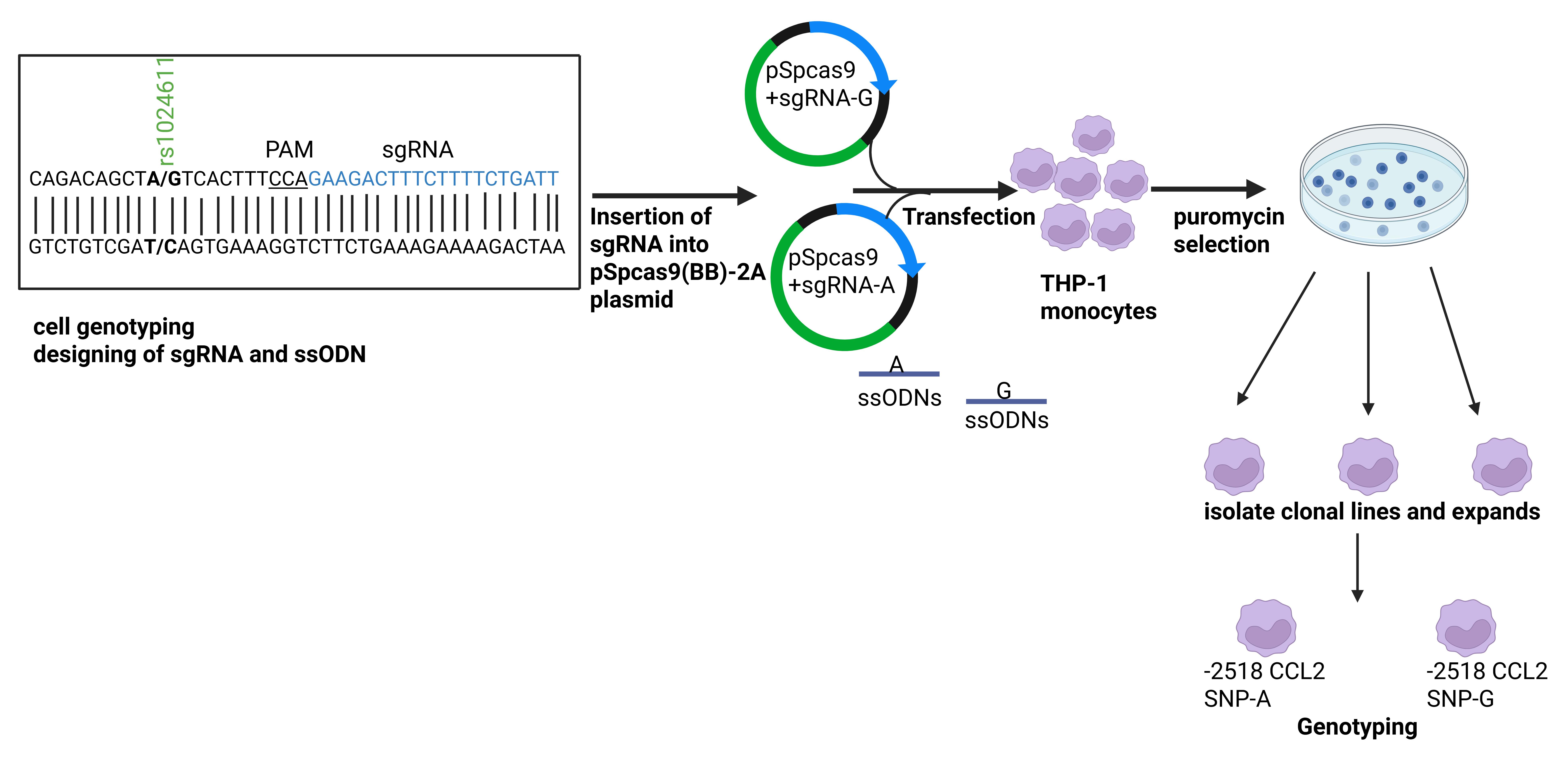
Overview of CRISPR-Cas9-mediated editing in the rs1024611 single-nucleotide polymorphism (SNP) of the CCL2 promoter in THP-1 cells
Background
The human THP-1 cell line, derived from a monocytic leukemia, represents a well-established model for studying monocyte and macrophage biology. THP-1 cells express innate immune receptors and can be differentiated into macrophage-like cells, making them particularly suitable for investigating gene regulation and inflammatory signaling pathways [1–3]. Establishing an isogenic THP-1 model carrying the desired mutation in the gene promoter [in this study, the isogenic THP-1 cells carrying either allele of the CCL2-2518A/G or rs1024611 single-nucleotide polymorphism (SNP) would provide a controlled system for directly comparing allele-specific transcriptional responses and downstream functional effects]. The rs1024611 SNP in the CCL2 promoter influences CCL2 chemokine expression and has been linked to susceptibility to inflammatory and infectious diseases [4]. We generated THP-1 cell lines differing only at this locus using CRISPR-Cas9 and a single-stranded donor oligonucleotide, enabling precise comparisons in an identical genetic background. CRISPR-Cas9 genome editing relies on a guide RNA (gRNA) to target the Cas9 endonuclease to a specific DNA sequence, where Cas9 creates a double-strand break that is subsequently repaired by either non-homologous end joining (NHEJ), resulting in insertions or deletions, or homology-directed repair (HDR) with a donor template, allowing for precise editing in the genes or regulatory regions. It has become a widely used tool for functional genomics studies [5–7].
We established a CRISPR-Cas9 technology to modify THP-1 cells through targeted gene editing, providing a powerful approach to better characterize immune-related mechanisms, including pathogen–host interactions. This protocol is for efficient CRISPR/Cas9-based single-nucleotide editing in THP-1 cells using the transfection method to deliver a designed pSPCas9:sgRNA plasmid construct into the cell nucleus. CRISPR/Cas9-mediated editing at the genetic level was validated by Sanger sequencing or using restriction fragment length polymorphism (RFLP). Advantages of using the plasmid-based CRISPR-Cas9 method for genome editing over other traditional methods are its higher efficiency, cost-effectiveness, and plasmid stability compared to the viral delivery or electroporation-based ribonucleoprotein (RNP) systems [6,8]. Using this protocol, up to 20% single-nucleotide substitution efficiency in the targeted locus was achieved. Our protocol provides an efficient and easy method to create single-cell clones with the desired genotype. Previous studies have reported HDR-mediated single-nucleotide substitution efficiencies ranging from 1% to 10% in human cell lines without enrichment, with improved efficiencies following antibiotic or fluorescence-based selection [6,7]. In THP-1, precise knock-in efficiencies are often lower due to reduced transfection efficiency and limited HDR activity. Using puromycin selection to enrich transfected cells, our plasmid-based CRISPR-Cas9 approach achieved up to 20% single-nucleotide substitution efficiency at the targeted locus, representing a comparatively high editing rate for this challenging cell type.
Materials and reagents
Biological materials
1. THP-1 cell line (ATCC)
2. Bacterial strain (XL10-Gold ultracompetent cells) (VWR)
Reagents
1. AnzaTM T4 DNA ligase master mix (Invitrogen, catalog number: IVGN2102)
2. BbsI (New England BioLabs, catalog number: R0539S)
3. T4 polynucleotide kinase (PNK) (Thermoscientific, catalog number: EK0031)
4. rCutSmart buffer, 10× (New England BioLabs, catalog number: B6004S)
5. T4 DNA ligase reaction buffer, 5× (Invitrogen, catalog number: 15224-017)
6. Alkaline phosphatase (rSAP) (New England BioLabs, catalog number: M0371S)
7. RPMI-1640 (Sigma-Aldrich, catalog number: R8758)
8. Fetal bovine serum (FBS) (Sigma-Aldrich, catalog number: 0926)
9. Penicillin-streptomycin (10,000 U/mL) (Sigma-Aldrich, catalog number: P0781)
10. Trypsin-EDTA solution (Sigma-Aldrich, catalog number: T3924)
11. Opti-MEMTM I reduced serum medium, no phenol red (Gibco, catalog number: 31985-070)
12. Lipofectamine 3000 (Invitrogen, catalog number: L3000-015)
13. Puromycin (Sigma-Aldrich, catalog number: P8833)
14. Taq DNA Polymerase kit (Invitrogen, catalog number: 18038-042)
15. Agarose (Sigma-Aldrich, catalog number: A9539)
16. Dulbecco's phosphate-buffered saline (DPBS) (Sigma-Aldrich, catalog number: D8537)
17. Gene Ruler 1 kb Plus DNA ladder (Thermoscientific, catalog number: SM1333)
18. Ampicillin (Sigma-Aldrich, catalog number: A9518)
19. Gene Elute Gel Extraction and PCR Purification kit (Sigma-Aldrich, catalog number: NA1111-1KT/NA1020-KT)
20. Gene Elute Plasmid Miniprep kit (Sigma-Aldrich, catalog number: PLN350-1KT)
21. Gene Elute Mammalian Genomic DNA Miniprep kit Gene Elutes (Sigma-Aldrich, catalog number: G1N70-1KT)
22. LB medium (Sigma-Aldrich, catalog number: L3022)
23. Agar, bacteriological (Amresco, catalog number: J637)
24. PvuII-HF (New England BioLabs, catalog number: R3151S)
25. 2-Beta-ME or 2-ME (Sigma-Aldrich, catalog number: M6250)
26. S.O.C. medium (Invitrogen, catalog number: 15544-034)
27. Trizma-base (Sigma-Aldrich, catalog number: T6066)
28. Ethylenediaminetetraacetic acid disodium salt dihydrate (EDTA) (Sigma-Aldrich, catalog number: E5134)
29. Glacial acetic acid (Sigma-Aldrich, catalog number: A6283)
30. L-Glutamine (Sigma-Aldrich, catalog number: G7513)
Solutions
1. 50× TAE buffer (see Recipes)
2. LB medium (see Recipes)
3. LB broth medium (see Recipes)
4. Complete RPMI 1640 (see Recipes)
5. Puromycin solution (1 mg/mL) (see Recipes)
Recipes
1. 50× TAE buffer
Weigh 242 g of Trizma-base (molecular weight 121.14 g/mol) and add to a 1 L Duran bottle. Dissolve it in 700 mL of MilliQ water. Add 100 mL of 0.5 M EDTA and carefully add 57.1 mL of glacial acetic acid. Finally, top up the solution to 1 L with MilliQ water.
2. LB agar medium
Add 2 g of agar powder and 2 g of LB medium to 100 mL of distilled water. Autoclave it before use.
3. LB broth medium
Add 2 g of LB broth powder to 100 mL of distilled water and autoclave it before use.
4. Complete RPMI 1640
To RPMI-1640, add 10% FBS (heat-inactivated), 1% penicillin-streptomycin antibiotics, and 1% glutamine.
5. Puromycin solution (1 mg/mL)
Dissolve 10 mg of puromycin in 1 mL of water and then dilute 1:10 to make a 1 mg/mL concentration.
Laboratory supplies
1. 96-well cell culture plate (Cellstar, catalog number: 655180)
2. 24-well cell culture plate (Cellstar catalog number: 665180)
3. 15 mL centrifuge tube (VWR, catalog number: 525-1069)
4. 50 mL centrifuge tube (VWR, catalog number: 525-0610)
5. 1.7 mL centrifuge tube (VWR, catalog number: 87003-294)
6. 10 μL tip (VWR, catalog number: 76323-388)
7. 200 μL tip (VWR, catalog number: 76323-390)
8. 1,250 μL tip (VWR, catalog number: 76323-404)
9. 10 mL serological pipette (Corning, catalog number: 75816-100)
10. 10 cm cell culture dish (Corning, catalog number: 430167)
11. 14 mL polystyrene round-bottom tube (Falcon, catalog number: 352057)
Plasmid and DNA sequences (Table 1)
Table 1. Plasmids, primers, sgRNAs, and ssODNs used for CRISPR-Cas9 editing of rs1024611
| Description | Source |
|---|---|
| pSpCas9 (BB)-2A-Puro (PX459) | Addgene |
| Sequencing primer: primer: U6-Fwd primer: GAGGGCCTATTTCCCATGATTCC | [8] |
| sgRNA1: sgRNA-A-top: CACCGCTTGACAGAGCAGAAGTGGG | IDT |
| sgRNA1: sgRNA-A-bottom: AAACCCCACTTCTGCTCTGTCAAGC | IDT |
| sgRNA2: sgRNA-G-top: CACCGAATCAGAAAAGAAAGTCTTC | IDT |
| sgRNA2: sgRNA-G-bottom: AAACGAAGACTTTCTTTTCTGATTC | IDT |
| Genotyping primer: rs1024611-Forward: GCTCCGGGCCCAGTATCT | IDT |
| Genotyping primer: rs1024611-Reverse: GAGTGTTGGAAGCATGTCTCTACTT | IDT |
| ssODN: rs1024611-A-F: GAGGGCATCTTTTCTTGACAGAGCAGAAGTGGGAGACAGACAGCTATCACTTTTCAGAAGACTTTCTTTTCTGATTCATACCCTTCACCTT | IDT |
| ssODN: rs1024611-A-R: AAGGTGAAGGGTATGAATCAGAAAAGAAAGTCTTCTGAAAAGTGATAGCTGTCTGTCTCCCACTTCTGCTCTGTCAAGAAAAGATGCCCTC | IDT |
| ssODN: rs1024611-G-F: GAGGGCATCTTTTCTTGACAGAGCAGAAGTGGGAGACAGACAGCTGTCACTTTTCAGAAGACTTTCTTTTCTGATTCATACCCTTCACCTT | IDT |
| ssODN: rs1024611-G-R: AAGGTGAAGGGTATGAATCAGAAAAGAAAGTCTTCTGAAAAGTGACAGCTGTCTGTCTCCCACTTCTGCTCTGTCAAGAAAAGATGCCCTC | IDT |
Equipment
1. Pipettes (Eppendorf)
2. PCR thermocycler (Bio-Rad, model: T100)
3. DNA electrophoresis apparatus (Bio-Rad, model: Wide-mini subcell GT)
4. Gel image analysis system (Invitrogen, model: iBright1500)
5. Nanodrop spectrophotometer (Thermo Scientific, model: Nanodrop One)
6. Centrifuge (Eppendorf, model: 5415 R)
7. 37 °C CO2 incubator (Thermo Scientific, model: 3578)
8. Shaker (New Brunswick Scientific I2400 incubator shaker)
9. Water bath (Fisher Scientific, model: ISOTEMP 215)
Software and datasets
1. Online sgRNA designing tools (https://portals.broadinstitute.org/gpp/public/analysis-tools/sgrna-design) (free tool)
Procedure
登录/注册后免费查看全文
文章信息
稿件历史记录
提交日期: Jan 23, 2026
接收日期: Mar 11, 2026
在线发布日期: Mar 23, 2026
出版日期: Apr 20, 2026
版权信息
© 2026 The Author(s); This is an open access article under the CC BY-NC license (https://creativecommons.org/licenses/by-nc/4.0/).
如何引用
Mahatha, A. C., Ramos-Espinosa, O., De Lima, D. S., Liu, E. Y., Vaidyan, S. and Liu, J. (2026). Protocol for Using CRISPR-Cas9 to Generate a Monocyte Cell Line Harboring a Single-Nucleotide Polymorphism. Bio-protocol 16(8): e5660. DOI: 10.21769/BioProtoc.5660.

 Download Citation in RIS Format
分类
免疫学 > 宿主防御 > 人
分子生物学 > DNA > 染色体工程
细胞生物学 > 细胞工程 > CRISPR-cas9
您对这篇实验方案有问题吗?
在此处发布您的问题,我们将邀请本文作者来回答。同时,我们会将您的问题发布到Bio-protocol Exchange,以便寻求社区成员的帮助。
 发布问题
发布问题


