


Quantitative Assessment of Heat Shock-Induced Ferroptosis-Like Cell Death via Electrolyte Leakage in Arabidopsis thaliana Seedlings
拟南芥幼苗热激诱导铁死亡样细胞死亡的电解质渗漏定量评估

发布: 2026年05月05日第16卷第9期 DOI: 10.21769/BioProtoc.5650 浏览次数: 387
评审: Noelia ForesiKishwar Jahan ShethiAnonymous reviewer(s)
 PDF
PDF  Q&A
Q&A
参见作者原研究论文
The authors used this protocol in:
Dec 2022
Advertisement







Abstract
We present a protocol to allow continuous assessment of cell death in Arabidopsis thaliana (L.) seedlings by measuring the release of electrolytes from dying cells upon heat shock. The electrolyte leakage assay is a well-established method to quantify the extent of cell death of plant tissues exposed to pathogen infection, since the activation of the immune response leads to compromised membrane integrity and to the release of ions from the dying cell. This prolonged release of electrolytes is considered a hallmark of regulated cell death in plants. Heat shock in plants induces ferroptosis-like cell death, which can be suppressed either pharmacologically, using inhibitors such as ferrostatin, or genetically through knockout of ferroptosis-related genes. Here, we have adapted the electrolyte leakage assay to quantify cell death in young Arabidopsis seedlings exposed to a heat shock previously shown to induce ferroptosis-like cell death. We also illustrate how this method can be used to assess activation of ferroptosis-like cell death in whole Arabidopsis seedlings using ferrostatin or knockout mutants of potential gene candidates involved in ferroptosis-like cell death.
Key features
• This protocol does not require any technical experience apart from gentle handling of young seedlings and is less labor-intensive than microscopy-based cell death evaluation.
• Builds upon existing methods to quantify the extent of cell death upon immune response in whole seedlings subjected to heat stress.
• Only requires a conductivity meter and allows the assessment of continuous cell death using multiple parallel replicates.
• The protocol demonstrates how heat shock-induced ferroptosis-like cell death can be inhibited pharmacologically or genetically in whole seedlings, supported with quantitative data.
Keywords: Heat shock (热激) Ferroptosis-like cell death (铁死亡样细胞死亡)
Electrolyte leakage (电解质渗漏)
Arabidopsis (拟南芥)
Regulated cell death (程序性细胞死亡)
Ferrostatin (铁死亡抑制剂)
Conductivity meter (电子电导率仪)
Ferroptosis-like cell death (铁死亡样细胞死亡)
Electrolyte leakage (电解质渗漏)
Arabidopsis (拟南芥)
Regulated cell death (程序性细胞死亡)
Ferrostatin (铁死亡抑制剂)
Conductivity meter (电子电导率仪)
Graphical overview
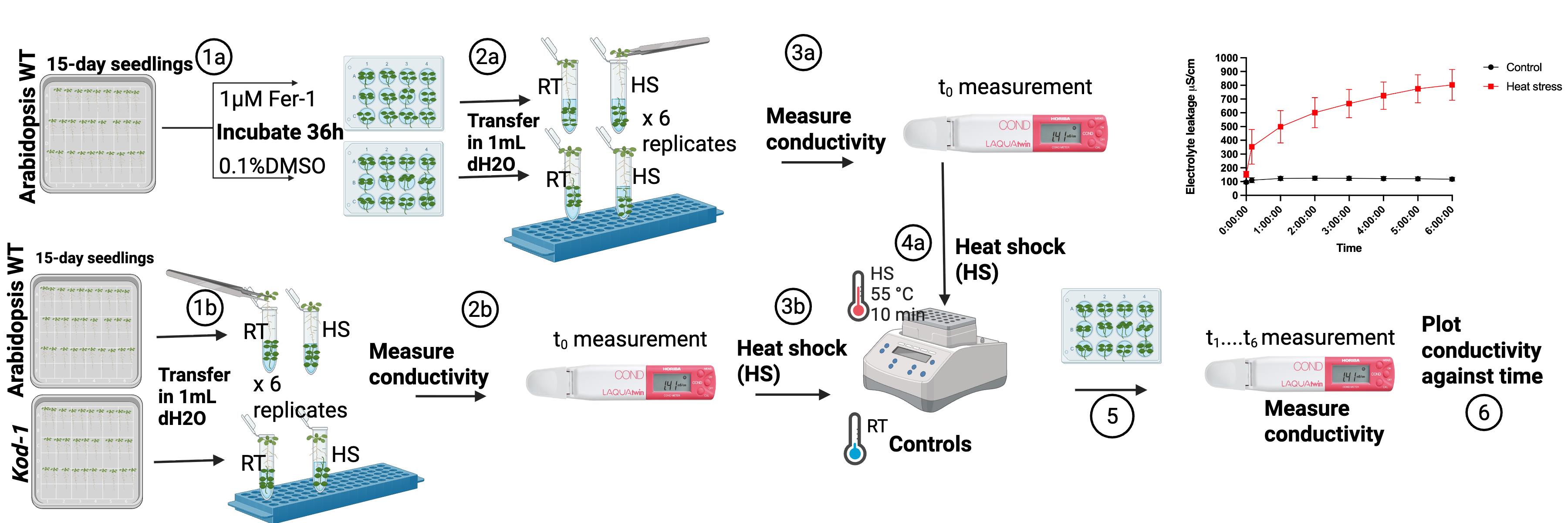
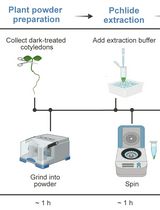
Overview of workflow for quantitative assessment of heat shock-induced cell death by electrolyte leakage assay in Arabidopsis. (1a) Arabidopsis wild-type (WT) seedlings are transferred to a 12-well plate and incubated for 36 h with 1 µM Ferrostatin-1 (Fer-1) or 0.1% DMSO. (2a) Seedlings are transferred to a 2 mL tube containing 1 mL of distilled water. (3a) T0 conductivity measurements are taken from each replicate. (4a) Tubes containing seedlings are incubated at 55 °C for 10 min (HS) or kept at room temperature for 10 min (RT). (1b) Arabidopsis WT and knockout seedlings for the gene of interest (Kiss of death, kod-1 in this case) are transferred to a 2 mL tube containing 1 mL of distilled water. (2b) T0 conductivity measurements are taken from each replicate. (3b) Tubes containing seedlings are incubated at 55 °C for 10 min (HS) or kept at room temperature for 10 min (RT). (5) Conductivity measurements are repeated for 150 min with measurements every 30 min. (6) Data analysis.
Background
Regulated cell death (RCD) is a controlled form of suicide that plant cells activate upon mild homeostatic disturbances, such as pathogen infection and heat stress. Upon biotic or abiotic stress, damaged cells are eliminated to ensure survival of the plant, for instance, to restrict pathogen proliferation from the point of infection [1,2]. RCD also participates during development, contributing to cell differentiation and ensuring the proper development of vegetative and reproductive organs [2,3].
RCD triggered upon pathogen recognition is characterized by compromised membrane integrity, with the concomitant leakage of cytoplasmic electrolytes out of the cell [4]. When dying plants are kept in an aqueous solution, the release of these electrolytes can be used as a proxy for cell death quantification. Current protocols for electrolyte leakage assays use simple and affordable conductivity meters, which allow continuous and repeated measurements of the electrolytes released by dying cells [5–7]. However, to date, these protocols are mainly used for plants exposed to pathogens, and no standardized protocol exists to quantitatively measure cell death induced by heat stress.
Ferroptosis is a form of RCD that is iron and reactive oxygen species (ROS) dependent and results in lipid peroxidation [8]. Ferroptosis-like cell death has recently been described in Arabidopsis upon heat shock and can be suppressed by ferrostatin, which inhibits lipid peroxidation [9]. Ferrostatin is a lipophilic antioxidant that scavenges lipid ROS radicals via its N-cyclohexyl moiety, thereby preventing cell membrane damage and subsequent cell death [10]. Additionally, several genes are upregulated during ferroptosis-like cell death in Arabidopsis, including Kiss of Death (KOD), which encodes a 25 amino acid peptide [9,11]. Ferroptosis-like cell death upon heat shock in Arabidopsis is visualized using the DNA probe Sytox Green [9,12]. In this case, the compromised plasma membrane integrity allows Sytox Green to penetrate the dying cell and to fluoresce upon DNA binding. While this method has been used to demonstrate heat shock–induced ferroptosis-like cell death in Arabidopsis roots, it has limitations: it is labor-intensive, requires a fluorescence or confocal microscope, and does not allow following the progression of cell death over time.
Here, we propose an adapted version of the electrolyte leakage assay to evaluate cell death of entire Arabidopsis seedlings upon heat shock. This new protocol uses a small and affordable conductivity meter and allows the parallel evaluation of several replicates per treatment (with several seedlings per replicate) and for multiple measurements of the same sample over time. We also show how the protocol can be adapted to include inhibitors or mutants to evaluate potential candidate genes involved in heat shock–induced ferroptosis-like cell death, in combination with statistical evaluation.
Materials and reagents
Biological materials
1. Arabidopsis thaliana (L), Colombia wildtype ecotype (Col.0) seeds
2. Kiss of death (kod-1), loss of function mutant seeds (At4g10613: LINE retrotransposon in Col.0; kod-1 T-DNA insertion in the GABI-kat line) [11]
Reagents
1. Murashige & Skoog (MS) basal salts (Sigma-Aldrich, catalog number: M5519)
2. 2-Morpholinoethanesulfonic acid monohydrate (MES) salt (Sigma-Aldrich, CAS number: 145224-94-8)
3. Sucrose (Sigma-Aldrich, CAS number: 57-50-1)
4. Agar (Sigma-Aldrich, CAS number: 9002-18-0)
5. Gellan gum (Sigma-Aldrich, CAS number: 71010-52-1)
6. Ethanol, 96% (VWR, CAS number: 64-17-5)
7. Hydrochloric acid (HCl) (Merck Millipore, CAS number: 7647-01-0)
8. Bleach (Chlorine)
9. Ferrostatin-1 (Fer-1) (Sigma-Aldrich, CAS number: 347174-05-4)
10. Dimethyl Sulfoxide (DMSO) (Thermo-Scientific, CAS number: 67-68-5)
11. Distilled water (dH2O)
Solutions
1. 1/2 MS basal salts medium (see Recipes)
2. Fer-1 solution (20 mM, 1 μM) (see Recipes)
3. Bleach, 50% (see Recipes)
4. Ethanol, 70% (see Recipes)
Recipes
1. 1/2 MS basal salts medium
| Reagent | Final concentration | Quantity or volume |
|---|---|---|
| MS basal salts | 2.2 g/L | 800 mL |
| MES salt | 0.05% | 0.5 g |
| Sucrose | 1% | 10 g |
| Gellan gum* or agar** | 0.8%* or 1%** | 8 g or 10 g |
| dH2O | 1,000 mL |
Gellan gum or agar can be safely used as a gelling agent in all experiments to prepare in-vitro 1/2 MS medium.
Weigh MS basal salts, MES, and sucrose and transfer to a large beaker. Add 800 mL of ultrapure dH2O and stir. Adjust pH to 5.7 with 2 M HCl using a calibrated pH meter. Top up volume to 1,000 mL. Divide the media into two 1,000 mL bottles. Weigh 4 g of gellan gum (or 5 g of agar) and add to each bottle. Autoclave the media at 121 °C for 20 min. Leave the media to cool to 55–60 °C and pour 50 mL aseptically into square plates. Leave the plates to solidify for 20 min in a laminar flow cabinet. Seal and keep plates at 4 °C for up to 1 month.
2. Fer-1 solution (20 mM, 1 μM)
| Reagent | Final concentration | Quantity or volume |
|---|---|---|
| Fer-1 stock | 20 mM in DMSO | 953 μL |
| Fer-1, 1:10 dilution | 2 mM in DMSO | 10 μL |
| DMSO working dilution | 0.1% v/v DMSO | 50 mL |
| Fer-1 working stock | 1 μM in 0.1% DMSO | 15 mL |
Dissolve 5 mg of Fer-1 powder (molecular weight = 262.35 g/mol) in 953 μL of DMSO to make a 20 mM stock solution. Aliquot into 10 μL and freeze at -20 °C. Next, dilute the stock (20 mM) 1:10 by taking 1 μL into 9 μL of DMSO to make 2 mM Fer-1. To prepare 0.1% DMSO, dilute 50 μL of DMSO into 50 mL of ultrapure water. Finally, prepare 1 μM Fer-1 by diluting 7.5 μL of working dilution (2 mM) into 15 mL of 0.1% DMSO.
3. Bleach, 50% v/v
| Reagent | Final concentration | Volume (for 10 mL) |
|---|---|---|
| Bleach, 50% v/v | 50% v/v | 5 mL |
| dH2O | n/a | 5 mL |
| Total | 50% | 10 mL |
4. Ethanol, 70% v/v
| Reagent | Final concentration | Volume (for 100 mL) |
|---|---|---|
| Ethanol, 70% v/v | 70% v/v | 72.9 mL |
| dH2O | n/a | 27.1 mL |
| Total | 70% | 100 mL |
Laboratory supplies
1. 1.5 mL microcentrifuge tubes (Sarstedt, catalog number: 690.001)
2. 2 mL microcentrifuge tubes (Sarstedt, catalog number: 72.695.500)
3. Pipette tips 10 μL (Sarstedt, catalog number: 70.3010)
4. Pipette tips 200 μL (Sarstedt, catalog number: 70.3030.100)
5. Pipette tips 1,000 μL (Sarstedt, catalog number: 70.3050.100)
6. 1,000 mL bottles (VWR, catalog number: 215-1595)
7. 50 mL Falcon tubes (Sarstedt, catalog number: 62.547.254)
8. Square plates 120 × 120 × 17 with vents (Greiner Bio-One, catalog number: 688102)
9. 12-well culture plates (CellStar, catalog number: 665 180)
10. 2,000 mL beaker (VWR, catalog number: 216-1643)
10. Aluminum foil
11. 3M Micropore tape
12. Spoon or spatulas (stainless steel)
13. Tweezers
Equipment
1. Growth chamber (CFL Plant climatics, model: AR-66L2)
2. Sterile hood (Holten LaminAir, model: HB2448)
3. Compact conductivity meter (HORIBA, model: LAQUAtwin-EC-33)
4. Autoclave (TOMY, model: SX-700E)
5. Thermomixer F1.5 (Eppendorf, catalog number: 5384000012)
6. pH meter (Radiometer analytical, model: PHM210)
7. 0.2–2 μL Finnpipette (Thermo Fisher Scientific, catalog number: 4641010N)
8. 2–20 μL Finnpipette (Thermo Fisher Scientific, catalog number: 4641050N)
9. 20–200 μL Finnpipette (Thermo Fisher Scientific, catalog number: 4641080N)
10. 100–1,000 μL Finnpipette (Thermo Fisher Scientific, catalog number: 4641100N)
11. Racks
12. Refrigerator (2–8 °C)
13. Freezer (-20 °C)
14. Cold room (2–8 °C)
15. ELGA water purification system (ELGA LabWater, model: PURELAB Quest)
16. Weighing scale (OHAUS CORP, model: Pioneer PA2102)
Procedure
登录/注册后免费查看全文
文章信息
稿件历史记录
提交日期: Dec 9, 2025
接收日期: Feb 26, 2026
在线发布日期: Apr 14, 2026
出版日期: May 5, 2026
版权信息
© 2026 The Author(s); This is an open access article under the CC BY-NC license (https://creativecommons.org/licenses/by-nc/4.0/).
如何引用
Kago-Gachao, L., Salas, C. C., Campos, M. S., Whitmore, G. and Sueldo, D. (2026). Quantitative Assessment of Heat Shock-Induced Ferroptosis-Like Cell Death via Electrolyte Leakage in Arabidopsis thaliana Seedlings. Bio-protocol 16(9): e5650. DOI: 10.21769/BioProtoc.5650.

 Download Citation in RIS Format
分类
植物科学 > 植物生理学 > 离子分析
细胞生物学 > 细胞活力 > 细胞死亡
植物科学 > 植物生理学 > 非生物胁迫
您对这篇实验方案有问题吗?
在此处发布您的问题,我们将邀请本文作者来回答。同时,我们会将您的问题发布到Bio-protocol Exchange,以便寻求社区成员的帮助。
 发布问题
发布问题


