


Behavioral Evaluation of Odor Memory in Mice
小鼠对气味记忆的行为评价

发布: 2018年09月20日第8卷第18期 DOI: 10.21769/BioProtoc.3023 浏览次数: 6365
评审: Edgar Soria-GomezShauna ParkesDeepika Suri
 PDF
 Q&A

参见作者原研究论文
The authors used this protocol in:

Dec 2016
Advertisement






Abstract
Behavioural tests based on the spontaneous recognition paradigm have been used extensively for examining the memory capacity of rodents. By exploiting their innate preference to investigate novel stimuli, inferences can be drawn about the perceived familiarity of encountered objects. Olfaction is the dominant sense used by mice to navigate their environment, yet these tests are often conducted using visual objects. By employing odors, one can reduce the high level of variability commonly observed between subjects. In this paper, we describe a protocol for assessing context-dependent odor memory by probing spatial and temporal associations separately or in conjunction with each other. We also detail a context-independent novel odor recognition protocol. These tests offer a simple and effective method for measuring odor memory in rodents using cheap and easily obtained materials.
Keywords: Memory (记忆) Olfactory (嗅觉)
Behaviour (行为)
Spontaneous (自发性)
Novelty (新奇)
Context (环境)
Background
When presented with a novel and familiar odor, mice behaviorally express memory for the familiar odor by spending a greater proportion of time investigating the unknown stimulus (Ennaceur and Delacour, 1988). Previously encountered odors can also instigate an increase in investigation if it is found in a novel position in space or temporal sequence (Mitchell and Laiacona, 1998; Eacott and Norman, 2004; Dere et al., 2005; Hunsaker et al., 2008; Barker et al., 2017; Aqrabawi and Kim, 2018). This sensitivity to the contextual information associated with an odor can be useful for evaluating different aspects of memory which may manifest from unique neural substrates. This is particularly useful when investigating with animal models of memory disorders where one form of memory is affected to a greater extent. Notably, none of the behavioral paradigms require extensive training and can be easily modified to suit experimental needs.
Materials and Reagents
- Woodchip bedding
- 3 cm wide x 1 cm high aluminum cups
- Ziploc bags
- Ground herbs and spices (Club House brand, although others are acceptable)
Equipment
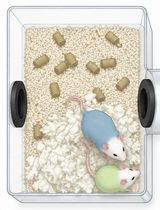
- Acrylic glass cages (50 cm x 25 cm x 20 cm and 50 cm x 50 cm x 20 cm) (Figure 1)
- Video Camera

Figure 1. Adaptable apparatus. Photograph of an acrylic glass cage (50 cm x 25 cm x 20 cm) used for Procedures A-D.
Software
- ANY-maze Behavioural Tracking Software (Stoelting Co)
- GraphPad Prism (GraphPad Software)
Procedure
登录/注册后免费查看全文
文章信息
版权信息
© 2018 The Authors; exclusive licensee Bio-protocol LLC.
如何引用
Aqrabawi, A. J. and Kim, J. C. (2018). Behavioral Evaluation of Odor Memory in Mice. Bio-protocol 8(18): e3023. DOI: 10.21769/BioProtoc.3023.

 Download Citation in RIS Format
分类
神经科学 > 行为神经科学 > 学习和记忆
神经科学 > 行为神经科学 > 认知
您对这篇实验方案有问题吗?
在此处发布您的问题,我们将邀请本文作者来回答。同时,我们会将您的问题发布到Bio-protocol Exchange,以便寻求社区成员的帮助。
 发布问题


