


- Protocols

- Articles and Issues
- For Authors
- About
- Become a Reviewer


Extraction and Activity of O-acetylserine(thiol)lyase (OASTL) from Microalga Chlorella sorokiniana


Published: Vol 7, Iss 12, Jun 20, 2017 DOI: 10.21769/BioProtoc.2342 Views: 12131
Reviewed by: Dennis NürnbergAnonymous reviewer(s)
 PDF
PDF  Ask a question
Original research article
The authors used this protocol in:
Sep 2016
Advertisement



Protocol Collections
Comprehensive collections of detailed, peer-reviewed protocols focusing on specific topics



Abstract
O-acetylserine(thiol)lyase (OASTL) is an enzyme catalysing the reaction of inorganic sulphide with O-acetylserine to form the S-containing amino acid L-cysteine. Here we describe an improved protocol to evaluate the activity of this enzyme from the microalga Chlorella sorokiniana. It is a colorimetric assay based on the reaction between cysteine, the product of OASTL activity, and ninhydrin reagent, which forms a thiazolidine (Thz).
Keywords: Chlorella sorokiniana Colorimetric assay
Cysteine
Microalgae
Ninhydrin
O-acetylserine(thiol)lyase
Sulphur
Colorimetric assay
Cysteine
Microalgae
Ninhydrin
O-acetylserine(thiol)lyase
Sulphur
Background
In archaea, bacteria, microalgae and plants, the synthesis of cysteine (Cys) represents a decisive stage of assimilatory sulphate reduction (Hell and Wirtz, 2008). Cys biosynthesis is the last step of sulphur assimilation and proceeds by two interconnected reactions catalysed by serine acetyltransferase (SAT, EC 2.3.1.30) and O-acetylserine(thiol)lyase (OASTL, EC 4.2.99.8) (Salbitani et al., 2014; Carfagna et al., 2015).
OASTLs catalyse the reaction between O-acetilserine (OAS) and sulphide to form Cys and acetate (Figure 1).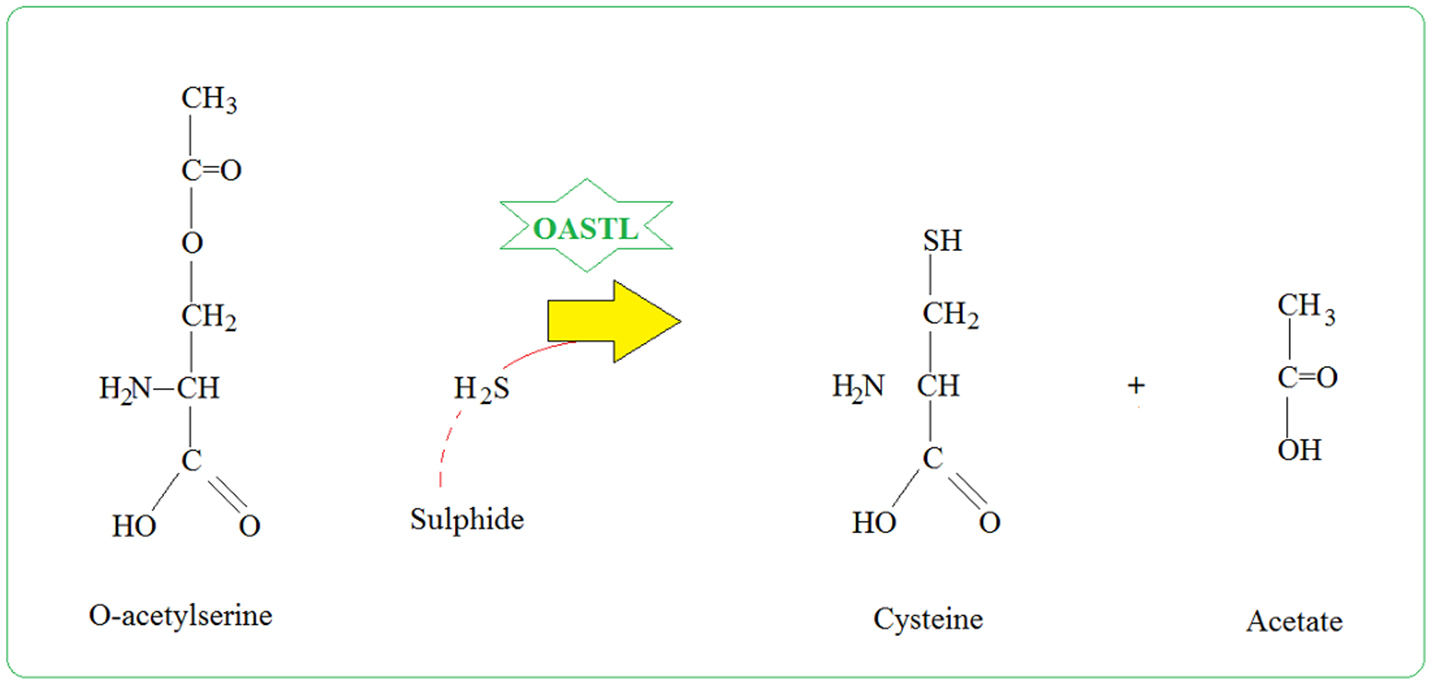
Figure 1. Schematic mechanism of cysteine biosynthesis catalyzed by O-acetylserine(thiol)lyase
In vascular plants, OASTLs are localized in chloroplasts, mitochondria and the cytosol with different functions for Cys synthesis (Jost et al., 2000; Birke et al., 2013). In microalgae, OASTLs seem to be mainly localized essentially in the chloroplasts (Merchant et al., 2007; Bromke, 2013). However, in Chlorella sorokiniana two isoforms, chloroplastic and cytosolic OASTL, were found under S-deprivation conditions (Carfagna et al., 2011).
Many researchers have developed and modified protocols to determine OASTLs activity in plants and bacteria (Gaitonde, 1967; Burnell and Whatley, 1977; Lèon et al., 1987; Rolland et al., 1992). Here we describe a protocol for the determination of OASTL activity, optimized for the green microalga Chlorella sorokiniana 211-8K (Figure 2). This OASTL assay is a spectrophotometric analysis based on the colorimetric reaction of the formed L-cysteine with ninhydrin reagent to form a thiazolidine (Thz) (Prota and Posiglione, 1973).
Figure 2. Optical microscope image of Chlorella sorokiniana cells
Materials and Reagents
- Eppendorf tubes (1.5-2.0 ml)
- Cuvettes 1.5 ml (BRAND, catalog number: 759115 )
- CO2 tank
- Chlorella sorokininana Shihira & Krauss, strain 211/8K (CCAP, Cambridge University) (Figure 2)
- Liquid nitrogen
- Milli-Q water
- O-Acetyl-L-serine (OAS) (Sigma-Aldrich, catalog number: CDS020792 )
- Dithiothreitol (DTT) (Sigma-Aldrich, catalog number: D9779 )
- Sodium sulfide nonahydrate (Na2S·9H2O) (Sigma-Aldrich, catalog number: S2006 )
- Trichloracetic acid (TCA) (Sigma-Aldrich, catalog number: 91228 )
- Acetic acid (CH3COOH) (Avantor Performance Materials, J.T. Baker®, catalog number: 401424 )
- Ethanol (EtOH) (Avantor Performance Materials, J.T. Baker®, catalog number: 8007 )
- Bio-Rad Protein Assay Dye Reagent Concentrate (Bio-Rad Laboratories, catalog number: 5000006 )
- Potassium phosphate monobasic (KH2PO4) (Sigma-Aldrich, catalog number: P5655 )
- Potassium phosphate dibasic (K2HPO4) (Sigma-Aldrich, catalog number: 04248 )
Note: This product has been discontinued. - Sodium chloride (NaCl) (Sigma-Aldrich, catalog number: S5886 )
- Magnesium sulfate (MgSO4) (Sigma-Aldrich, catalog number: M2643 )
- Ethylenediaminetetraacetic acid ferric sodium salt (Fe-EDTA) (Sigma-Aldrich, catalog number: E6760 )
- Calcium chloride (CaCl2) (Sigma-Aldrich, catalog number: C5670 )
- Potassium nitrate (KNO3) (Sigma-Aldrich, catalog number: P8291 )
- Copper(II) sulfate (CuSO4) (Sigma-Aldrich, catalog number: 451657 )
- Ammonium molybdate tetrahydrate, (NH4)6Mo7O24·4H2O (Sigma-Aldrich, catalog number: M1019 )
- Manganese(II) chloride (MnCl2) (Sigma-Aldrich, catalog number: 13217 )
Note: This product has been discontinued. - Zinc sulfate heptahydrate (ZnSO4·7H2O) (Sigma-Aldrich, catalog number: Z0251 )
- Boric acid (H3BO3) (Sigma-Aldrich, catalog number: B6768 )
- Pyridoxal-phosphate (PLP) (Sigma-Aldrich, catalog number: P3657 )
- Ninhydrin (Sigma-Aldrich, catalog number: N4876 )
- Hydrochloric acid 37% (Avantor Performance Materials, J.T. Baker®, catalog number: 6012 )
- HEPES (Sigma-Aldrich, catalog number: H4034 )
- Bovine serum albumin (BSA) (Sigma-Aldrich, catalog number: A7030 )
- Basal medium (see Recipes)
- Phosphate buffer (see Recipes)
- Extraction buffer (see Recipes)
- Ninhydrin solution (see Recipes)
- 1 M HEPES solution (see Recipes)
Equipment
- Culture flask (WHEATON, catalog number: 356954 )
- Fluorescent lamps (Philips Lighting, model: TL-D 30W/55 )
- Bench centrifuge (Thermo Fisher Scientific, Thermo ScientificTM, model: IEC CL30 )
- French pressure cell press (AMINCO RESOURCES, model: FA-078 )
- Superspeed centrifuge (Thermo Fisher Scientific, Thermo ScientificTM, model: Sorvall RC-5C Plus )
- Vortex mixer (Troemner, catalog number: 945302 )
- Eppendorf ThermoMixer® Comfort (Eppendorf, model: 5355 )
- Eppendorf MiniSpin® (Eppendorf, model: 5453000011 )
- Thermo bath (Labortechnik medingen, model: MWB 5 )
- Spectrophotometer (Cole-Parmer, JENWAY, model: 7315 )
- Optical microscope (Esselte, Leitz, model: Leitz Laborlux K )
Software
- SigmaPlot® 12 software
Procedure
- Algal culture condition
Grow Chlorella sorokiniana culture in batch in basal medium (see Recipes) at 35 °C and under continuous illumination (fluorescent lamps, 250 μmol photons m-2 sec-1). Bubble the culture with air containing 5% CO2. Under these conditions, the algal growth rate constant (µ) is 3 d-1. - Preparation of microalgae extracts
- Harvest 200 ml of algal culture by centrifugation (4,500 x g for 10 min). Collect the cells during the exponential growth phase (culture OD550 between 0.5 and 1.0).
- Discard the supernatant and re-suspend the pellet in 5 ml of cold (4 °C) extraction buffer (see Recipes).
- Lyse the cells by passing twice through a French pressure cell (1,100 psi).
Note: Other methods and procedures can be used to lyse microalgae; among the most common methods, there are the use of magnetic stirrer, microwave radiation, ultrasonication and enzyme treatment (Dvoretskyet al., 2016; Farooq et al., 2016; Huang et al., 2016). The breaking of the cells can be observed with an optical microscope. - Centrifuge cell homogenate at 11,000 x g for 15 min at 4 °C. Use the resulting supernatant as crude extract (CE) and assay it for enzyme activity.
- Keep the crude extract on ice or freeze the sample in liquid nitrogen and store at -80 °C for future assays.
Note: Store the samples at -80 °C for a maximum period of six months. The frozen sample can be thawed at room temperature.
- Harvest 200 ml of algal culture by centrifugation (4,500 x g for 10 min). Collect the cells during the exponential growth phase (culture OD550 between 0.5 and 1.0).
- OASTL assay
- Add the following solutions as shown in Table 1 to Eppendorf tubes (1.5-2.0 ml)
Table 1. OASTL protocol assay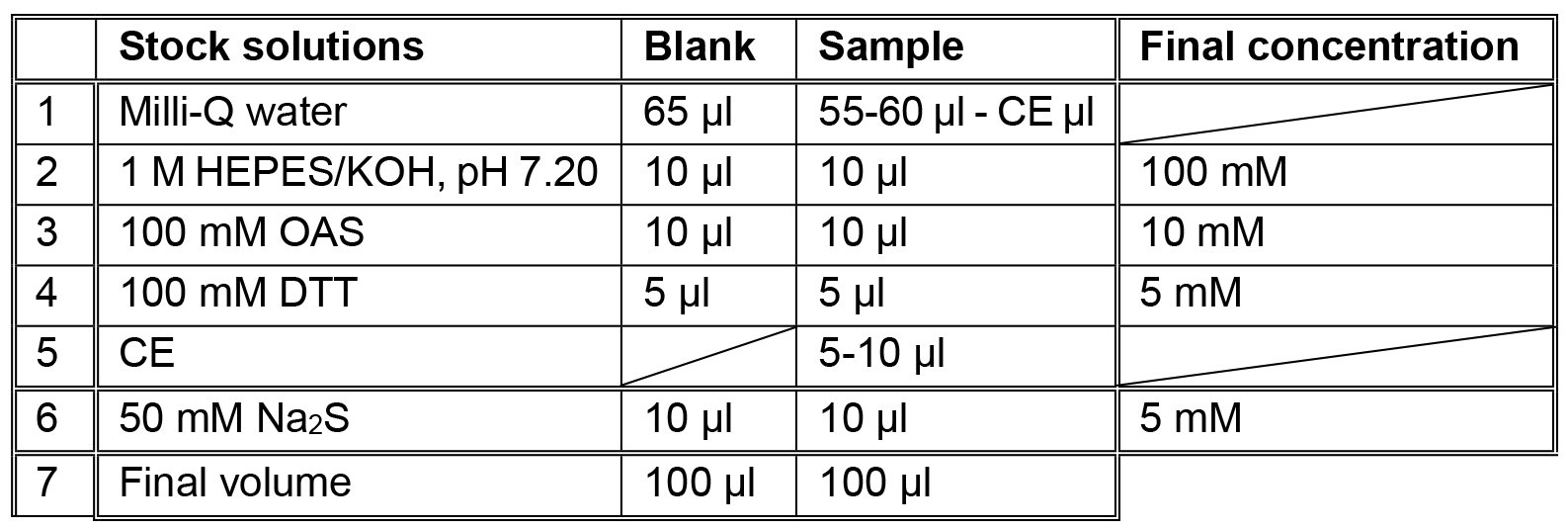
Notes:- For the preparation of the reaction mix, it is important to respect the order of the solutions as shown in Table 1.
- The volume of Milli-Q water in the sample depends on the amount of CE used, considering a final volume of the reaction mix of 100 µl.
- OAS (O-acetylserine) needs to be prepared fresh before use. DTT and Na2S can be prepared, aliquoted and stored at -20 °C for six months.
- For the preparation of the reaction mix, it is important to respect the order of the solutions as shown in Table 1.
- After preparation of the reaction mix, vortex the samples and incubate the tubes in a thermomixer at 50 °C for 5 min.
- Stop the reaction by adding 50 µl of 20% (v/v) trichloracetic acid (TCA). Spin at 13,000 x g and transfer the supernatants to clean tubes.
Note: TCA can be stored at 4 °C for six months. - Add to the tubes 100 µl of glacial acetic acid and 200 µl of ninhydrin solution (see Recipes).
- Incubate the samples at 100 °C for 5 min and then cool them in a Thermo bath at 10 °C for 5 min.
Note: As an alternative to Thermo bath, the samples can be incubated in a thermomixer at 99 °C. - Add 550 µl of ethanol, vortex and read the absorbance spectrophotometrically at 560 nm.
- Add the following solutions as shown in Table 1 to Eppendorf tubes (1.5-2.0 ml)
Data analysis
- To evaluate the range of reliable activity, it is necessary to make a calibration curve for L-cysteine using known concentrations of the amino acid (0.1-3.0 mM).
Note: We estimated valid an absorbance range at 560 nm between 0.5-1.5. - Enzymatic units were calculated using the following formula:
Enzymatic units (U) = A560V2V0/εt1V1Ve
where, A560 is the absorbance at 560 nm; V2 is the final volume (ml) including ethanol; V0 is the volume of the reaction mix incubated at 50 °C; ε is the OAS molar extinction coefficient (mM-1 cm-1); t1 is the time (min) of incubation at 100 °C; V1 is the volume of the reaction mix incubated at 50 °C included TCA; Ve is the crude extract volume used for the assay (ml).
Note: We estimated ε = 6.4 mM-1 cm-1. - OASTL activity was expressed in units that correspond to the formation of 1 µmol of cysteine min-1. The OASTL activity in each sample should be correlated with the soluble protein content (mg ml-1 extract) that was determined by the Bio-Rad Protein Assay based on the Bradford method (Bradford, 1976), using bovine serum albumin as the standard. The enzymatic unit correlated with the protein content is U mg-1 protein.
Note: The use of other methods for protein determination is possible. - Data of the mean ± SE of 3-6 independent experiments should be presented (Figure 3).
- Experimental data analyses and graphs could be carried out using SigmaPlot® 12 software (Carfagna et al., 2016).
Note: The use of other software to analyze data is possible.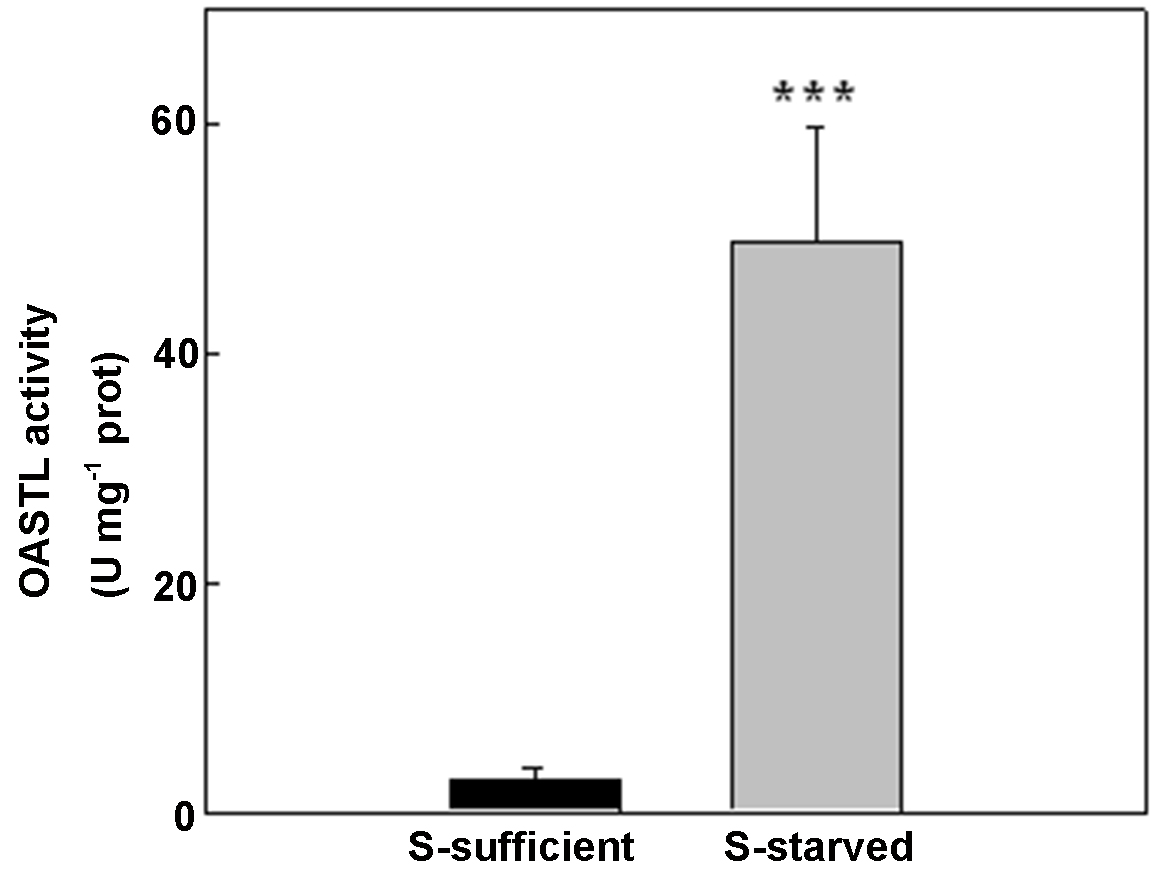
Figure 3. OASTL activity in Chlorella sorokiniana. Effect of 24 h sulphur-starvation on enzymatic activity (Salbitani et al., 2014).
Recipes
- Basal medium
13 mM KH2PO4
4.3 mM K2HPO4
0.35 mM NaCl
1.2 mM MgSO4
0.35 mM Fe-EDTA
0.18 mM CaCl2
5 mM KNO3
Oligoelements: 0.31 mM CuSO4, 0.12 mM (NH4)6Mo7O24, 14 mM MnCl2, 0.76 mM ZnSO4, 46 mM H3BO3
Adjust the pH to 6.5 and sterilize by autoclaving. The medium is stored at 2-8 °C, in the dark - Phosphate buffer, pH 7.5
To prepare 50 mM phosphate buffer pH 7.5, mix 0.94 ml of 1 M KH2PO4 with 4.06 ml of 1 M K2HPO4 and add distilled water up to a final volume of 100 ml
Note: Store the buffer at 2-8 °C for three months. The pH should be measured prior to use and adjusted, if necessary. - Extraction buffer
50 mM phosphate buffer pH 7.5
10 μM PLP (pyridoxal-phosphate)
1 mM DTT (dithiothreitol)
Note: Prepare fresh before use. - Ninhydrin solution
To prepare the ninhydrin solution, dissolve 0.12 g of ninhydrin in 3 ml of glacial acetic acid and 2 ml of hydrochloric acid 37%
Note: The ninhydrin solution can be stored in the dark at room temperature for five days. - 1 M HEPES solution
Dissolve 11.9 g of HEPES in Milli-Q water up to a final volume of 50 ml
Adjust the pH to 7.20 with KOH
Note: Store the buffer at 2-8 °C for three months. The pH should be measured prior to use and adjusted, if necessary.
Acknowledgments
We thank the anonymous reviewers for helpful comments. This study was financed by Regione Campania (PON-Smart Generation and LR 5/2002).
References
- Birke, H., Heeg, C., Wirtz, M. and Hell, R. (2013). Successful fertilization requires the presence of at least one major O-acetylserine(thiol)lyase for cysteine synthesis in pollen of Arabidopsis. Plant Physiol 163(2): 959-972.
- Bradford, M. A. (1976). A rapid and sensitive method for the quantitation of microgram quantities of protein utilizing the principle of protein–dye binding. Anal Biochem 72: 248-254.
- Bromke, M. A. (2013). Amino acid biosynthesis pathways in diatoms. Metabolites 3(2): 294-311.
- Burnell, J. N. and Whatley, F. R. (1977). Sulphur metabolism in Paracoccus denitrificans. purification, properties and regulation of serine transacetylase, O-acetylserine sulphydrylase and β-cystathionase. Biochim Biophys Acta 481(1): 246-265.
- Carfagna, S., Bottone, C., Cataletto, P. R., Petriccione, M., Pinto, G., Salbitani, G., Vona, V., Pollio, A. and Ciniglia, C. (2016). Impact of sulfur starvation in autotrophic and heterotrophic cultures of the extremophilic microalga Galdieria phlegrea (Cyanidiophyceae). Plant Cell Physiol 57(9): 1890-1898
- Carfagna, S., Salbitani, G., Bottone, C., De Marco, A. and Vona, V. (2015). Cross-effects of nitrogen and sulphur starvation in Chlorella sorokiniana 2112/8K. Nat Resour 6: 221-229.
- Carfagna, S., Salbitani, G., Vona, V. and Esposito, S. (2011). Changes in cysteine and O-acetyl-L-serine levels in the microalga Chlorella sorokiniana in response to the S-nutritional status. J Plant Physiol 168(18): 2188-2195.
- Dvoretsky, D., Dvoretsky, S., Temnov, M., Akulinin, E. and Peshkova, E. (2016). Enhanced lipid extraction from microalgae Chlorella vulgaris biomass: experiments, modelling, optimization. Chem Eng Trans 49: 175-180.
- Farooq, W., Mishra, S. K., Moon, M., Suh, W. I., Shrivastav, A., Kumar, K., Kwon, J. H., Park, M. S. and Mu, Y. (2016). Energy efficient process for microalgae cell disruption for oil recovery using triiodide resin. Algal Res 13: 102-108.
- Gaitonde, M. K. (1967). A spectrometric method for the direct determination of cysteine in the presence of other naturally occurring amino acids. Biochem J 104: 627–633.
- Hell. R. and Wirtz, M. (2008). Metabolism of cysteine in plants and phototrophic bacteria. In: Hell, R., Dahl, C. and Leustek, T. (Eds.). Sulfur metabolism in phototrophic organisms. Springer pp: 61-94.
- Huang, Y., Qin, S., Zhang, D., Li, L. and Mu, Y. (2016). Evaluation of cell disruption of Chlorella vulgaris by pressure-assisted ozonation and ultrasonication. Energies 13: 173-184.
- Jost, R., Berkowitz, O., Wirtz, M., Hopkins, L., Hawkesford, M. J. and Hell, R. (2000). Genomic and functional characterization of the oas gene family encoding O-acetylserine (thiol) lyases, enzymes catalyzing the final step in cysteine biosynthesis in Arabidopsis thaliana. Gene 253(2): 237-247.
- Lèon, J., Romero, L. C., Galvan, F. and Vega, J. M. (1987). Purification and physicochemical characterization of O-acetyl-l-serine sulfhydrylase from Chlamydomonas reinhardtii. Plant Sci 53(2): 93-99.
- Merchant, S. S., Prochnik, S. E., Vallon, O., Harris, E. H., Karpowicz, S. J., Witman, G. B., Terry, A., Salamov, A., Fritz-Laylin, L. K., Marechal-Drouard, L., Marshall, W. F., Qu, L. H., Nelson, D. R., Sanderfoot, A. A., Spalding, M. H., Kapitonov, V. V., Ren, Q., Ferris, P., Lindquist, E., Shapiro, H., Lucas, S. M., Grimwood, J., Schmutz, J., Cardol, P., Cerutti, H., Chanfreau, G., Chen, C. L., Cognat, V., Croft, M. T., Dent, R., Dutcher, S., Fernandez, E., Fukuzawa, H., Gonzalez-Ballester, D., Gonzalez-Halphen, D., Hallmann, A., Hanikenne, M., Hippler, M., Inwood, W., Jabbari, K., Kalanon, M., Kuras, R., Lefebvre, P. A., Lemaire, S. D., Lobanov, A. V., Lohr, M., Manuell, A., Meier, I., Mets, L., Mittag, M., Mittelmeier, T., Moroney, J. V., Moseley, J., Napoli, C., Nedelcu, A. M., Niyogi, K., Novoselov, S. V., Paulsen, I. T., Pazour, G., Purton, S., Ral, J. P., Riano-Pachon, D. M., Riekhof, W., Rymarquis, L., Schroda, M., Stern, D., Umen, J., Willows, R., Wilson, N., Zimmer, S. L., Allmer, J., Balk, J., Bisova, K., Chen, C. J., Elias, M., Gendler, K., Hauser, C., Lamb, M. R., Ledford, H., Long, J. C., Minagawa, J., Page, M. D., Pan, J., Pootakham, W., Roje, S., Rose, A., Stahlberg, E., Terauchi, A. M., Yang, P., Ball, S., Bowler, C., Dieckmann, C. L., Gladyshev, V. N., Green, P., Jorgensen, R., Mayfield, S., Mueller-Roeber, B., Rajamani, S., Sayre, R. T., Brokstein, P., Dubchak, I., Goodstein, D., Hornick, L., Huang, Y. W., Jhaveri, J., Luo, Y., Martinez, D., Ngau, W. C., Otillar, B., Poliakov, A., Porter, A., Szajkowski, L., Werner, G., Zhou, K., Grigoriev, I. V., Rokhsar, D. S. and Grossman, A. R. (2007). The Chlamydomonas genome reveals the evolution of key animal and plant functions. Science 318(5848): 245-250.
- Prota, G. and Ponstglione, E. (1973). On the reaction of ninhydrin with cysteine and its analogues: A revision. Tetrahedron 29(24): 4271-4274.
- Rolland, N., Droux, M. and Douce, R. (1992). Subcellular distribution of O-acetylserine(thiol)lyase in cauliflower (Brassica oleracea L.) inflorescence. Plant Physiol 98(3): 927-935.
- Salbitani, G., Wirtz, M., Hell, R. and Carfagna, S. (2014). Affinity purification of O-acetylserine(thiol)lyase from Chlorella sorokiniana by recombinant proteins from Arabidopsis thaliana. Metabolites 4(3): 629-639.
Article Information
Copyright
© 2017 The Authors; exclusive licensee Bio-protocol LLC.
How to cite
Salbitani, G. and Carfagna, S. (2017). Extraction and Activity of O-acetylserine(thiol)lyase (OASTL) from Microalga Chlorella sorokiniana. Bio-protocol 7(12): e2342. DOI: 10.21769/BioProtoc.2342.

 Download Citation in RIS Format
Category
Plant Science > Plant biochemistry > Protein > Activity
Biochemistry > Protein > Activity
Do you have any questions about this protocol?
Post your question to gather feedback from the community. We will also invite the authors of this article to respond.
 Post a Question


