


FLARE: A Flow Cytometry–Based Fluorescent Assay for Measuring HSV-1 Nuclear Egress
FLARE:一种基于流式细胞术检测HSV-1核出壳的荧光分析方法


(§Technical contact: bing.dai@tufts.edu) 发布: 2026年01月05日第16卷第1期 DOI: 10.21769/BioProtoc.5554 浏览次数: 1063
评审: Alexander DupuyAnonymous reviewer(s)
 PDF
PDF  Q&A
Q&A
参见作者原研究论文
The authors used this protocol in:

Nov 2025
Advertisement







Abstract
During herpesvirus replication, capsids are assembled inside the nucleus and translocated into the cytosol by a non-canonical nucleocytoplasmic export process termed nuclear egress. Traditional methods of measuring nuclear egress rely on imaging-based technologies such as confocal and electron microscopy. These techniques are labor-intensive, limited by the number of cells that can be examined, and may not accurately represent the entire population, generating a potential bias during data interpretation. To overcome these problems, we have developed a flow cytometry–based method to measure HSV-1 nuclear egress that we termed FLARE (FLow cytometry–based Assay of nucleaR Egress). This assay uses a double fluorescent reporter system, utilizing HSV-1-tdTomato to identify infected cells and an Alexa Fluor-488-conjugated, capsid-specific antibody to detect cytosolic capsids, thereby distinguishing infected cells with nuclear egress from those without it. This assay provides more quantitative results than traditional methods, enables large-scale high throughput, and can be adapted for use with other herpesviruses.
Key features
• Quantification of HSV-1 nuclear egress by flow cytometry using a double fluorescent reporter system.
• The assay is suitable for large-scale high-throughput screens, e.g., CRISPR/Cas9.
• The assay can be adapted for use with other herpesviruses, provided a mature capsid-specific antibody is available.
Keywords: HSV-1 (1型单纯疱疹病毒(HSV-1)) Nuclear egress (核出壳)
Nucleocytoplasmic export (核质输出)
Capsid (衣壳)
Antibody (抗体)
Fluorescence reporter (荧光报告基因)
Double fluorescent reporter system (双荧光报告系统)
Flow cytometry (流式细胞术)
Nuclear egress (核出壳)
Nucleocytoplasmic export (核质输出)
Capsid (衣壳)
Antibody (抗体)
Fluorescence reporter (荧光报告基因)
Double fluorescent reporter system (双荧光报告系统)
Flow cytometry (流式细胞术)
Graphical overview

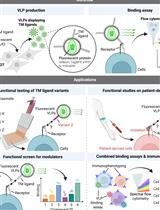
Schematic overview of the FLow cytometry–based Assay of nucleaR Egress (FLARE). Workflow for quantifying nuclear egress in HSV-1-infected cells using the custom flow cytometry–based assay developed here. HeLa cells are infected with HSV-1 encoding a tdTomato transgene reporter. Twenty-four hours post-infection, cells are fixed with 4% paraformaldehyde, partially permeabilized with digitonin, and incubated with a capsid-specific primary antibody and Alexa Fluor-488-conjugated secondary antibody. Flow cytometry identifies cells positive for both tdTomato and Alexa Fluor-488 signal, which are HSV-1-infected cells undergoing nuclear egress.
Background
Herpesvirales is an order of enveloped double-stranded DNA viruses that can infect a variety of hosts, both invertebrate and vertebrate [1]. Nine herpesviruses infect humans, causing lifelong infections and diseases ranging from painful mucocutaneous sores to life-threatening encephalitis and cancers. Current therapeutic strategies are not curative and preventives are limited [2–6]. As such, in-depth studies of the herpesviral replication cycle will not only improve our understanding of the virus–host interactions but may lead to improved antivirals targeting herpesviruses.
During viral replication, herpesvirus genomes are packaged into capsids in the nucleus. These capsids then exit the nucleus using a non-canonical nucleocytoplasmic export, one that does not rely on the nuclear pore complex (NPC). Instead, viral capsids are recruited to the inner nuclear membrane (INM), where they bud into the perinuclear space, forming perinuclear enveloped vesicles (PEVs). These PEVs then fuse with the outer nuclear membrane (ONM), releasing the capsids into the cytoplasm. This process of capsid translocation from the nucleus to the cytoplasm is termed “herpesvirus nuclear egress” [7].
Traditional methods used by the field to study herpesvirus nuclear egress rely on observing phenotypes by confocal microscopy or transmission electron microscopy (TEM) [8–12]. However, these methods pose some limitations. Namely, the number of cells captured by the microscope is small, and the data analysis process is generally time-consuming and labor-intensive.
To address the need for a faster, easier, and more robust way of measuring nuclear egress, we have developed a flow cytometry–based method to directly measure HSV-1 nuclear egress across entire cell populations (Graphical overview). HSV-1-infected cells are first partially permeabilized using digitonin, a mild detergent, which disrupts the plasma membrane but leaves the nuclear envelope intact. Next, cells are incubated with a mature capsid-specific antibody that specifically binds viral capsids in the cytosol but not in the nucleus (due to intact nuclear envelope) and does not bind free capsid proteins synthesized in the cytosol. Cells are subsequently incubated with a fluorescently labeled secondary antibody. Finally, cells that emit fluorescence are sorted from those that do not by flow cytometry, which enables quantification of nuclear egress across the entire cell population.
This protocol uses a two-reporter system, in which the use of HSV-1 encoding a tdTomato transgene under the control of a CMV promoter [13] enables the detection of infected cells, and the use of a capsid-specific primary antibody [14] in conjunction with an Alexa-Fluor-488-conjugated secondary antibody enables the detection of cytoplasmic capsids. Thus, by flow cytometry, cells can be separated into three groups: uninfected cells (tdTomato-/488-), HSV-1-infected cells without nuclear egress (tdTomato+/488-), and HSV-1-infected cells with nuclear egress (tdTomato+/488+). Although this protocol was optimized to measure nuclear egress in HeLa cells infected with HSV-1-tdTomato, it has also been used with Vero and Hep-2 cells, as well as with HeLa cells infected with HSV-1 lacking a fluorescent reporter. Our method, which we have termed FLARE (FLow cytometry-based Assay of nucleaR Egress), addresses the lack of robust measurements for herpesvirus nuclear egress and provides a faster route to identifying new factors controlling herpesvirus nuclear egress.
Materials and reagents
Biological materials
1. HeLa cells (ATCC, CCL2)
2. Hep-2 cells (ATCC, CCL23)
3. Vero Cells (ATCC, CCL-81)
4. HSV-1-tdTomato [strain HSV-1 F GS3217, a gift from Dr. Greg Smith, Northwestern University, encodes NLS-tdTomato under the control of a CMV immediate-early (IE) promoter in place of the envelope glycoprotein gJ] [13]
5. HSV-1 (strain HSV-1 F GS6000, a gift from Dr. Greg Smith, Northwestern University) [15]
6. HSV-1-tdTomato-d34 (strain HSV-1 F GS3217 containing a UL34 gene knockout, generated by our lab using En Passant mutagenesis method [16]), serves as a no-nuclear-egress control
7. HSV-1-d34 (strain HSV-1 F GS6000 containing a UL34 gene knockout, generated by our lab using En Passant mutagenesis method [16]), serves as a no-nuclear-egress control
Reagents
1. DMEM high glucose, with sodium pyruvate, without L-glutamine (Cytiva, catalog number: SH30285.02), store at 4 °C
2. Opti-MEM reduced serum medium (Thermo Fisher Scientific, catalog number: 31985070), store at 4 °C
3. Fetal bovine serum (FBS), heat-inactivated (Biowest, USDA-approved, catalog number: S1680-500, or Thermo Fisher Scientific, catalog number: 10438026), store at -20 °C
Note: Catalog numbers may vary depending on the manufacturer, source, and batch. Researchers are encouraged to contact the company prior to placing the order.
4. L-Glutamine, 200 mM (Corning, catalog number: 25-005-CI), store at 4 °C
5. Penicillin-Streptomycin (100×), penicillin 10,000 U/mL, streptomycin: 10,000 μg/mL (Cytiva, catalog number: SV30010), store at 4 °C
6. Phosphate-buffered saline (PBS), 1× (Cytiva, catalog number: SH30256.FS), store at room temperature
7. Trypsin, 0.05% (w/v), 1× (Cytiva, catalog number: SH30236.01), store at 4 °C
8. Trypan blue in PBS, 0.4% (w/v) (Cytiva, catalog number: SV30084.01), store at room temperature
9. Paraformaldehyde (PFA) in PBS, 4% (w/v) (Thermo Scientific, catalog number: J19943K2), store at 4 °C
10. Digitonin, 5% (w/v) (Thermo Fisher Scientific, catalog number: BN2006), store at 4 °C
11. Triton X-100 (Sigma-Aldrich, catalog number: T8787-100ML), store at room temperature
12. Bovine serum albumin (BSA) (Fisher Scientific, BP1600100), store at 4 °C
13. 8F5 mouse anti-VP5 capsid-specific antibody [14], 1.3 mg/mL (hybridoma generated by Dr. Jay Brown, University of Virginia, and purchased from the University of Virginia Stem Core Facility, single cell clone 8F5-D12-A6; purified IgG was produced from the hybridoma by Cell Essentials, Inc. and can be ordered by referencing 8F5-D12-A6), long-term storage at -80 °C for up to 5 years, short-term storage at 4 °C for up to 1 year. Additional details are provided in the Validation of Protocol section, under the subsection “Testing the efficacy of an anti-VP5 antibody.”
14. Alexa-Fluor-488-conjugated goat anti-mouse antibody (Thermo Scientific, catalog number: A28175), store at 4 °C
15. Bleach (Clorox, catalog number: 30966), store at room temperature
Solutions
1. Complete cell culture growth medium (see Recipes)
2. Stock digitonin solution (see Recipes)
3. Partial (plasma membrane) permeabilization solution, 2× (see Recipes)
4. Full membrane permeabilization solution, 2× (see Recipes)
5. Blocking buffer (see Recipes)
6. Primary antibody solution, 5× (see Recipes)
7. Secondary antibody solution, 1× (see Recipes)
8. Bleach, 20% (v/v) (see Recipes)
Recipes
1. Complete cell culture growth medium
| Reagent | Final concentration | Quantity or volume |
|---|---|---|
| DMEM | 1× | 1 L |
| FBS | ~10% (v/v) | 100 mL |
| L-Glutamine, 200 mM | ~2 mM | 11 mL |
| Penicillin-Streptomycin (100×) | ~1× (penicillin 100 U/mL and streptomycin 100 μg/mL) | 11 mL |
Store at 4 °C for up to 1 year.
2. Stock digitonin solution
| Reagent | Final concentration | Quantity or volume |
|---|---|---|
| Digitonin, 5% (w/v) | 5 mg/mL | 1 mL |
| PBS | 1× | 9 mL |
Heat the 5% digitonin solution at 95 °C for 5 min and allow to fully dissolve before use. Store in 1 mL aliquots at -20 °C for up to 3 years or at 4 °C for up to 1 year. Avoid freeze and thaw cycles.
3. Partial (plasma membrane) permeabilization solution, 2×
| Reagent | Final concentration | Quantity or volume |
|---|---|---|
| Stock digitonin solution (5 mg/mL) | 80 μg/mL | 16 μL |
| PBS | 1× | 1 mL |
If the stock digitonin solution precipitates, heat at 95 °C for 3 min to fully dissolve before use. Prepare fresh for each experiment.
4. Full membrane permeabilization solution, 2×
| Reagent | Final concentration | Quantity or volume |
|---|---|---|
| Triton X-100 | 0.4% (v/v) | 4 μL |
| PBS | 1× | 1 mL |
Prepare fresh for each experiment.
5. Blocking buffer, 2×
| Reagent | Final concentration | Quantity or volume |
|---|---|---|
| BSA | 1% (w/v) | 0.5 g |
| PBS | 1× | 50 mL |
Store at 4 °C for up to 1 month.
6. Primary antibody solution, 5×
| Reagent | Final concentration | Quantity or volume |
|---|---|---|
| 8F5 mouse anti-VP5 antibody (1.3 mg/mL) | 3.25 μg/mL | 2.5 μL |
| Blocking buffer | 2× | 1 mL |
Prepare fresh for each experiment.
7. Secondary antibody solution, 1×
| Reagent | Final concentration | Quantity or volume |
|---|---|---|
| Alexa Fluor-488 goat anti-mouse antibody | 2 μg/mL | 2 μL |
| Blocking buffer | 2× | 1 mL |
Prepare fresh for each experiment.
8. Bleach 20% (v/v)
| Reagent | Final concentration | Quantity or volume |
|---|---|---|
| Bleach | 20% (v/v) | 200 mL |
| Water | 1× | 800 mL |
Store at room temperature for up to 1 year.
Laboratory supplies
1. 10-cm tissue culture dish (CELLTREAT, catalog number: 229620)
2. 6-well tissue culture plates (CELLTREAT, catalog number: 229106)
3. Conical tubes, 50 mL (CELLTREAT, catalog number: 229421)
4. Conical tubes, 15 mL (CELLTREAT, catalog number: 229411)
5. Centrifuge tubes, 1.5 mL (Bio Plas, catalog number: 4030)
6. Pipette set (Eppendorf, catalog number: 2231300004)
7. Pipet controller (Drummond Scientific, catalog number: 4000501)
8. Filter pipette tips (USA Scientific, catalog numbers: 1122-1830, 1120-8810, 1120-3810)
9. Serological pipettes (CELLTREAT, catalog numbers: 229005B, 229010B, 229025B)
10. Cell counter slides (Thermo Scientific, catalog number: C10228)
Equipment
1. CO2 cell culture incubator (Thermo Scientific, model: Heracell VIOS 160i)
2. Biosafety cabinet (Nuaire, model: NU-425-400)
3. Countess II cell counter (Thermo Fisher Scientific, model: AMQAX1000)
4. Centrifuge for 15/50 mL tubes (Thermo Fisher Scientific, model: 75009381)
5. Centrifuge for 1.5 mL tubes (Eppendorf, model: 5424R)
6. Plate rocker (VWR, model: 75832-308)
7. Benchtop vortex (Fisher Scientific, model: 02215365)
8. Flow cytometer (Thermo Fisher Scientific, model: Attune Cytpix)
Software and datasets
1. Attune cytometric software (Thermo Scientific, Version 6.21)
2. FlowJo (Becton, Dickinson & Company, Version 10.10.0)
3. Excel (Microsoft, Version 16.96.1)
4. Prism (GraphPad, Version 10.4.1)
Procedure
登录/注册后免费查看全文
文章信息
稿件历史记录
提交日期: Sep 17, 2025
接收日期: Nov 23, 2025
在线发布日期: Dec 3, 2025
出版日期: Jan 5, 2026
版权信息
© 2026 The Author(s); This is an open access article under the CC BY-NC license (https://creativecommons.org/licenses/by-nc/4.0/).
如何引用
Dai, B., Polack, L., Moores, S., Calderón-Zavala, A. C. and Heldwein, E. E. (2026). FLARE: A Flow Cytometry–Based Fluorescent Assay for Measuring HSV-1 Nuclear Egress. Bio-protocol 16(1): e5554. DOI: 10.21769/BioProtoc.5554.

 Download Citation in RIS Format
分类
微生物学 > 微生物-宿主相互作用 > 病毒
细胞生物学 > 基于细胞的分析方法 > 核质穿梭
细胞生物学 > 基于细胞的分析方法 > 流式细胞术
您对这篇实验方案有问题吗?
在此处发布您的问题,我们将邀请本文作者来回答。同时,我们会将您的问题发布到Bio-protocol Exchange,以便寻求社区成员的帮助。
 发布问题
发布问题


