


In situ Chemotaxis Assay in Caenorhabditis elegans (for the Study of Circadian Rhythms)
秀丽隐杆线虫原位趋化性实验(用于生命周期节律研究)


发布: 2014年02月05日第4卷第3期 DOI: 10.21769/BioProtoc.1040 浏览次数: 14595
评审: Fanglian He
 PDF
PDF  Q&A
Q&A
参见作者原研究论文
The authors used this protocol in:

Dec 2012
Advertisement







Abstract
Olfaction is a well-studied sensory mechanism in Caenorhabditis elegans (C. elegans). The nematodes respond to a wide range of chemicals by either attraction, repulsion or a mixture thereof (Bargmann et al., 1993). We have used olfaction to characterize behavioural and molecular circadian rhythms in C. elegans. The circadian clock is a biological oscillator that provides an endogenous temporal structure that approximately matches the 24-hour periodicity in the environment (due to the rotational movement of the Earth). Circadian rhythms are present in most organisms from cyanobacteria to humans and they typically regulate sensory functions among many other processes. Olfaction is under circadian control in many animals (Granados-Fuentes et al., 2006; Granados-Fuentes et al., 2011; Tanoue et al., 2008; Krishnan et al., 1999). This protocol was designed to allow the assessment of olfaction for a population of worms within a short time interval, in the same plate where the worms grew (to avoid washing steps that may disturb the rhythms), and in the presence of food.
Keywords: Circandian (昼夜) Olfaction (嗅觉)
C. elegans (线虫)
Behaviour (行为)
Rhythms (节奏)
Olfaction (嗅觉)
C. elegans (线虫)
Behaviour (行为)
Rhythms (节奏)
Materials and Reagents
- Egg preparation
100 eggs are used for each petri dish. Assays are performed in triplicate. - LB broth
- Cholesterol
- Ethanol
- CaCl2
- MgSO4
- KPO4
- 3.7% (v/v) 1-octanol (Merck KGaA, catalog number: 820931 ) in Ethanol
This concentration was established after a titration assay to find the lowest concentration needed for a fast response (within the minutes range) (Olmedo et al., 2012) - NGM plates (see Recipes)
Note: For one experiment, always use plates that were poured from the same batch and were allowed to dry for the same amount of time. - Escherichia coli (E. coli) OP50 culture at 100 g wet bacterial weight/liter (see Recipes)
Equipment
- Template for labeling plate (Figure 1)
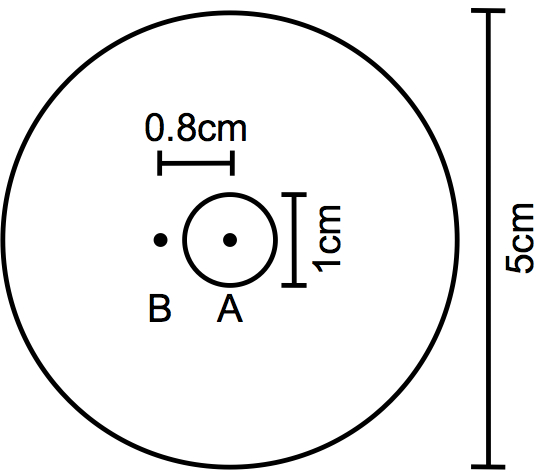
Figure 1. Template for plate labeling. On a piece of paper or plastic, draw a 5 cm-diameter circle in which to place the petri dish and a concentric 1 cm-diameter circle to mark the spot for the E. coli drop. Mark the center of this circle (A) with a dot. Draw another dot (B) at 0.8 cm from the center of the circle. - 5 cm Petri plates
- Stereomicroscope equipped for picture acquisition (we use a Stereo Discovery V8 from Zeiss at a 10x magnification.)
- Centrifuge
Procedure
登录/注册后免费查看全文
文章信息
版权信息
© 2014 The Authors; exclusive licensee Bio-protocol LLC.
如何引用
Merrow, M. and Olmedo, M. (2014). In situ Chemotaxis Assay in Caenorhabditis elegans (for the Study of Circadian Rhythms). Bio-protocol 4(3): e1040. DOI: 10.21769/BioProtoc.1040.

 Download Citation in RIS Format
分类
神经科学 > 行为神经科学 > 趋化性
发育生物学 > 形态建成 > 能动性
神经科学 > 感觉和运动系统
您对这篇实验方案有问题吗?
在此处发布您的问题,我们将邀请本文作者来回答。同时,我们会将您的问题发布到Bio-protocol Exchange,以便寻求社区成员的帮助。
 发布问题
发布问题


